Polycrystalline vs Monocrystalline: Solar Panel Comparison
An objective comparison of polycrystalline and monocrystalline solar panels, covering efficiency, cost, durability, and suitability for homes. Learn which type fits your roof size, climate, and budget for the best long-term value.


Monocrystalline panels typically deliver higher efficiency and better performance in limited space, while polycrystalline panels offer a lower upfront cost. The best choice depends on roof size, budget, and climate. This comparison explains the core differences and helps homeowners decide which type fits their solar goals.
Why this comparison matters for homeowners
Understanding polycrystalline solar panel vs monocrystalline is essential for maximizing roof space, cost efficiency, and long-term reliability. According to Solar Panel FAQ, material choice affects not just upfront price but also performance under heat, shading, and aging. Homeowners often assume one type is universally better; in practice, the best option depends on the specifics of your roof, budget, and energy goals. This section explains the core trade-offs, how each technology translates to real-world results, and what questions to ask your installer. By the end, you'll have a clearer framework for deciding which panel type aligns with your home and climate.
How polycrystalline and monocrystalline panels are manufactured
Polycrystalline panels are created by melting multiple silicon fragments and pouring them into a mold, where they form a mosaic of tiny crystals. This method is straightforward and relatively forgiving, which contributes to lower material costs. Monocrystalline panels begin with a single-crystal silicon ingot, which is carefully grown and sliced into wafers. The single-crystal approach yields higher purity and more uniform electrical properties, which often translate to higher efficiency per unit of surface area. The difference in manufacturing also influences supply chain dynamics: mono panels are frequently produced by a smaller circle of specialized manufacturers, while poly panels benefit from broader production and competition. For homeowners, the practical implications are cost timing and output density. Clean energy projects from Solar Panel FAQ indicate that reputable brands optimize both processes to minimize waste, maximize quality, and ensure reliable performance across temperature ranges and sunlight conditions.
Efficiency and performance: real-world implications
In the field, monocrystalline panels typically deliver more watts per square meter than polycrystalline panels. That advantage matters most on rooftops with limited area or ambitious energy targets. In practice, the difference in energy output also depends on module quality, installation angle, and the inverter strategy. Temperature affects both types, but mono panels often sustain higher output under heat because of their higher baseline efficiency. Shading and soiling create more complex losses; with modern microinverters, power optimizers, or string inverters, both types can mitigate these losses, though the benefit is greater when the high-efficiency module is paired with advanced power electronics. Solar Panel FAQ analysis shows that the performance gap between the two types narrows when system design emphasizes module matching, proper soldering, and cable management, reminding readers that installation quality and component synergy frequently matter more than cell type alone.
Temperature, shading, and climate considerations
Climate influences yield, but the panel type interacts with environmental conditions in distinct ways. Monocrystalline panels typically offer better performance in hot climates and in scenarios with partial shade due to their higher baseline efficiency and better temperature coefficients. Polycrystalline panels may require a bit more surface area to achieve the same energy production, making roof space a critical constraint in hot, sunny regions with limited space. In areas with heavy cloud cover or diffuse light, the gap between mono and poly can narrow, especially when high-quality brands with good warranties are involved. The key takeaway is that climate, shading patterns, and roof geometry collectively determine which panel type achieves your energy targets. The Solar Panel FAQ analysis further emphasizes site-specific expectations when selecting modules.
Space, orientation, and system sizing considerations
System sizing begins with energy goals, but the number of panels you choose is constrained by rooftop space and orientation. Monocrystalline panels, with their higher efficiency, often allow a given target output on a smaller footprint, which can reduce installation complexity and upkeep across limited roofs. Polycrystalline panels, while requiring more area to reach the same output, can lower upfront costs and simplify procurement for large roof surfaces. Consider vertical versus horizontal mounting, row spacing, and shading from nearby structures. The inverter sizing and string configuration should align with the module choice to optimize microinverter or centralized inverter performance. This is where a careful site assessment, often performed by a licensed installer, pays off. Solar Panel FAQ notes that early layout design has a bigger payoff than chasing tiny efficiency gains later.
Cost considerations and total-value thinking
Price is a major driver in panel selection, but total value matters more. Monocrystalline modules typically carry a higher upfront price due to material purity and manufacturing steps, while polycrystalline modules generally come with a lower sticker price. The total value equation includes maintenance costs, expected energy yield, and eligibility for incentives or financing programs. A favorable financial model combines system size, local electricity rates, and panel reliability over time. Brand reputation, warranties, and installer expertise can influence long-term performance as much as the cost per watt. Solar Panel FAQ emphasizes evaluating the full lifecycle value rather than focusing solely on initial price.
Aesthetics, installation, and warranty considerations
Appearance matters for some homeowners. Monocrystalline panels present a uniform, dark aesthetic that many buyers prefer for modern rooftops. Polycrystalline panels display a speckled blue hue, which can be less visually striking but not functionally inferior. Installation considerations include roof angle, mounting hardware, wiring, and shading. The warranty and service terms offered by manufacturers and installers vary widely, but both panel types typically come with multi-year protection against manufacturing defects and performance degradation. When evaluating warranties, pay attention to performance warranties, labor coverage, and exclusions related to shading or soiling. A quality installation team should provide a clear maintenance plan and a predictable service schedule.
How to compare quotes and select an installer
Quote comparison should go beyond the sticker price. Look for system design notes, proposed equipment brands, and expected energy output. Ask installers to show a comparative analysis of mono versus poly options on similar roof geometries. Check electrical planning, wiring routes, and potential shading mitigation. Verify the installer’s licensing, safety records, and project timeline. Solar Panel FAQ recommends requesting multiple bids, verifying references, and comparing warranties to ensure you are buying a robust, long-term solar solution.
Scenario-based guidance: small roof vs large roof decisions
Scenario A: a compact urban roof with limited south-facing space makes monocrystalline a strong fit due to higher output per area and easier integration with a roof layout. Scenario B: a larger suburban roof with ample space but a tight budget benefits from polycrystalline modules, which keep upfront costs lower while meeting energy goals with sufficient area. In both cases, pairing the chosen module with a high-quality inverter, durable mounting hardware, and a reputable installer is essential. Solar Panel FAQ analysis confirms that aligning module type with site constraints yields the best long-term returns.
Common myths debunked
Myth: Mono panels always outperform poly in every climate. Fact: In most situations, monocrystalline panels offer higher efficiency, but site specifics and quality matter more than the cell type alone. Myth: Poly panels are always the cheapest option. Fact: Upfront cost is lower for poly, but total value can favor mono depending on roof space and energy goals. Myth: All panels of a given type are the same. Fact: Module quality, cell arrangement, and brand matter significantly. Myth: Aesthetics do not matter. Fact: Many homeowners care about appearance, particularly for visible installations.
Decision framework: steps to choose
Step 1: Assess roof space, orientation, and shading. Step 2: Determine budget and payback expectations. Step 3: Compare mono and poly options from reputable brands. Step 4: Evaluate warranties, service plans, and installer credentials. Step 5: Select the module that best matches your site conditions and long-term goals. This framework keeps you focused on site-specific factors and real-world performance rather than broad claims.
Next steps and final checks
Before purchasing, confirm permits and inspection requirements in your area, obtain multiple quotes, and request a site-specific energy yield estimate for both panel types. Consider a pilot installation if possible to validate performance under your local conditions. Keep in mind Solar Panel FAQ’s guidance that the right module choice should be driven by roof space, climate, and total value, not just the lowest price.
Comparison
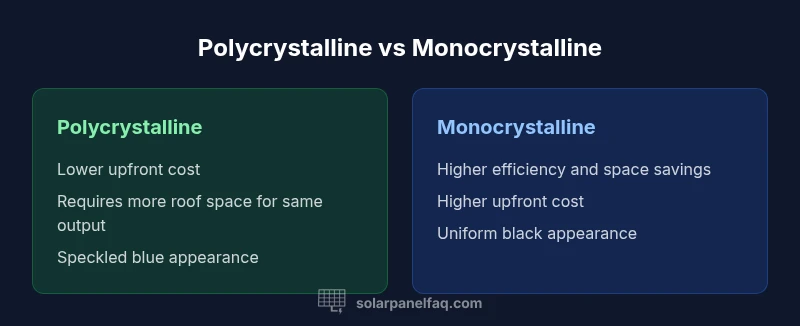
| Feature | Polycrystalline | Monocrystalline |
|---|---|---|
| Efficiency differential | Typically lower efficiency (polycrystalline) | Typically higher efficiency (monocrystalline) |
| Upfront cost | Lower upfront cost | Higher upfront cost |
| Space efficiency | Requires more roof space for the same output | Requires less roof space for the same output |
| Appearance | Bluish-speckled color | Uniform black appearance |
| Manufacturing footprint | Lower energy intensity | Higher energy intensity |
| Warranty expectations | Similar warranty ranges by brand | Similar warranty ranges by brand |
Strengths
- Typically lower upfront cost for polycrystalline
- Higher efficiency per square foot with monocrystalline
- Strong availability and competition among manufacturers
- Solid option for budget-conscious large installations
- Good long-term performance when installed by qualified installers
Drawbacks
- Monocrystalline can be more expensive upfront
- Polycrystalline requires more area to reach the same output
- Aesthetic preferences may favor monocrystalline's uniform look
- Manufacturing footprint considerations vary by brand
Monocrystalline panels are generally the better choice for space-constrained homes, while polycrystalline panels offer a cost-effective option for larger rooftops.
Choose mono when roof space is limited and efficiency matters most. Choose poly when upfront cost matters and you have ample roof area.
Frequently Asked Questions
Which type generally offers higher efficiency, polycrystalline or monocrystalline?
Monocrystalline panels typically deliver higher efficiency and superior output per square foot across conditions. The gap narrows with high-quality manufacturing and smart installation.
Monocrystalline panels usually give you more output per square foot, especially in tight roof spaces.
Is polycrystalline a good budget option?
Yes, polycrystalline panels often cost less upfront, making them attractive for larger roof installations or tight budgets.
Polycrystalline panels are usually cheaper upfront, good for larger roofs.
How do climate and shading affect the two types?
Climate and shading affect both types, but monocrystalline panels generally maintain higher output under heat and partial shade due to higher efficiency.
Shade and heat affect both, but mono usually stays ahead in those conditions.
Are warranties different between panel types?
Warranty terms vary by manufacturer rather than by panel type. Review the exact coverage for defects, performance, and labor.
Warranties depend on the brand, not strictly on mono or poly.
Can polycrystalline panels be recommended for small roofs?
Polycrystalline can be suitable if you have enough space to meet energy goals and you want lower upfront costs.
Poly is fine for small roofs if there’s enough space.
What should I compare when evaluating quotes?
Look beyond price: compare expected energy output, system design, brands, warranties, and installer credentials.
Check energy estimates, brands, warranties, and installer quality, not just price.
Top Takeaways
- Prioritize roof space first; mono shines there.
- Consider climate and shading when choosing type.
- Balance upfront cost with long-term value.
- Check installer quality and warranty terms.
- Poly is a pragmatic budget option for large roofs.