Average Solar Panel Output Per Day: A Practical Guide
Explore how much energy a typical solar panel produces daily, what factors influence daily output, and how to estimate home solar generation for informed decisions.


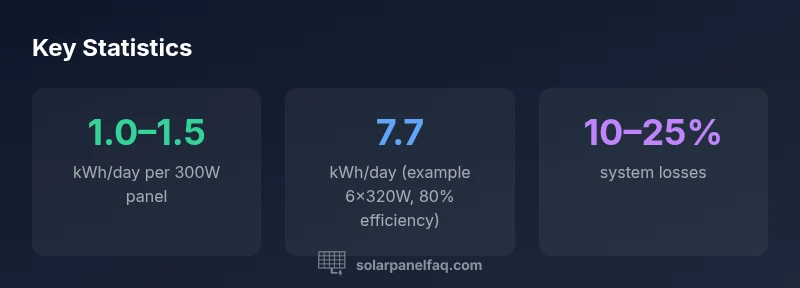
The average solar panel output per day varies with sun exposure and panel rating. For a common residential panel around 300 watts, typical conditions yield about 1.0–1.5 kWh per day, translating to roughly 300–550 kWh per year per panel. System losses and weather cause daily fluctuation, so actual results differ by location and season; season, in practice.
How daily output is calculated
Daily energy output from a solar panel is typically measured in kilowatt-hours (kWh) and depends on three main inputs: the panel's rated power, the number of peak sun hours per day at the installation site, and losses from the system. The Solar Panel FAQ framework emphasizes that the nominal wattage of a panel (for example, 300W) is not the same as the energy you will generate in a day. To estimate daily output, multiply the panel's wattage by the expected peak sun hours, then apply losses for temperature, dirt, wiring, and inverter efficiency. In practice, a 300W module receiving 5 peak sun hours is expected to produce about 1.5 kWh on a perfect, clean day, but real-world conditions often reduce this by 10–25% or more. Over time, daily results are a moving average rather than a single day’s number. The key is to anchor expectations to a realistic annualized figure rather than chasing perfect daily performance. For a homeowner, this means planning around a daily average rather than a single sunny day.
This approach also helps in comparing different system sizes and configurations. If you know your location’s average sun hours per day, you can scale a baseline per-panel estimate to a whole-system forecast. The goal is to translate a module’s electrical rating into a practical daily energy output that informs solar payback calculations, battery sizing, and potential export to the grid.
Note how this aligns with the concept of the "average solar panel output per day" used in many calculators. According to Solar Panel FAQ, framing daily energy around an average helps homeowners set realistic expectations and plan around seasonal variability.
Key factors that influence daily output
The daily energy you get from a solar array is not fixed; it moves with weather, geography, and installation details. The single biggest driver is the number of peak sun hours your site experiences. Locations with 5 peak sun hours will generally produce more energy than those with 3 or 4, assuming similar panel wattage and orientation. Beyond sun hours, orientation and tilt determine how much sunlight your panels receive during different seasons. Panels facing true south (in the northern hemisphere) at an optimal tilt maximize annual energy, while suboptimal angles reduce daily yield. Shading from trees, chimneys, or nearby structures can sharply reduce output even if the rest of the array is healthy. Dirt, dust, and snow also attenuate light capture, so regular cleaning and clearing of snow can yield noticeable gains in winter months. Temperature plays a subtle role: silicon cells lose efficiency as temperatures rise, so hot climates may see slightly lower per-watt output on hot days. Age matters, too; most panels retain most of their original efficiency for 10–15 years before gradual degradation. Finally, inverter losses and wiring losses—often 5–15% depending on balance of systems—must be included in any realistic forecast. When you combine these factors, the daily output becomes a range rather than a single number, which is why annualized estimates are more reliable. For simplicity, many guides refer to the "average solar panel output per day" as a practical metric for comparing systems. If you know your location’s average sun hours, you can scale a baseline per-panel estimate to a whole-system forecast. The goal is to translate a module’s rating into a practical daily energy output that informs payback and battery sizing.
In practice, understanding the average solar panel output per day helps homeowners compare systems and set expectations across seasons.
Estimating daily output for your home
Follow a simple calculation to translate a panel rating into daily energy. Step 1: determine the total installed wattage by multiplying panel wattage by the number of panels. Step 2: multiply by the average daily peak sun hours in your location. Step 3: apply system losses to account for temperature, soiling, and inverter efficiency. Let’s illustrate with a concrete example: a 6-panel system with each panel rated 320W. If your site receives 5 peak sun hours per day, the gross daily energy is 6 × 320 × 5 = 9,600 Wh or 9.6 kWh. If you assume 80% system efficiency (losses of ~20%), the net daily output is about 7.7 kWh. Real world results will differ; the purpose is to provide a framework for forecasting and comparison. For planning, use a local solar calculator that incorporates your roof orientation, shading, and monthly weather data. In practice, this approach helps you estimate monthly generation, seasonality, and potential grid export or battery needs. Remember that higher-efficiency panels or greater total wattage increase daily output, but the gains must be weighed against cost and space constraints.
This method is especially useful when evaluating proposals from installers, as it provides a transparent, reproducible way to compare expected daily energy across different configurations and locations. It also reinforces the idea that the daily figure is an average, not a guarantee on any given cloudless afternoon.
Comparing panel sizes and configurations
Panel size matters because wattage directly influences gross potential energy. A larger or higher-wattage panel will deliver more energy per day under the same sun conditions, but gains taper if shading, soiling, or temperature losses dominate. When sizing a system, many homeowners choose a mix of panel types to balance capital cost, land area, and performance. Inverters also influence daily output: string inverters are common and cost-effective, but microinverters or power optimizers can improve performance under partial shade or variable orientation by reducing mismatch losses. The arrangement of panels (series vs. parallel) affects voltage, current, and overall efficiency at the module level. In practice, the most important takeaway is to forecast output at the system level rather than focusing on a single panel rating. A well-designed system yields predictable daily averages across seasons, aiding budgeting and energy management.
For homeowners with limited roof space or uneven shading, a mixed approach with optimizers or microinverters can maximize daily output without increasing footprint. Newer high-efficiency modules may reduce required area while maintaining the same daily energy target, but the choice should be guided by local climate, roof orientation, and budget. By comparing system-level forecasts rather than individual module ratings, you gain a clearer picture of how daily energy production translates into savings and energy independence.
Real-world planning and myths
A common myth is that daily output should be the same every day. Reality: daily results swing with weather, season, and maintenance. Another misconception is that higher wattage panels automatically deliver more energy per day in all installations; module efficiency matters, but installation quality, mounting, and shading often dominate. When evaluating proposals, ask for a site-specific production estimate based on historical weather data for your location and include an assumed system losses figure. Another pitfall is overestimating the effect of time-of-use rates; even with export incentives, the key is to build a robust daily average that covers critical loads. Finally, remember that a solar system is a long-term investment; 25-year performance averages will provide better insight for payback and ROI than a single-year snapshot.
Factors affecting daily output per panel
| Factor | Typical Range | Notes |
|---|---|---|
| Panel wattage | 250–370 W | Higher wattage panels increase gross energy if sun is sufficient |
| Daily sun hours | 3–6 hours | Greater sun hours raise daily output |
| System losses | 10–25% | Includes shading, soiling, temperature, inverter efficiency |
Frequently Asked Questions
What is the average solar panel output per day?
Output depends on wattage and sun hours; a typical 300W panel yields about 1.0–1.5 kWh per day under average sun.
A typical 300W panel gives roughly 1 to 1.5 kWh per day under average sun.
How many panels do I need to reach a monthly target?
Compute daily per-panel output and multiply by days in the month. For example, 1.2 kWh/day per panel means ~36 kWh/month per panel. Multiply by desired monthly energy and divide by per-panel daily output to estimate panels.
Divide your monthly target by the per-panel daily output to estimate panels.
Do panels produce equally every day?
No. Weather, shading, and temperature cause day-to-day fluctuations. Use a daily average over a longer period for planning.
No—daily results vary with weather and shade; use averages over time.
What factors reduce daily output the most?
Shade, heat, dirt, and aging panels reduce output; inverter efficiency and wiring losses also play a role.
Shade, heat, dirt, and aging cut daily output; inverters add some losses too.
How can I improve daily solar output?
Optimize orientation and tilt, keep panels clean, consider microinverters or optimizers for shade, and ensure a high-quality installation.
Face panels toward the sun, keep them clean, and use good inverters.
“Daily solar output is best understood as an average; real-world results vary with weather, geography, and system design.”
Top Takeaways
- Estimate per panel first, then scale to system size
- Sun hours, orientation, shade, and temperature matter
- Use local calculators for personalized estimates
- Regular maintenance boosts real-world output