How Many Watts Do Solar Panels Produce? A Practical Guide
Discover how many watts solar panels produce, what factors influence output, and how to size a home solar system with practical, data-driven guidance. Learn how wattage affects system design and real-world performance.


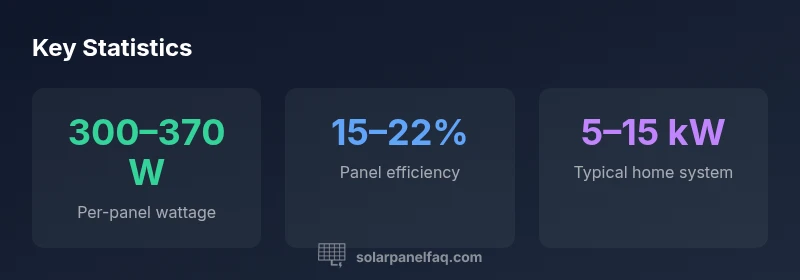
Most residential solar panels today produce about 300–370 watts under standard test conditions, with real-world output varying by orientation, shading, temperature, and ageing. In practice, many homeowners install systems with module ratings in this range to match daily energy use. When sizing, consider a mix of panel wattages to optimize roof space.
Understanding Wattage: What It Tells You About a Panel
Wattage is the maximum power a solar panel can deliver under standardized testing conditions (STC). It indicates peak output, not what you will always get on a cloudy afternoon. Real-world performance deviates due to temperature, irradiance, panel temperature coefficient, angle, shading, and how panels are wired in a string. When planning a system, wattage alone is not enough; you must consider derating factors and site specifics. This section helps homeowners translate rated watts into practical expectations and sizing decisions.
How Much Wattage Does a Typical Panel Produce?
Most modern residential solar panels fall in the 300–370 watt range per module under standard test conditions. Some high-performance modules push above 370 W, while older or smaller panels may sit near 250–300 W. The choice between 60-cell and 72-cell designs also affects the nominal wattage rating. When selecting panels, aim for a balance between available roof space, energy goals, and system cost. Remember that STC values are idealized; you will see lower numbers in real-world conditions. Higher-wattage modules can reduce the number of panels, while low-wattage models may fit small roofs.
Sizing a Home System: From Panels to Kilowatts
To size a home solar system, you don’t just sum the wattage. You must translate energy use into kilowatt-hours (kWh) and estimate average sun hours. A 1 kW array might produce roughly 3–5 kWh on an average sunny day in many locations, but this varies by latitude and weather. A typical home today falls in the 5–15 kW range, often built from a mix of panel wattages to optimize roof space. An accurate system design requires an energy audit and a solar calculator that accounts for local conditions and equipment efficiency.
Real-World Factors That Change Output
Wattage can swing widely within a day. Temperature elevates panel efficiency up to a point, but most panels lose output as they heat up. Shade from trees, neighboring structures, or dirt on the surface can dramatically cut production. In addition, inverter losses, wiring, and mismatch within strings reduce net energy even when individual panels show high rated wattage. A well-designed system mitigates these effects with proper layout and periodic maintenance.
Reading Panel Labels: Wp, Vmp, and Imp
Panel datasheets report Watt-peak (Wp), Max Power Voltage (Vmp), and Max Power Current (Imp). Wp is the rating of the module under STC and is the number homeowners use to estimate system size. Vmp and Imp help you calculate how much energy a string of panels can deliver under operating conditions. When you see a panel labeled 320 Wp with Vmp ~32 V and Imp ~10 A, you can plan string sizes that stay within inverter input limits and avoid clipping at high sun.
Practical Scenarios: Estimating Wattage for Different Homes
Consider a roof with space for 16 panels of 320 W each. The nominal system size would be around 5 kW (16 × 320 = 5120 W). After derating for real conditions (temperature, wiring losses, etc.), you might expect 3.5–4.0 kW of usable AC power capacity, which translates to roughly 12–16 kWh per day on sunny days in moderate climates. If you have higher energy use (e.g., air conditioning or EV charging), you’ll want more panels or higher-wattage modules. Use a calculator to tailor estimates to your location.
Common Myths About Panel Wattage
Myth: Higher-wattage panels always mean bigger savings. Reality: On a fixed roof, more watts can reduce the number of panels and balance cost, but you must still account for shade, orientation, and inverter sizing. Myth: Wattage alone guarantees the amount of energy produced. Reality: Energy output depends on sun hours, temperature, and system efficiency.
Step-By-Step Guide to Estimate Your Needs
- Audit your energy use with past utility bills. 2) Measure available roof space and determine minimum panel count. 3) Choose a target system size in kW and pick wattage per panel accordingly. 4) Run a local solar calculator to factor in climate and panel efficiency. 5) Get quotes that show expected annual output and payback period.
Key data points to understand panel wattage and system sizing
| Aspect | Typical Watt Range | Notes |
|---|---|---|
| Per-panel wattage | 300–370 W | Under STC |
| System size (typical) | 5–15 kW | Depends on roof and energy goals |
| Panel efficiency | 15–22% | Varies by technology |
| Shading impact | Significant | Depends on layout and shading |
Frequently Asked Questions
What does panel wattage mean?
Wattage is the maximum power a panel can deliver under standardized test conditions (STC). It indicates peak output, not necessarily what you get every hour of sun.
Wattage is the panel's peak output under standard testing conditions.
Why do panels with the same wattage differ in real output?
Real output depends on temperature, shading, orientation, and insulation of the system. Tolerances and wiring losses also affect actual energy.
Real output depends on temperature, shade, and orientation.
Is higher wattage always better?
Not always. Roof space, climate, and inverter limits determine whether higher wattage panels reduce the number of modules without sacrificing performance.
Higher wattage isn’t always better; consider your roof and climate.
How many watts do I need for a typical home?
Watt needs depend on energy usage and sun hours. A professional assessment using an energy audit and calculator provides a personalized target. Most homes aim for a multi-kilowatt system.
It depends on your energy use and sun hours; get a local assessment.
What is Watt-peak (Wp) and why read it?
Wp is the rating under STC and helps estimate system size. Vmp and Imp guide how a panel behaves in real operating conditions.
Wp is the panel's rated peak power under standard conditions.
Can temperature reduce wattage?
Yes. Temperature impacts panel efficiency; proper installation and ventilation help minimize losses.
Yes, temperature can reduce wattage; proper installation helps.
“Selecting the right panel wattage is about balancing roof space, budget, and sun exposure; higher-watt modules can reduce panel counts, but real-world factors still drive energy yield.”
Top Takeaways
- Know wattage is peak output under test conditions
- Read Wp, Vmp, and Imp on the panel label
- Size the system to annual energy use, not panel count
- Shading and temperature dramatically affect real output
- Use a professional calculator for location-specific estimates