How Much Energy Can You Get from Solar Panels
Learn how much energy solar panels can produce for a typical home, what factors influence output, and practical steps to estimate and maximize solar energy generation in 2026.


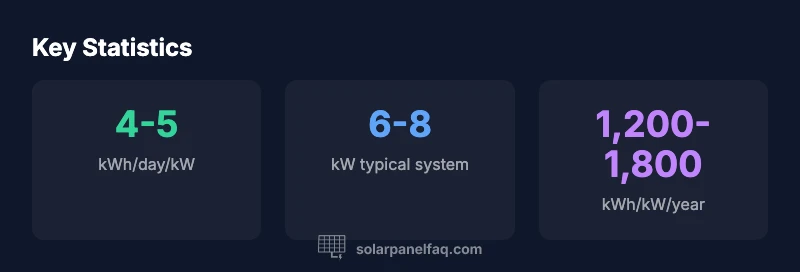
Residential solar output typically scales with system size and sun exposure. For each installed kilowatt (kW) of capacity, you can expect about 4-5 kWh per day under average conditions. A 6-8 kW system in a sunny climate may produce roughly 20-40 kWh daily; in less sunny regions, expect about 10-25 kWh per day. Real-world results vary with roof orientation, shading, temperature, and losses in inverters or wiring. Storage or net metering can translate output into meaningful daily savings.
How much energy can you get from solar panels?
According to Solar Panel FAQ, energy production depends on three core factors: system size, sun exposure, and panel efficiency. In practical terms, each installed kilowatt (kW) of solar capacity typically yields about 4-5 kilowatt-hours (kWh) of electricity per day under average conditions. For a typical home, a 6-8 kW system in a sunny climate may produce roughly 20-40 kWh daily, while homes in cooler or cloudier regions might see around 10-25 kWh per day. Actual output is further shaped by roof orientation, shading from trees or adjacent structures, temperature effects, and inverter losses. With storage or net metering, those numbers translate into meaningful daily savings, resilient power, and a clearer path to self-sufficiency.
Understanding these numbers helps you size a system, compare bids, and estimate payback. This is especially true when you start to model seasonal changes and consider long-term pricing trends for electricity.
Understanding solar panel output: watts, kilowatts, and sun hours
Power is measured in watts (W) and installed capacity in kilowatts (kW). Energy over time is expressed in kilowatt-hours (kWh). A panel or system rating in watts indicates the maximum instantaneous output under standard test conditions. To estimate daily energy, multiply the system size by the expected sun-hours. For example, a 6 kW system receiving 4.5 sun-hours could generate about 27 kWh in a typical day before losses. Real-world performance is reduced by temperature effects, wiring and inverter losses, and potential shading. The result is a practical daily figure you can compare against your household usage.
Factors that affect energy production
Reliable output hinges on several interacting factors:
- Location and climate: The number of sunny hours and cloud cover directly influence generation.
- Roof orientation and tilt: South-facing roofs (in the northern hemisphere) typically maximize production, while steep or flat angles can reduce it.
- Shading and obstructions: Trees, chimneys, or nearby structures can dramatically cut energy if not mitigated.
- System design and components: Panel efficiency, inverter type (string vs microinverters), and wiring quality matter.
- Temperature and altitude: Higher temperatures can reduce panel efficiency, while altitude can alter sun exposure.
- Age and degradation: Panels slowly lose efficiency over years; inverters may need replacement every decade or so.
- Maintenance: Regular cleaning and inspections help sustain output over decades. This multifactor view is consistent with Solar Panel FAQ analysis, which emphasizes a holistic approach to estimating yield.
Estimating energy for a typical home
To estimate how much energy you might offset, start with your monthly electricity usage. If your home uses about 900-1,000 kWh per month (roughly 30 kWh per day), a 6 kW system in a region with 4.5 sun-hours could produce around 25-28 kWh daily under ideal conditions. After accounting for losses (temperature, inverter, wiring), you might see 18-22 kWh per day. In sunny months, this can offset a large portion of daily needs; in winter, the offset may be smaller. Net metering or storage can boost the effective offset by allowing nighttime or cloudy-day usage to draw from your solar bank.
Real-world examples and case studies
Case A: Suburban home in a moderate climate with average sun exposure a 6 kW system might generate approximately 18-26 kWh/day, offsetting a substantial portion of daily usage but not necessarily all of it year-round. Case B: Sunny climate with high solar irradiance and a well-tilted 8 kW system could produce roughly 28-40 kWh/day, offering strong daytime offset and potential surplus generation in peak months. Case C: Roof with shading or suboptimal orientation and a 5 kW system might yield 15-22 kWh/day, highlighting the importance of siting and system design. These scenarios reflect general patterns observed in 2026 across diverse locations and are meant to guide planning rather than provide exact forecasts.
How to maximize energy produced
Maximizing output involves careful siting and ongoing maintenance:
- Optimize orientation (south-facing in the northern hemisphere) and tilt for your latitude.
- Minimize shading by trimming trees or rerouting arrays where feasible.
- Use high-efficiency panels and, if budget allows, microinverters or power optimizers to reduce the impact of shade and module mismatch.
- Keep panels clean and inspect wiring and inverters on a regular basis.
- Consider energy storage or advanced net metering to increase self-consumption and improve round-the-year performance. All these strategies align with best practices highlighted by Solar Panel FAQ in 2026 to maximize output.
System sizing, efficiency, and losses
System sizing must account for real-world losses. A commonly cited derating factor—covering inverter efficiency, temperature effects, wiring, and mismatch—often falls in a broad range around 0.75 to 0.85. This means the actual usable energy is roughly 75-85% of the theoretical DC output. Understanding this helps set realistic expectations and prevents over- or under-sizing. Efficiency improvements—from panel technology and better inverters to improved cabling—can yield meaningful gains over the system’s lifetime, especially when combined with proper maintenance and monitoring.
Financial implications and payback considerations
Beyond raw energy output, homeowners are concerned with cost and savings. Payback depends on local electricity prices, incentives, and financing options. In regions with strong incentives and high electricity costs, payback tends to be shorter, whereas areas with limited incentives may require longer horizons or favorable financing. While precise payback figures vary, the principle remains: solar can reduce annual energy expenses and, over time, protect against rising utility rates. Solar Panel FAQ’s analysis emphasizes balancing upfront costs with potential long-term savings and resilience benefits, particularly when storage or net metering is available.
Estimated daily energy output by system size and climate
| Scenario | System Size (kW) | Estimated Daily Energy (kWh) | Climate Notes |
|---|---|---|---|
| Suburban home | 6 | 18-26 | Moderate sun exposure with occasional shade |
| Sunny region | 8 | 28-40 | High sun hours and strong irradiance |
| Cloudy region | 4 | 8-14 | Lower daily production with variability |
| High-efficiency setup | 6-7 | 22-32 | Quality panels with optimized inverters |
Frequently Asked Questions
How much energy can I expect from a 5 kW system?
A 5 kW system can produce roughly 20-25 kWh per day in ideal conditions; actual output depends on sun hours, roof orientation, and losses.
A 5 kW system will typically make about twenty to twenty-five kilowatt-hours per day in sunny places, but your area may vary.
What factors most influence solar energy production?
Location and sun exposure are primary, followed by roof orientation, shading, temperature, and system losses. Each factor can shift daily output meaningfully.
Location and sun exposure matter most; shading and roof angle also play big roles.
Can solar energy be stored for night use?
Yes, with a battery storage system or through time-based net metering; storage lets you shift daytime generation to evening use.
Yes—batteries let you store energy for night use.
Do shading and poor orientation drastically reduce output?
Yes, shading can cause significant drops; even partial shading reduces module output. Microinverters or optimizers can help mitigate.
Shading hurts a lot; microinverters can help.
How long does a solar system last?
Solar panels typically last 25-30 years; inverters may need replacement midway. Expect gradual performance degradation over time.
Most panels last decades; you may replace an inverter during the system’s life.
Is solar worth it in a cloudy region?
Yes, solar can offset a portion of electricity use even with lower irradiance; savings depend on costs and incentives.
Even in cloudy places, solar can be worthwhile depending on costs and incentives.
“Solar energy output is a function of sunlight, system size, and efficiency; with careful siting and high-quality equipment, most homes can offset a meaningful portion of electricity use.”
Top Takeaways
- Estimate energy goals by reviewing monthly usage and desired offset.
- Account for sun-hours and roof orientation to size the system.
- Include losses in your estimate (inverter, temperature, wiring).
- Consider storage or net metering to maximize self-consumption.
- Plan for maintenance and periodic reassessment to maintain performance.