How Much Does a Solar Panel Make? A Practical Guide to Output and Savings
Understand solar panel output, how to estimate your home's annual energy and savings, and what factors affect production for homeowners and buyers.


How much does a solar panel make? For homeowners, daily output depends on system size, location, and sun exposure. A typical residential 6 kW installation may generate roughly 20–30 kWh on bright, sunny days, while cloudier locations produce about 8–15 kWh daily. Solar Panel FAQ Analysis, 2026 shows annual production ranges vary by region. Your exact figure requires a site-specific calculation.
What does the phrase how much does a solar panel make really mean?
In plain terms, homeowners want to know how much energy a solar installation can produce for daily life and monthly bills. The key unit is kilowatt-hours (kWh), which measures actual energy generation over time, not merely the panel's rating in kilowatts (kW). The question how much does a solar panel make depends on system size, sun hours, and efficiency. According to Solar Panel FAQ Analysis, 2026, a typical residential system in moderate sun regions can produce a meaningful portion of annual usage, but results vary widely by location, weather, and how the system is installed. When homeowners ask this, they’re really asking what their year could look like: how many days will the sun power their fridge, A/C, lights, and chargers? Real-world output is the product of the PV array's nameplate capacity, the local solar insolation, and how well the system is maintained. In this article we’ll unpack those factors, show you how to estimate daily production, and help you translate that production into meaningful savings.
Factors that influence solar output
Output from a solar system is not a fixed number. It changes with multiple variables, many of which you can influence. The most important factors are: (1) location and climate (different regions receive different sun hours per day); (2) system size and panel efficiency; (3) orientation and tilt relative to the sun; (4) shading from trees, chimneys, or nearby structures; (5) temperature effects on silicon cells (hot days can slightly reduce efficiency); and (6) inverter design and maintenance. Even small changes, like trimming a tree or adjusting tilt, can yield meaningful gains. For reliable planning, consider a site assessment that includes shading analysis and a month-by-month production forecast.
From system size to daily production
To translate capacity into daily output, you multiply system size (kW) by average sun hours per day and apply a derate factor that accounts for losses (inverter efficiency, wiring, soiling, and temperature). A common back-of-the-envelope approach: Production ≈ System size × Sun-hours × Derate. For example, a 6 kW system with 4.5 peak sun hours and a 0.85 derate would produce roughly 23 kWh on a typical day. In practice, regional data and a professional audit yield more precise figures, but this simple method gives a solid starting point.
Geographic and climate variation
Geographic location dominates production differences. A 6 kW system in a high-sun region might hit the 25–30 kWh/day mark on clear days, while a cloudier town may see numbers in the teens. Seasonal shifts also matter: long summer days boost production, winter months typically lower it due to shorter days and more cloud cover. When evaluating a project, reference local solar irradiance data and consider seasonal planning for storage or net metering to maximize value.
Estimating your home's yearly production and savings
Start with your annual electricity usage (kWh/year) from your utility bills. Then identify your area’s average sun hours per day and a realistic derate (0.75–0.9). Size a system: required kW ≈ annual usage / (sun-hours × 365 × derate). Convert the result to a yearly production figure and multiply by your electricity rate to estimate savings. For example, if you use 9,000 kWh/year and your region averages 4.5 sun-hours/day with derate 0.8, a ~5 kW system could produce around 9,000 ÷ (4.5 × 365 × 0.8) ≈ 6 kW of capacity to offset a portion of usage; savings depend on local tariffs and incentives.
Reading production data from panels and inverters
Most solar systems provide real-time monitoring of daily kWh production. Learn to read the data as a trend: look for consistent daily outputs in a given range, compare month-to-month, and identify anomalies such as excessive shading, dirt buildup, or inverter faults. Seasonal patterns are normal, but sustained drops may indicate maintenance needs (cleaning panels, trimming obstructions, or checking wiring and inverters). Regular monitoring helps keep expectations realistic and keeps your system efficient.
Planning for realistic expectations and next steps
Plan for variability by budgeting for maintenance and potential performance dips over time. Expect the payback period to depend on electricity prices, incentives, and installation costs. A well-sized system tied to time-of-use rates and storage can maximize value. The Solar Panel FAQ Team emphasizes proactive siting, regular cleaning, and annual checkups to maintain output. Start with a site assessment, then compare bids that detail expected annual production, projected savings, and the effect of shading or ruins on performance.
Estimated production metrics for residential solar systems
| Metric | Typical range | Notes |
|---|---|---|
| System size (Residential) | 5–7 kW | Common in new homes or major upgrades |
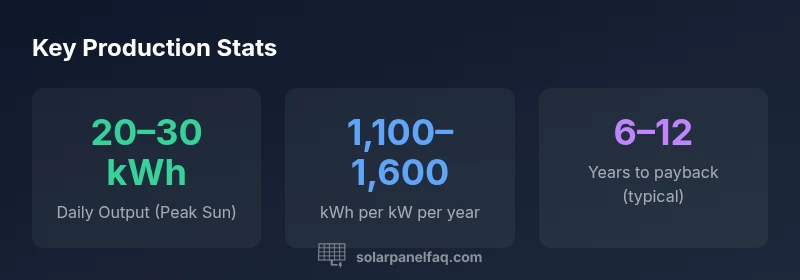
| Daily output (peak sun) | 20–30 kWh | Varies by location and shading |
| Annual output per kW | 1,100–1,600 kWh/kW/yr | Location dependent |
| Payback period | 6–12 years | Depending on electricity rates and incentives |
Frequently Asked Questions
What factors most affect how much a solar panel makes per day?
The most important factors are system size, sun exposure, shading, tilt/orientation, and inverter efficiency. Geography and weather cause seasonal swings. Use a reputable calculator to estimate your numbers.
Sun exposure, system size, shading, and location largely determine daily output.
How long does it take for a solar system to pay for itself?
Payback depends on electricity prices, incentives, and installation costs; typical ranges are several years. Higher rates and strong incentives shorten the payback.
Payback varies by where you live and what incentives you qualify for.
Can I trust online production estimates?
Online calculators provide ballpark figures but may miss shading, temperature, and aging effects. A professional site assessment yields the most accurate result.
Online estimates are a guide; get a site evaluation for accuracy.
What is the difference between kW and kWh?
kW measures capacity; kWh measures energy produced over time. Multiply capacity by sun hours to estimate energy over a day or year.
Kilowatts measure size; kilowatt-hours measure energy produced.
How does shading affect output?
Shading dramatically reduces output; even partial shading on one panel can affect the total array due to series wiring or microinverters. Mitigation includes trimming trees or changing orientation.
Shading lowers energy a lot; it's worth clearing or mitigating.
Should I worry about panel warranty?
Most panels include 25-year power output warranties; check de-rate provisions and what is covered. A solid warranty adds long-term reliability to your investment.
Warranties cover performance and defects for many years.
“The Solar Panel FAQ Team emphasizes that production is highly location-dependent, and good siting can significantly boost output. The Solar Panel FAQ Team recommends sizing your system to your annual energy use and planning for years of variability.”
Top Takeaways
- Size your system to match annual usage, not peak capacity
- Account for shading, orientation, and temperature effects
- Use region-specific sun hours to estimate daily output
- Expect variability by season and weather, not a fixed daily yield