How Much Is a 200W Solar Panel? A Practical Cost Guide for 2026
Explore the cost range for a 200W solar panel, factors driving price, and practical buying tips. Learn from Solar Panel FAQ's 2026 analysis.


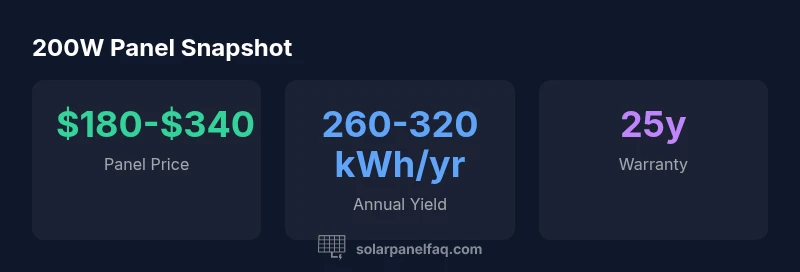
How much is a 200 watt solar panel? In 2026, a single 200W panel typically costs between $180 and $340 before installation, depending on type, brand, warranties, and regional factors. This price range reflects panel cost rather than total system cost. Prices can swing based on frame material, glass quality, and certifications, while shipping, taxes, and handling can add to the sticker price. Expect variation by retailer and warranty terms (often 25 years).
What a 200W solar panel is and how it fits a home solar setup
A 200W solar panel is a common nominal power rating used in residential systems. Under standard test conditions, it can produce up to 200 watts of usable DC electricity at peak sun. In practice, actual output varies with sun angle, shading, temperature, and orientation. For homeowners planning a system, a single 200W panel is often considered a building block that combines with other panels to reach the desired daily energy production. According to Solar Panel FAQ, a typical residential array might start with several 200W modules to fit roof space and budget, then expand over time as energy needs grow.
How much is a 200W solar panel?
If you're wondering how much is a 200 watt solar panel, the price you see on label cards often reflects panel cost rather than installed price. In 2026, a single 200W panel typically costs between $180 and $340 before installation, depending on type (monocrystalline vs polycrystalline), brand, warranties, and regional factors. If you’re asking how much is a 200 watt solar panel, the price you see on label cards often reflects panel cost rather than installed price. Cheaper panels may use older cell technology and offer shorter warranties, while higher-end models emphasize efficiency and durability. Other costs—shipping, taxes, and handling—can add to the sticker price. When comparing options, also consider efficiency (typically in the 18-22% range for modern 200W modules), heat tolerance, and the availability of certifications like UL or IEC.
What factors influence the price of a 200W panel?
- Cell technology and efficiency: Monocrystalline cells typically deliver higher efficiency (closer to the 20%+ range) than polycrystalline, influencing price.
- Brand and warranty: Bigger brands with longer warranties (25 years) may cost more but offer greater perceived value.
- Frame and materials: Glass quality, frame corrosion resistance, and connectors can raise price.
- Certifications and origin: Panels certified for safety and performance in major markets cost more.
- Shipping and batch discounts: Bulk purchases or direct-from-manufacturer shipments can reduce per-panel costs.
- Subsidies and regional incentives: Local rebates or tax credits can effectively lower the net price.
Beyond the panel: total system costs
The panel is only part of the equation. To estimate true affordability, include the balance of system (BOS) costs: mounting hardware, wiring, conduit, racking, inverters, and electrical permits. An inverter converts DC to AC usable by home appliances, and its efficiency rating affects overall production. Wiring and protection devices add safety and reliability, while professional installation ensures code compliance and warranty validity. Depending on your roof, you may need microinverters or a string inverter; microinverters often cost more upfront but can improve performance in shaded areas. Permits and inspections vary by locality and can add to installation timelines and costs. In sum, don’t price-shop panels in isolation—calculate the full system price to understand value.
Regional variation and incentives
Prices for a 200W panel vary by region due to logistics, local demand, and incentives. In many markets, the net price after incentives can be significantly lower than the sticker price, while regions without strong programs may show higher effective costs. When evaluating offers, ask about local rebates, sales tax exemptions, and any interconnection fees. Solar Panel FAQ's analysis shows that buyers who plan for incentives often realize a faster payback and lower lifetime cost, even if the upfront price appears higher. Keep in mind that availability and rules can change year to year, so confirm current programs before purchasing.
How to assess value: efficiency, durability, and service
Price is important, but value depends on multiple factors. Compare panel efficiencies (closer to 20% or higher yields more electricity per area), temperature coefficients (how output drops in heat), and warranty length. A longer warranty signals confidence in durability. Check the panel's performance in similar climate conditions and the manufacturer's reputation for customer service. When you compare quotes, ensure the same system size and component quality, or you may misjudge relative value.
Buying strategy: how to compare quotes
- Standardize system size: Decide on total wattage and roof space, then compare bids on a per-watt basis.
- Total cost matters: Focus on complete price, not just panel price.
- Ask about warranties and what they cover (performance vs. product).
- Compare shipping, taxes, and install charges; some installers include permit fees.
- Request performance data from the manufacturer for your climate.
Common mistakes to avoid
- Focusing only on the cheapest panel without considering warranties or degradation rates.
- Ignoring roof condition, angle, and shading that affect yield.
- Not verifying inverter type and compatibility with future storage options.
- Underestimating BOS costs and permitting timelines.
- Not obtaining multiple quotes or referencing independent reviews.
Quick-start checklist for buyers
- Define system goals, roof space, and budget.
- Gather 3-5 quotes, compare per-watt price and total system price.
- Confirm warranty terms and what they cover.
- Check local incentives and potential payback period.
- Plan future expansion or storage if desired.
Panel wattage comparison by wattage and price
| Panel Type | Nominal Power (W) | Typical Efficiency | Estimated Price Range | Notes |
|---|---|---|---|---|
| 200W Panel | 200 | 18-22% | $180-$340 | Common residential size |
| 250W Panel | 250 | 19-23% | $210-$390 | Higher output per panel |
| 150W Panel | 150 | 17-20% | $120-$260 | Lower wattage, less common today |
Frequently Asked Questions
What is the typical price range for a 200W panel?
In 2026, a 200W panel typically costs roughly $180-$340 before installation; total system cost depends on installation and components. Compare warranties and efficiency when evaluating options.
Typically $180 to $340 before installation; compare total cost and warranty when shopping.
Is a 200W panel enough for a home?
A 200W panel can contribute meaningfully to a home solar system, especially when multiple panels are used. The sufficiency depends on energy usage, roof space, and local sun exposure.
It can contribute, but total system size determines sufficiency based on your energy use.
What affects the price of a 200W panel?
Price is driven by cell type and efficiency, brand and warranty, frame quality, certifications, and shipping. Regional incentives can further reduce net cost.
Cell quality, warranty, and regional incentives drive price variations.
Are 200W panels efficient?
Modern 200W panels typically sit in the 18-22% efficiency range, with higher efficiency often commanding a premium. Efficiency matters more when roof space is limited.
Most 200W panels are around 18-22% efficient.
Do warranties differ by wattage?
Warranties depend more on the brand and model than wattage alone. Look for at least 25-year performance warranties and robust product coverage.
Warranties vary by model; prioritize long performance warranties.
What should I consider besides price?
Consider efficiency, temperature coefficient, degradation rate, warranty terms, and the installer’s reputation. These factors affect long-term performance and savings.
Look beyond price—efficiency and warranty drive long-term savings.
“A 200W panel is a practical building block for most residential systems, but buyers should focus on total system cost, warranty, and after-sales support. Always compare warranties when shopping.”
Top Takeaways
- Prices shown reflect panel cost before installation.
- Total system cost includes BOS and permitting.
- Efficiency and warranty influence long-term value.
- Shop around; compare quotes on total price and warranty.