What Do Solar Panels Cost? A Practical Homeowner Guide
Learn what factors drive solar panel costs, typical price ranges before incentives, and how to estimate your installation. This data-driven guide covers system size, incentives, financing, and how to compare bids for homeowners.


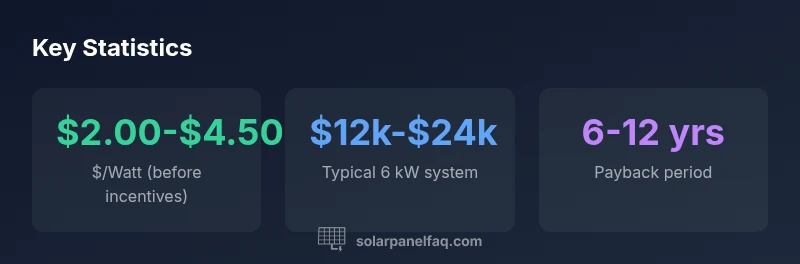
What does solar panels cost? For a typical residential install, the installed price before incentives usually ranges from roughly $2.00 to $4.50 per watt, translating to about $12,000 to $30,000 for a common 6 kW to 8 kW system. Costs vary by roof type, site shading, panel choice, and labor. Federal tax credits and state incentives can substantially reduce the net price.
How pricing is built for residential solar
Pricing for residential solar is a composite of hardware, labor, permitting, interconnection, and soft costs. The up-front sticker price covers modules (panels), inverters, racking, wiring, and monitoring equipment. Labor covers roof penetrations, electrical work, and system commissioning. Permits, interconnection fees, and design work can add several hundred to several thousand dollars. Optional add-ons include optimizers, microinverters, or storage. According to Solar Panel FAQ Analysis, 2026, the total installed price reflects not only equipment quality but also local labor markets and permitting timelines. Understanding this mix helps homeowners set realistic expectations and compare bids effectively.
Key cost drivers you can control
Several factors drive solar pricing, and many are within your influence as a homeowner. System size is the most obvious lever: larger systems require more panels and bigger inverters, raising costs but also increasing annual electricity savings. Panel technology matters: higher-efficiency modules can reduce roof footprint but cost more upfront. Inverter type (central vs. microinverters) affects both price and performance in shaded or complex roof orientations. Roof condition and mounting type (flush-mounted vs. ballasted) impact labor and scaffolding costs. Finally, permitting, interconnection, and the availability of skilled installers in your area contribute to final price. By planning around these factors, you can tighten the budget without sacrificing value. Solar Panel FAQ Team notes that bids can vary widely even within the same city, underscoring the importance of side-by-side quotes.
Pricing by system size and configuration
Pricing generally scales with system size, but the exact math depends on local factors. A compact 2–4 kW system may cost less per watt but still deliver meaningful electricity savings in sunny climates. A typical 4–6 kW setup balances footprint and production for many homes. Larger 6–8 kW systems often maximize solar credits and utility offsets. For a residential install, the nationwide price range before incentives commonly falls between roughly $2.00 and $4.50 per watt, with total installed costs ranging in the tens of thousands. Remember, higher-efficiency panels can reduce rooftop area but add to upfront price. Your installer should provide a detailed breakdown comparing module costs, inverter options, and mounting hardware so you can see how each component affects the bottom line.
Incentives, financing, and net costs
Incentives influence the net price homeowners pay after subsidies. A federal tax credit is typically available, reducing the upfront outlay, and many states offer additional rebates or performance-based incentives. Some utilities provide net metering programs that improve long-term savings by crediting excess generation on future bills. Financing options such as loans, leases, or power purchase agreements can spread costs over time, changing the economics of the project. When calculating payback, include maintenance, potential warranty extensions, and the energy rate trajectory in your area. The Solar Panel FAQ Analysis, 2026, emphasizes that incentives are policy-dependent and can shift over a 5–10 year horizon, so revisit your calculations if programs change.
Step-by-step cost estimation for your home
Follow these practical steps to estimate your solar cost with confidence. 1) Assess your latest electricity usage and daytime sun exposure. 2) Pick a system size that aligns with your goals (offset a portion or most of usage). 3) Gather at least three quotes from reputable installers and request a line-item breakdown. 4) Compare module, inverter, and mounting options side-by-side. 5) Factor in soft costs like permits, interconnection, and design fees. 6) Add a contingency for weather or design changes. 7) Run a net-present-value analysis that accounts for potential rate increases. 8) Review financing options and the impact of incentives on your net cost. By documenting each element, you’ll avoid sticker shock and identify the best value for your home.
Red flags when budgeting and choosing an installer
To avoid overpaying or poor workmanship, watch for these warning signs.
- Vague quotes with no line-item detail
- Pressure to sign quickly without a contract
- Subcontractors or unlicensed installers
- Missing permits or questionable interconnection arrangements
- No clear warranty or after-install service plan Take time to verify licenses, check references, and confirm warranty terms. A well-documented bid and a transparent contract are the best protections for homeowners.
Cost ranges by system size (before incentives)
| System size (kW) | Estimated installed cost (before incentives) | Notes |
|---|---|---|
| 4 | 8000-16000 | Moderate footprint; common choice |
| 6 | 12000-24000 | Balanced cost and output |
| 8 | 16000-32000 | Larger homes with higher savings |
Frequently Asked Questions
What is the typical price per watt for residential solar panels?
Prices per watt vary by market, but common quotes range from $2.00 to $4.50 per watt before incentives, depending on equipment and installer.
Prices per watt vary; typical quotes range from two to four and a half dollars per watt before incentives.
Do federal tax credits apply to solar panel costs?
Yes, a federal tax credit is generally available and reduces net cost. The exact credit depends on current policy and your tax situation.
Yes, a federal tax credit reduces the net cost, though the exact amount depends on current policy.
What costs are included in the quoted price?
Quotes typically include equipment, labor, permits, interconnection, and design. Maintenance and long-term service are usually separate.
Quotations cover equipment, labor, permits, and interconnection; maintenance is usually separate.
How long does payback take?
Payback varies with usage and incentives; common ranges fall around 6-12 years, depending on energy rates and sun exposure.
Payback typically ranges from about 6 to 12 years, depending on usage and incentives.
Are there financing options for solar installations?
Yes, financing options include loans, leases, and PPAs; each changes monthly costs and ownership timelines.
Yes—loans, leases, or PPAs are common financing options.
How should I compare solar bids?
Request a line-item breakdown, compare panels, inverters, warranties, and estimated production, and verify incentive eligibility.
Ask for a line-by-line quote and compare components and warranties.
“"Understanding solar costs goes beyond sticker price; homeowners should consider long-term savings and maintenance when evaluating bids."”
Top Takeaways
- Know what drives price and what you can influence
- Use per-watt ranges to compare bids
- Account for incentives to evaluate net cost
- Get multiple bids to ensure best value