How much is a 400 watt solar panel in 2026?
Learn how much a 400 watt solar panel costs, including price ranges, installation factors, incentives, and ROI considerations to help homeowners budget accurately.


On average, a single 400 watt solar panel falls in the mid-range of module prices before installation. Expect a price range of roughly $200 to $350 per panel, depending on brand and efficiency. When you add mounting hardware, wiring, and an inverter, the total before labor can rise. Local incentives and installer pricing will further affect final figures.
How much is a 400 watt solar panel in 2026?
The price of a 400 watt solar panel is a common question for homeowners planning a solar upgrade. In 2026, the typical pre-install cost for a 400W module sits in the mid-range for residential panels. The exact figure depends on the panel’s efficiency, chemistry (monocrystalline vs. polycrystalline), framing, and the supplier’s brand. The Solar Panel FAQ team notes that regional market dynamics and supplier promotions can shift prices by a noticeable margin. When budgeting, start with the baseline per-panel price and add the common line items you’ll encounter during installation. Remember that the headline module price is only part of the story; you should also factor in mounting hardware, wiring, inverters, and permit fees. In practice, homeowners should expect to see price ranges rather than a single fixed number for a 400W solar panel.
What drives the price of a 400W solar panel?
Several levers determine the final out-of-pocket cost for a 400W solar panel. Module efficiency and brand play a major role: higher efficiency panels typically cost more upfront but may generate more energy in smaller roof areas. Cell technology (monocrystalline vs. polycrystalline), frame material, and protective coatings affect both price and durability. Certification and warranties add value but also cost. Installation readiness also matters: pre-wired panels with universal connectors can reduce labor time, while non-standard mounting systems may raise labor rates. Finally, logistics like shipping distance and local demand influence the listed price. For context, a 400W panel from a reputable brand with a solid warranty will usually command a premium relative to generic or less efficient options, but the performance gains can justify the extra upfront cost over the panel’s life.
Regional price variation and incentives
Prices don’t exist in a vacuum; regional dynamics heavily shape the final bill. In high-demand markets with abundant sunlight, installers may price competitively to secure volume work, while regions with supply chain constraints can see higher panel costs. Local incentives — including state rebate programs, net metering rules, and federal tax credits — can significantly reduce the effective cost of a 400W panel when claimed during tax season or through utility programs. Insurance, building codes, and permitting fees add another layer of variability. To optimize value, compare quotes from multiple installers in your area and ask how incentives are applied to the quoted price. A smart approach is to model two scenarios: base price without incentives and price after applying relevant grants or credits.
Breaking down the cost components
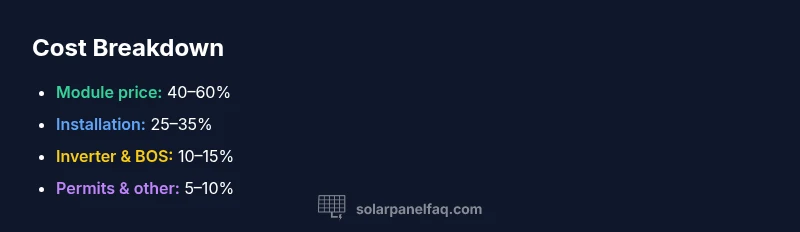
A typical 400W solar panel project includes several line items beyond the panel itself. Core components are: (1) the module price (the 400W panel), (2) mounting hardware and racking, (3) wiring, fuses, and connectors, (4) an inverter or microinverters, and (5) labor and permitting. Some projects also include a warranty extension or monitoring service as a separate line item. Understanding the share each component represents helps you negotiate effectively. For example, installation labor can vary by roof complexity and height, while the inverter choice (string vs. microinverters) can affect both upfront cost and future maintenance. A clear itemized quote makes it easier to compare apples to apples across installers.
How installation affects total cost
Roof type, orientation, and accessibility all raise or lower installation costs for a 400W panel system. A simple, single-story roof with easy access tends to keep labor costs down, while steep pitches, multiple roof surfaces, or irregular layouts demand more scaffolding, time, and safety measures. Local building codes may require special permitting or additional electrical work, which adds to the bill. If your roof requires repairs or replacement before installation, those costs should be added to the project scope. On the upside, a well-planned layout can reduce waste and maximize output, yielding higher value over the system’s life.
Financing, incentives, and ROI
Financing options matter for total cost. Cash purchases avoid financing fees but tie up capital, while loans or leases shift some costs into monthly payments. Incentives such as federal tax credits, state rebates, and utility programs can dramatically shorten the payback period. When evaluating ROI, consider not just the upfront price but also projected energy savings, degradation rates, and maintenance needs. A robust model includes a sensitivity analysis for changes in electricity rates and incentive availability. The takeaway: the cheapest panel today may not always be the best long-term value if incentives shift or if warranty terms differ.
How to compare quotes and avoid common pitfalls
To compare quotes effectively, request a detailed, line-by-line breakdown including module price, hardware, labor, permits, and warranties. Check panel efficiency, warranty duration, and the inverter type. Beware quotes that look superficially cheap but rely on hidden costs later, such as high permit fees or mandatory upgrades. Ensure quotes assume the same roof layout and system size; otherwise you’re not comparing like-for-like. Ask for third-party performance estimates and customer references. Finally, verify that the installation plan accounts for your utility’s interconnection process and any required inspections to avoid delays and unexpected charges.
Maintenance, warranties, and long-term cost considerations
A 400W solar panel system is designed to last decades, but costs accrue if maintenance is neglected. Expect some performance degradation over time and plan for periodic cleaning and inspection. Warranties typically cover defects and performance for 25 years or more; extended warranties can be worth it for edge-case durability concerns. Factor in potential replacement parts for inverters or mounting hardware as the system ages. By budgeting for routine maintenance and ensuring comprehensive warranties, you reduce the risk of expensive, unplanned repairs and protect your investment over the long term.
Cost comparison across panel types
| Panel Type | Nominal Power | Estimated Install Cost Range | Notes |
|---|---|---|---|
| 400 W panel | 400 W | $500-$900 | Typical price range with basic mounting |
| 350 W panel | 350 W | $400-$800 | Lower power, often cheaper upfront |
| 320 W panel | 320 W | $350-$700 | Lower output, potential savings with larger arrays |
Frequently Asked Questions
What is a typical price range for a 400W solar panel?
A typical 400W panel costs roughly $200-$350 before installation. The final price depends on brand, efficiency, and purchasing options. Always compare multiple quotes to see how incentives affect the delivered price.
A typical 400W panel costs about two to three hundred dollars before installation; get several quotes to see how incentives impact the final price.
Does installation cost vary by roof type?
Yes. Roof complexity, height, and orientation affect labor time and safety requirements, which influence installation costs. A straightforward, single-story install is usually cheaper than a multi-roof or steep-roof project.
Roof complexity can change installation costs; simpler roofs are cheaper than complex or tall ones.
What incentives affect 400W panel pricing?
Federal, state, and utility incentives can significantly reduce the effective price. These may come as tax credits, rebates, or enhanced net metering terms, and availability varies by location.
Incentives can cut the upfront price a lot, but it depends on your location.
Is a higher wattage panel always more expensive per watt?
Not always. Some higher-wattage panels offer better efficiency and may reduce balance-of-system costs, but the upfront price per watt can be higher. Compare total installed cost per watt for the best perspective.
Higher wattage can cost more per watt, but it might save on other costs.
How long does it take to recoup costs?
Payback depends on energy usage, electricity rates, and incentives. Typical ranges span several years to over a decade, with higher savings in regions with high electricity prices and strong incentives.
ROI depends on usage and incentives; it often takes several years.
What warranty should I expect for a 400W panel?
Look for a product warranty of 10-25 years and a performance warranty ensuring minimal degradation over time. Warranties on inverters are often shorter, so plan for potential replacement.
Warranty of 10-25 years on the panel is common; inverter warranties may be shorter.
“Cost transparency is essential when evaluating solar panels; the 400W class sits between compact and high-output modules, with total system cost driven by installation and incentives.”
Top Takeaways
- Define system goals to size and price correctly.
- Expect per-panel price in the $200-$350 range before installation.
- Total installed cost per panel commonly runs $500-$900.
- Payback period typically 5-12 years depending on incentives.
- Warranties and maintenance influence long-term ownership costs.