How Long Does It Take to Benefit from Solar Panels? Payback Outlook
Discover when solar panels start delivering tangible savings, the factors that affect payback timelines, and practical steps to accelerate your return. Learn how location, incentives, and usage shape the payoff window.


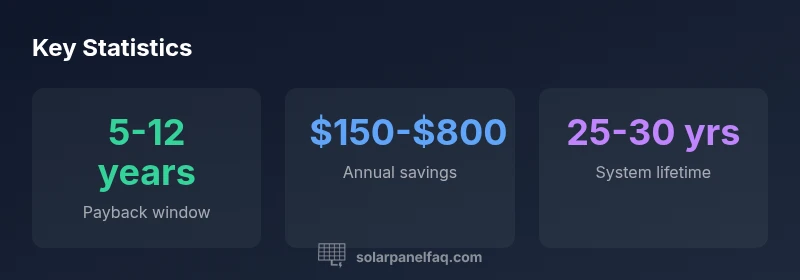
Most homeowners begin to see net benefits within a 5-12 year window, with full payback often around 10-15 years. The exact timeline depends on location, average daily sunlight, system size, local electricity rates, net metering rules, and any incentives or tax credits. Reading this article will help you estimate your own timeline and plan for upgrades.
How long does it take to benefit from solar panels? timelines and what counts as a benefit
When homeowners ask how long it takes to benefit from solar panels, they’re usually measuring two things: the time to payback (recouping the net investment) and the point at which ongoing energy savings become noticeable. In practice, most households report tangible savings within a 5-12 year window, but the full financial payback can extend beyond a decade depending on several context-specific factors. Importantly, benefits aren’t purely financial: greater energy independence, resilience during outages, and a reduced exposure to utility rate volatility are also meaningful gains. This is why it’s helpful to think of solar benefits as a multi-faceted payoff rather than a single dollar figure. According to Solar Panel FAQ, the overall payoff timeline varies with solar resource, system design, and policy incentives, so your personal experience may diverge from national averages.
"-"55 words per paragraph?
Core drivers that shape your payoff speed
Several interrelated factors determine how quickly you see benefits from solar panels. (1) Sun exposure and roof orientation: regions with strong year-round sun and minimal shading shorten the payback window. (2) System size relative to your usage: a well-mimensioned system that closely matches your annual consumption reduces waste and speeds savings. (3) electricity rates and policy structures: higher local electricity prices and favorable net metering or feed-in tariffs improve annual savings. (4) Incentives and tax credits: upfront incentives reduce net cost, accelerating payback. (5) Installation quality and inverter efficiency: high-quality components and proper maintenance preserve output over time. These factors interact, so a one-size-fits-all payback figure isn’t realistic. Solar Panel FAQ emphasizes evaluating both upfront costs and long-term savings to gauge timing accurately.
Estimating your own timeline: a practical approach
To personalize your payback estimate, start with three numbers you can typically obtain or approximate: (a) system cost before incentives, (b) expected annual energy savings, and (c) available incentives. A simple approach is to compute payback as Net Cost / Annual Savings. If your system cost after incentives is $10,000 and you expect $400 annually in savings, the rough payback is around 25 years. If the same system earns $800 annually, payback drops to about 12.5 years. These rough math estimates illustrate how much incentives and local energy prices move timelines, and why a precise household calculation matters. Elasticity in technology and markets means your actual outcome could be shorter or longer, but the method remains a reliable planning tool.
Policy, incentives, and regional differences that affect payback
Incentives matter. Federal, state, and local programs can dramatically trim upfront costs, speeding up the payoff. Net metering rules and interconnection processes also influence how quickly a system earns value by offsetting a utility bill. Regions with strong solar incentives and favorable interconnection timelines tend to see shorter payback periods. Conversely, areas with limited or no incentives and restrictive net-metering policies may experience longer timelines. Solar Panel FAQ notes that policy stability matters as much as the technology itself, so it's wise to review current programs and how they may change over the life of the system.
Practical steps to accelerate the payoff
If you want to shorten the time to benefit, consider these practical actions: (1) maximize system match to annual usage by performing an energy audit and adjusting load profiles. (2) Time energy usage to daylight production, or add smart controls to shift heavy loads to sunny periods. (3) Invest in a higher efficiency inverter and reliable modules to minimize performance losses. (4) Take full advantage of available incentives and track any changes in policy that could affect your net cost. (5) Schedule regular maintenance to keep panels and inverters operating near peak efficiency. By combining design choices with smart energy management, you can improve your payback trajectory even in less-than-ideal climates.
Key factors affecting payback timeline
| Factor | Impact on Payback | Typical Range (years) |
|---|---|---|
| Location / sun exposure | Higher sun reduces payback time | 5-12 years |
| System size (kW) | Larger systems can shorten time by spreading fixed costs | 5-12 years |
| Electricity rates / policy | Higher rates and favorable policies shorten payback | 5-15 years |
Frequently Asked Questions
What factors affect how quickly I benefit from solar panels?
Key factors include location and sun exposure, roof orientation, shading, system size versus annual usage, local electricity rates, and eligible incentives. These determine how much you save each year and how quickly you recoup costs.
Factors like sun exposure and system size primarily drive how fast you see benefits.
Do incentives shorten the payback period?
Yes. Upfront incentives reduce net cost, which directly shortens the payback period. The exact impact depends on the incentive amount and eligibility.
Incentives lower your initial cost and speed up payback.
Does adding battery storage change the timeline?
Battery storage can increase upfront costs and may extend the simple payback period, but it can improve the value by enabling time-shifting and resilience. The overall payback depends on storage costs and how you value backup power.
Storage can add value, but it often changes the payback math.
How important is net metering for payback?
Net metering can significantly improve annual savings by crediting excess electricity back to the grid. The gain depends on your utility’s rules and compensation rates.
Net metering can boost savings, but depends on local rules.
What if my roof has shading or issues?
Shading reduces panel output and can extend payback. Mitigation strategies include trim shading trees or re-routing panels to capture more sun, if feasible.
Shading lowers output and can delay payback.
“The pace of benefit from solar panels is highly variable, but a properly sized system in a sunny location typically delivers noticeable savings within a few years.”
Top Takeaways
- Identify your payback window early using a simple calculator
- Maximize sun exposure and system sizing to match usage
- Leverage incentives to reduce net cost and accelerate payoff
- Monitor policy changes and utility rate trends to adjust expectations
- Consider storage or smart energy use to improve annual savings