Solar Panel Investment Return: What Homeowners Should Know
Explore how solar panel investment return works, including payback periods, ROI ranges, and factors that influence long-term savings for homeowners seeking clear, data-driven guidance.


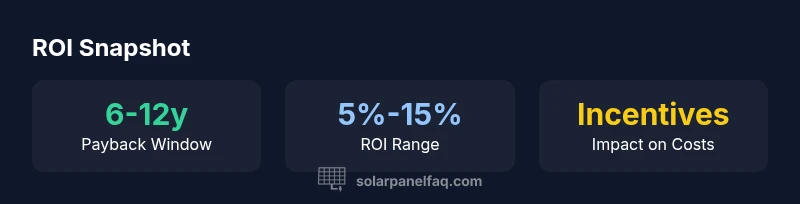
According to Solar Panel FAQ analysis, typical solar panel investment return—measured by payback period and lifetime savings—arrives in about 6-12 years for many U.S. homes, with total ROI often ranging from 5% to 15% when accounting for energy savings and incentives. The exact return depends on location, system size, and local policies, so personalization is essential.
What the term 'solar panel investment return' means
In plain terms, solar panel investment return is about how much value a home gains from a solar installation compared with the upfront cost. It reflects the combination of energy cost savings, potential increases in home value, incentives, and the expected lifespan of the equipment. Solar Panel FAQ analysis shows that return is not a single number; it’s a range defined by local electricity prices, policy incentives, system performance, and maintenance. For homeowners, the key is to translate upfront dollars into annual cash flow and long-term savings over the system's 25-year design life. The definition also depends on whether you include non-financial benefits such as energy resilience and environmental impact, which some buyers value highly. This broader view helps explain why two homes can experience very different investment returns even with similar system sizes.
How ROI is measured: payback period, IRR, and cash flow
ROI for solar panels is commonly discussed in terms of payback period, internal rate of return (IRR), and cumulative cash flow over the life of the system. The payback period looks at how many years of energy savings it takes to recover the upfront cost, excluding non-cash factors like maintenance or rate increases. IRR captures the annualized rate of return accounting for the time value of money. A simple way to think about cash flow is to compare year-by-year energy savings against the initial investment, then adjust for incentives and any system degradation. In practice, homeowners should consider all three metrics to form a complete picture of solar investment return.
Typical ROI ranges (as of 2026) and what drives them
The 2026 Solar Panel FAQ Analysis highlights a broad ROI range, typically driven by electricity prices, system size, climate, and policy incentives. In many markets, payback often falls within 6-12 years, with total lifetime ROI commonly cited in the low-to-mid double digits when incentives are strong and electricity costs are high. Regions with steep electricity growth or favorable net metering policies tend to deliver higher returns, while areas with lower rates and limited credits may see more modest gains. Importantly, these figures assume proper installation, good system performance, and regular maintenance.
Incentives, rebates, and tax credits
Incentives are a major lever on investment return. The federal Investment Tax Credit (ITC) has historically reduced upfront costs by a sizable percentage, boosting the net present value of the project. State and local programs can further trim the payback period, potentially shortening it by several years when combined with net metering or feed-in tariff schemes. Maintenance costs, though typically low for modern panels, should still be factored in over time. To maximize return, homeowners should gather a current incentive mix for their property and model scenarios with and without incentives to see how the numbers shift.
Regional variations: climate, electricity prices, and policy
Where you live matters as much as the panels you buy. Higher local electricity prices or rising tariffs increase the value of solar energy, shortening the payback period and boosting ROI. Climate influences solar yield; sunnier regions produce more kWh per installed kilowatt, all else equal. Policy structures, such as net metering rules and interconnection processes, determine how clean energy credits translate into savings. Solar Panel FAQ analysis emphasizes that a region with robust incentives and favorable policy design typically yields stronger investment return than a market with limited programs.
Case examples: hypothetical scenarios for different homes
Consider three typical homes with a 7 kW solar system. Home A resides in a market with high electricity costs and strong incentives; Home B faces moderate rates and modest credits; Home C has low energy costs and minimal incentives. While all installations may reduce monthly bills, Home A often enjoys the shortest payback and the highest ROI, followed by Home B, with Home C achieving the slowest payback. These scenarios illustrate how local costs, incentives, and usage patterns shape the actual investment return.
How to estimate your own ROI with a simple calculator
A practical approach is to estimate annual energy savings by multiplying your system size by expected annual production and by your electricity rate. Subtract any annual maintenance costs and adjust for degradation over time. Then apply available incentives to reduce the upfront cost and calculate payback. For planning, run a few scenarios: base case, with incentives, and with higher electricity prices. A good calculator should also allow you to test different system sizes and roof orientations.
Tips to maximize return: system sizing, monitoring, and maintenance
Maximizing solar investment return starts with accurate sizing—oversizing can capture more sun but at diminishing returns if usage is low. Regular performance monitoring helps detect shading issues or degradation early, preserving output. Keeping panels clean and ensuring inverters run efficiently also sustains performance. Consider adding battery storage only if it meaningfully shifts usage to peak pricing or offers resilience value. Lastly, compare multiple installers to ensure you’re getting the best price-to-performance ratio.
Planning and expectations for homeowners
Expectations should be grounded in local conditions. Get a detailed estimate that includes system size, expected annual production, anticipated degradation, maintenance costs, and a transparent breakdown of incentives. Evaluate your break-even point, not just the percentage ROI, and think about non-financial benefits like energy independence and environmental impact. With careful planning, the solar investment return can align with your long-term financial goals while contributing to a cleaner grid.
ROI scenarios for residential solar panels
| Scenario | System Size (kW) | Payback (years) | ROI (%) |
|---|---|---|---|
| Typical residential | 6-8 | 6-12 | 5-15 |
| High electricity rates | 8-10 | 5-9 | 8-18 |
| With strong incentives | 6-9 | 4-8 | 10-20 |
Frequently Asked Questions
What is solar panel investment return?
Solar panel investment return refers to the net value created by the system over its lifetime after accounting for upfront costs, energy savings, maintenance, and incentives. It is most commonly expressed as payback period and ROI but should be considered alongside IRR and total cash flow.
ROI for solar is about how quickly the system pays for itself and how much you save over time, considering incentives and maintenance.
How long does it take to recoup the cost?
In many markets, payback periods commonly fall in the 6-12 year range, depending on electricity prices, system size, and available incentives. After payback, the system continues to generate savings for many years, though output gradually declines with degradation.
Most homeowners see payback within about a decade, then enjoy ongoing savings.
Do batteries affect the investment return?
Battery storage adds upfront cost but can improve ROI if it enables greater use of daytime solar during peak pricing or improves resilience. The incremental benefit depends on local tariffs, usage patterns, and how much you value reliability.
Storage can boost value if it helps you use more solar electricity when prices are high.
Do incentives influence the return?
Yes. Federal, state, and utility incentives reduce upfront costs, shorten the payback period, and raise the overall ROI. The exact effect varies by program and timing, so compare current offers before committing.
Incentives can significantly shorten your payback and boost ROI.
Is ROI the only measure homeowners should care about?
No. In addition to ROI, homeowners should consider resilience, environmental impact, and the potential increase in home value. Each of these factors contributes to the overall value of going solar beyond simple dollars and cents.
ROI isn’t everything—think resilience and environmental benefits too.
“Solar investments generate not just monthly savings, but a long-term financial shift as electricity prices rise and policies evolve. The key is modeling multiple scenarios to understand true investment return.”
Top Takeaways
- Identify your true upfront cost after incentives
- Expect a payback window of several years depending on region
- ROI varies widely by electricity prices and policy
- Incentives and net metering can dramatically improve returns
- A bigger system isn't always better for every home