How Long Do Solar Panels Take to Pay Back? A Practical Guide
Learn how long solar panels take to pay back with practical steps, incentives, and a calculator to tailor estimates to your home and usage.


How long do solar panels take to pay back? A primer on payback timelines
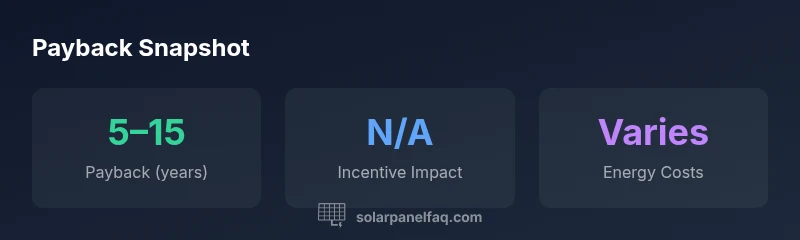
Understanding the payback period helps homeowners evaluate whether solar makes financial sense for their home. Put simply, the payback period is the amount of time required for cumulative net savings to equal the net upfront investment. It does not account for all future benefits, but it provides a clear, tangible target. In practice, the typical range is broad because it mirrors real-world differences in energy usage, local electricity prices, and the availability of incentives. When you compare proposals from installers, ask for a payback estimate that uses your actual bills and your local rate structure. This helps you see whether the project makes sense under your specific conditions. For homeowners weighing options, this metric often sits alongside total return and environmental impact in decision making. The Solar Panel FAQ team emphasizes that payback is highly sensitive to incentives and usage patterns, so personalized calculations beat generic rules of thumb.
What determines the length of the payback period?
Several core variables shape payback: system size and output, local climate, roof orientation and shading, and how efficiently the panels convert sunlight into usable electricity. A larger system can generate more savings, but it also costs more upfront. If your home has frequent cloud cover or significant shading, output drops, extending payback. The electricity price you pay and whether you participate in net metering or time-of-use rates also matter. Finally, the presence of incentives—the federal, state, or utility rebates—reduces the net upfront cost and shortens the time to break even. Practical homeowners often create a simple model: estimate annual production and savings, subtract ongoing costs, and divide the net upfront by annual net savings to get a rough payback figure.
The role of incentives and policy
Incentives act like a shortcut to payoff by reducing the net upfront cost or increasing the value of each kilowatt-hour produced. Net metering credits, where available, add a stream of savings by multiplying the value of solar energy exported to the grid. When incentives are strong and energy prices are rising, payback periods shrink noticeably. Conversely, if incentives are weak or grid rates are flat, payback can lengthen. The solar policy landscape varies by region and changes over time, so it’s critical to verify current programs before committing to a system. Solar Panel FAQ analysis shows that policy design—how credits are calculated and how long they last—can be the difference between a short and a long payback.
How to estimate your payback using your own data
To tailor a calculation, gather four pieces of information: your system cost before incentives, the upfront incentives you expect to receive, your annual electricity savings from the solar system, and any ongoing maintenance costs. A simple formula, payback years = (system cost - incentives) / (annual savings - annual maintenance), gives a clear estimate. It’s wise to run a few scenarios: best-case with high incentives, worst-case with lower rates, and a mid-case based on your budget. Also consider an annual degradation rate for panels, typically small but real, to see how payback may shift over time. Use your real bill data to anchor the savings figure and keep the input values consistent across scenarios for meaningful comparisons.
Real-world adjustments you should consider
People often forget long-term factors that affect payback. Weather extremes can alter output; energy usage patterns may shift with new appliances or occupancy; and policy changes can alter incentive availability. You may also see evolving electricity rates that change the value of each kilowatt-hour produced. A few practical steps help: (1) review annual bills for at least a year, (2) project rate increases using conservative assumptions, (3) include maintenance and potential inverter or panel replacements in a 25-year horizon. Ultimately, the payback calculation should be part of a broader ROI assessment that accounts for non-financial benefits like energy resilience and environmental impact.