100 kW Solar Panel Cost: A Practical 2026 Guide
Analyze the cost of a 100 kW solar system in 2026, including per-watt ranges, total price, incentives, and financing options to help homeowners and business buyers estimate budgets.


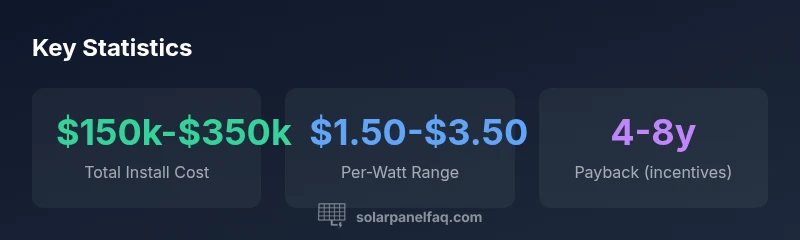
For a 100 kW solar system, installed costs typically range from about $150,000 to $350,000 in 2026, depending on equipment, labor, and location. That equates to roughly $1.50–$3.50 per watt, with incentives potentially lowering net price. Financing options and contractor bids strongly influence final numbers.
What a 100 kW System Represents in Solar Scale
In the solar industry, a 100 kW system is considered a large, commercial-scale installation typically deployed on commercial rooftops or ground-mounted sites. It sits well above typical residential arrays and often powers multiple buildings or a business operation. The capacity is enough to offset a substantial portion of on-site electricity use and may participate in utility programs or demand response. According to Solar Panel FAQ, a 100 kW project is usually planned and bid as a single scope with a dedicated interconnection path, and it requires careful coordination among design, permitting, and financing teams.
Where 100 kW Fits: Rooftop vs Ground-Mount, Commercial vs Industrial
A 100 kW system can be roof-mounted on large commercial buildings or installed as a ground-mount on open land. Rooftop configurations maximize space efficiency but may require structural assessments and specialized mounting hardware. Ground-mount setups offer easier accessibility for maintenance and potential optimization for orientation and shading but come with higher site preparation costs. In many markets, 100 kW projects are pursued by mid-to-large businesses, nonprofit campuses, or multi-tenant developments seeking reliable, long-term energy cost savings.
Core Cost Components for a 100 kW Installation
The total cost of a 100 kW solar project is driven by several primary components. First, modules represent a sizable portion of upfront costs and vary by efficiency, warranty, and supplier. Second, inverters and electrical balance of system (BOS) equipment determine performance and reliability; modern hybrids or string inverters may influence upfront and long-term maintenance. Third, racking and mounting hardware must withstand local weather and roof conditions. Finally, permitting, design, engineering, interconnection fees, site preparation, and labor are substantial factors. Collecting multiple detailed bids helps reveal price drivers and avoid hidden costs.
How Location and Site Impacts the 100 kW Cost
Geography strongly shapes the 100 kW cost. Labor rates, permitting complexity, and interconnection requirements vary by state or country. Climate affects equipment choice (panel type, mounting angle) and potential shading concerns. Higher wind or snow loading demands can require sturdier mounting systems, increasing BOS costs. Utilities’ interconnection tariffs and net-metering rules further influence the economics, as do local incentives and tax considerations. Accurate, site-specific quotes are essential for a realistic budget.
Inverters, Mounting, and BOS: Major Cost Drivers
Two big categories dominate the cost structure: electronics and installation. Inverter selection—string, central, or hybrid—affects efficiency, maintenance, and replacement cycles. Mounting systems must withstand local weather and roof geometry, with tracking options sometimes used in ground-mounted installations to boost production. The BOS encompasses wiring, conduit, wiring trunks, combiner boxes, safety equipment, and monitoring hardware. Each choice adds value but also cost; a bid comparison helps understand trade-offs between upfront price and long-term performance.
Incentives, Tax Credits, and Financing: Reducing the Net Price
Incentives can substantially alter the net cost of a 100 kW project. Regions with tax credits, depreciation allowances, performance-based incentives, or utility rebates can shorten payback and raise the project’s net value. Financing structures—capital leases, power purchase agreements (PPAs), or traditional debt—change cash flow patterns and may reduce initial outlays. When evaluating bids, map incentives to the after-incentive price and model different financing scenarios to compare net present value and internal rate of return.
Procurement Strategy: Bids, Specifications, and Vendor Selection
A rigorous procurement process lowers risk and avoids overpaying. Publish clear technical specifications (module type, efficiency, warranty, mounting details, wiring, and monitoring). Require vendor disclosures, site-specific drawings, and a detailed interconnection plan. Request multiple bids, compare not just price but scope, schedule, warranties, and service terms. Shortlist bidders who demonstrate experience with systems of similar scale and provide credible project timelines and commissioning plans.
The Payback Equation: Energy Savings, Rates, and Usage
Payback hinges on how much electricity the system offsets, the local utility rate structure, and the availability of incentives. If a site consumes most of its generated energy during peak-rate periods, savings rise. Net metering or export credit policies influence the economics, as do changes in utility tariffs. For budgeting, build scenarios for best-case, base-case, and worst-case energy prices to understand sensitivity and resilience of the investment.
Maintenance, Degradation, and System Lifespan
A 100 kW installation requires periodic maintenance, including panel cleaning, connection checks, and inverter replacements as equipment cycles progress. Panel degradation reduces production over time but is typically gradual, and warranties often cover performance for 20–25 years. Monitoring systems help detect underperformance early, enabling proactive maintenance and avoiding revenue losses. Budget for occasional replacements of inverters and components that wear faster in harsh climates.
Cost ranges and payback basics for a 100 kW solar installation
| Aspect | Low Range | High Range | Notes |
|---|---|---|---|
| Installed cost per watt | 1.50 | 2.50 | Typical industrial/commercial range (USD) |
| Total installed cost (100 kW) | 150000 | 250000 | Excludes incentives; site affects price |
| Payback period (before incentives) | 4 | 7 | Varies with energy rates and usage |
| Payback period (with incentives) | 6 | 10 | Depends on local programs and rate design |
Frequently Asked Questions
What qualifies as a 100 kW solar system?
A 100 kW system refers to the nameplate DC capacity of the array. Actual annual production depends on location, shading, and inverter configuration. This size is typically used for commercial or industrial applications and requires interconnection with the utility grid.
A 100 kW system is a commercial-scale solar setup whose production depends on location and design. It’s common for businesses or campuses and needs grid interconnection.
Is a 100 kW system feasible for a typical home?
Generally not for a typical residential property due to space and structural considerations. It’s more common for commercial rooftops or ground mounts. Homeowners should explore smaller, scalable options and potential utility programs.
Usually not for a single-family home; it’s more suited to commercial sites or campuses. Consider scalable approaches for homes.
What drives the cost of a 100 kW system?
Main drivers include panels and inverters, mounting hardware, electrical BOS, permitting, site prep, and labor. Equipment choice, warranties, and interconnection fees can shift the price substantially.
Panels, inverters, mounting, and permitting are the big cost drivers. Each choice changes upfront price and long-term performance.
What incentives should I expect for 100 kW systems?
Incentives vary by region and program. Look for tax credits, depreciation, rebates, and performance-based incentives. Utilities may offer demand charges reductions or favorable interconnection terms.
Incentives vary by location; check local tax credits, depreciation, and utility programs to reduce net price.
How long is the payback period for a 100 kW system?
Payback ranges widely based on energy rates, usage, and incentives. Expect several years to over a decade depending on program structure and rate design.
Payback varies a lot—often several years, sometimes longer if incentives are limited or energy rates are low.
What maintenance is required for a 100 kW system?
Regular inspections, periodic cleaning, and monitoring are typical. Inverters may need replacement over time; warranty terms and service plans affect maintenance costs.
Expect regular checks and occasional inverter replacements. Monitoring helps catch issues early.
“Budgeting a 100 kW solar project isn’t just the sticker price. It’s total lifecycle costs, incentives, and reliable installation, evaluated through multiple bids.”
Top Takeaways
- Define 100 kW as commercial-scale capacity and plan bids accordingly
- Expect wide ranges: $150k to $350k total when incentives are uncertain
- Incentives and financing shape net price and payback
- Compare multiple bidders with clear scope and warranties
- Account for site, permitting, and interconnection in budgeting