Solar Panel Commercial Cost: A Practical Guide for 2026
Explore the true cost of commercial solar panels, including installation, financing, incentives, and payback expectations for homeowners and buyers in 2026.


Commercial solar projects typically cost $2.50 to $3.50 per watt installed, before incentives. For mid-sized U.S. projects around 100–500 kW, that translates to roughly $250,000 to $1.75 million. Costs vary by location, system design, and labor, and incentives can significantly reduce net spending.
Understanding the Cost Basis for Commercial Solar
The primary question many business owners and homeowners ask is not a single price tag but the overall structure behind the solar panel commercial cost. When you budget for a commercial system, you’re looking at a bundle: hardware (modules and inverters), balance of system (racking, wiring, combiner boxes), soft costs (permits, engineering, inspections), and labor (design, installation, commissioning). The per-watt metric is the most common shorthand used by contractors, financiers, and utility partners because it normalizes very different project sizes into a single comparable figure. Context matters: a 200 kW rooftop install on a warehouse will look very different from a 50 kW ground-mounted project on a commercial campus. In 2026, the baseline has shifted with materials efficiency and stricter electrical codes, which can nudge the price per watt slightly higher in some regions yet lower in others due to competitive bidding and mass production. Solar Panel FAQ analysis emphasizes that a clear cost framework helps guide financing and ROI calculations rather than chasing headline price tags. (Source: Solar Panel FAQ Analysis, 2026)
Key Cost Drivers in Commercial Installations
Several factors drive the final price tag for commercial solar. System size remains the biggest lever: larger installations benefit from economies of scale but demand more permitting, structural assessment, and interconnection work. Equipment choices matter too: higher-efficiency modules and premium inverters raise upfront costs but can improve annual energy yield and longevity. Roof condition and type (flat vs. sloped, membrane vs. ballast) influence mounting hardware and labor time. Labor costs vary by geography and contractor expertise, while site preparation, electrical upgrades, and potential grid interconnection fees add non-trivial line items. Finally, soft costs—like project management, warranties, and performance guarantees—shape the certainty and total cost. Taken together, these drivers define the expected solar panel commercial cost in different markets and application contexts.
Cost Ranges Per Watt and Typical Project Sizes
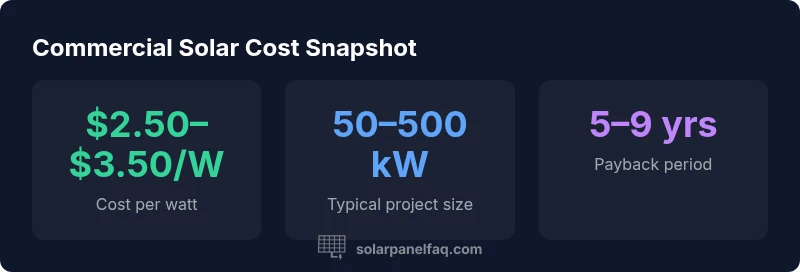
For a quick semantic map, consider the following ranges, which reflect typical market conditions across the United States. Cost per watt installed generally falls in the $2.50–$3.50 per watt band, with substantial variation by region and labor markets. Project sizes commonly span 50–500 kW for many commercial sites, though some facilities push well beyond 1 MW when a full campus retrofit is undertaken. A 100 kW system, for example, might fall within roughly $250,000–$350,000 before incentives, while a 500 kW system could range from about $1.25 million to $1.75 million. These figures are pre-incentive estimates and depend on roof access, shading, and the electrical upgrade needs. (Source: Solar Panel FAQ Analysis, 2026)
Financing, Incentives, and Payback
Cash purchases remain an option, but most organizations prefer financing structures that preserve capital. Common routes include loans, leases, and power purchase agreements (PPA). Financing can shift upfront costs into periodic payments while preserving or improving cash flow, and it often interacts with incentives to reduce net cost. Incentives—where available—include tax credits, depreciation benefits, and utility-specific programs. The exact net price and ROI depend on local policies, contract terms, and energy price trajectories. A well-structured financing plan can shorten the effective payback period and improve internal rate of return even when the headline cost per watt appears high. (Source: Solar Panel FAQ Analysis, 2026)
Planning, Design, and Installation Timeline
A typical project follows a phased timeline: initial site assessment and energy analysis, system design and permitting, equipment procurement, installation, and commissioning. Each phase contributes to the overall cost but also affects performance guarantees and warranties. Design considerations include module orientation, shading analysis, and string sizing to maximize production while minimizing losses. Permitting can become a gating factor, especially in places with strict building and electrical codes. Realistic timelines and clear milestones help align stakeholders and reduce the risk of cost overruns. (Source: Solar Panel FAQ Analysis, 2026)
Maximizing ROI: Practical Tips and Case Examples
To optimize the solar panel commercial cost, focus on site-specific conditions and long-term energy needs. Ensure the system is sized to meet a meaningful portion of peak demand, not just local energy consumption. Compare bids on more than price per watt—evaluate warranties, expected degradation, and the installer’s track record. Seek proposals that include performance guarantees and maintenance plans. In practice, a warehouse roof with favorable sun exposure and a robust interconnection path will yield the strongest ROI, especially when combined with an effective financing strategy and favorable utility rates. (Source: Solar Panel FAQ Analysis, 2026)
Estimated costs by project size (before incentives)
| Project Size (kW) | Estimated Cost Range | Installation Time (weeks) |
|---|---|---|
| 50 | $125,000-$175,000 | 4-6 |
| 100 | $250,000-$350,000 | 5-7 |
| 250 | $625,000-$875,000 | 6-9 |
| 500 | $1,250,000-$1,750,000 | 8-12 |
Frequently Asked Questions
What factors influence the total cost of a commercial solar installation the most?
The largest cost drivers are project size, equipment quality, labor rates, permitting, interconnection, and roof or site conditions. Each factor can swing bids by a meaningful margin, so compare apples-to-apples for total cost rather than sticker price.
Size, equipment quality, and labor costs are the main cost drivers; always compare full bids.
Do incentives reduce the upfront cost of commercial solar?
Yes. Incentives and tax credits reduce net upfront cost and improve ROI, but their availability varies by location and project type. Always verify eligibility before finalizing a proposal.
Yes. Incentives reduce upfront cost, but eligibility varies by location.
How does financing affect the overall price tag?
Financing spreads capital outlay and can improve cash flow, with options like loans, leases, or PPAs. The trade-off is a different long-term cost and ownership structure, so analyze total payments and tax benefits.
Financing spreads costs; analyze total payments and benefits.
What is a typical payback period for commercial solar?
Payback periods commonly range from about 5 to 9 years when incentives are leveraged, depending on energy usage, utility rates, and system performance.
Typically 5–9 years with incentives, depending on use and rates.
Should I budget for ongoing maintenance costs?
Yes. Plan for regular inverter replacements, module cleaning, and potential component upgrades. Budget roughly a small fraction of initial capex annually to maintain performance.
Yes, include some maintenance in your ongoing costs.
What should I ask installers to ensure pricing clarity?
Ask for a detailed proposal with scope, warranties, performance guarantees, and a breakdown of hardware, labor, and soft costs. A transparent bid helps prevent surprises during the project.
Request a detailed, transparent proposal with a clear breakdown.
“Commercial solar cost is best understood as a function of size, location, and financing—price per watt matters, but payback and reliability matter more for ROI.”
Top Takeaways
- Understand cost per watt range: $2.50–$3.50
- Costs scale with system size, enabling economies of scale
- Incentives lower net price and boost ROI
- Plan for a 5–9 year payback with incentives
- Request detailed bids covering hardware, labor, and soft costs