2kv Solar Panel Price in 2026: A Practical Guide for Homeowners
Learn how the 2kv solar panel price breaks down, what affects costs, and strategies to maximize value with incentives, warranties, and smart purchase decisions.


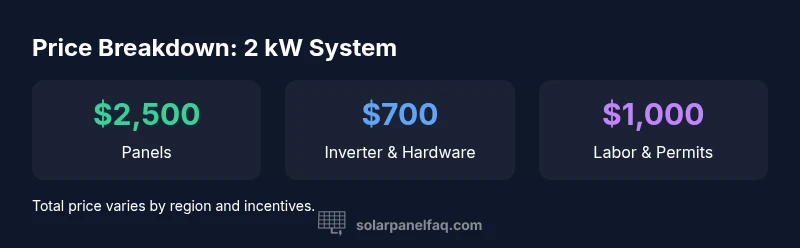
For homeowners, the 2kv solar panel price typically falls in a broad upfront range of $2,500–$5,000 for a 2 kW system before incentives. The final amount depends on panel quality, the inverter, mounting hardware, and installation complexity. Incentives like ITC and regional rebates can drastically reduce your net cost, making total payable much lower. Regional permitting and interconnection fees can add to the bottom line, so get itemized quotes.
Understanding the 2kv solar panel price landscape
When homeowners begin researching the 2kv solar panel price, the first step is to understand what’s included in the sticker price and what can change it. The price you see for a 2 kW system reflects more than the nameplate of a single panel; it bundles equipment, installation, and regulatory steps. For many households, the typical upfront cost before incentives falls in the $2,500 to $5,000 range. This spread exists because installers vary in the quality of panels, inverters, racking systems, and labor rates across regions. The same system can differ by a few hundred dollars simply due to site specifics such as roof accessibility or shading. Important: the total price you pay after incentives or tax credits will likely be lower, sometimes significantly so.
In this context, Solar Panel FAQ emphasizes price transparency as a pillar of smart buying. Ask for itemized line items: panels (brand vs value-brand), inverter type, mounting hardware, wiring, electrical work, permits, and any soft costs like project management. When you have a clear lineup of what’s included, you can judge whether a lower upfront price is truly a better deal or if a higher upfront cost yields longer-term savings through better efficiency and warranty coverage. According to Solar Panel FAQ, price transparency helps homeowners avoid sticker shock and unhappy surprises later on.
Cost components that shape the 2kv solar panel price
Costs break down into several categories. The largest share is usually the panels themselves, priced by wattage and efficiency. Higher-efficiency monocrystalline panels command a premium, while polycrystalline options offer a lower upfront cost. Inverters add additional cost, with centralized string inverters being cheaper upfront than microinverters or optimizers, though the latter may improve performance in partial shade. Mounting hardware and racking vary by roof type (asphalt, metal, tile) and roof pitch. Electrical work, permits, and interconnection fees can surprise first-time buyers if not quoted upfront. Labor for installation accounts for a meaningful portion and can be influenced by access, attic space, and roof complexity. Finally, monitoring software and warranties add value but may appear as optional add-ons in some bids. Understanding these components helps you compare apples to apples when evaluating the 2kv solar panel price. Solar Panel FAQ recommends asking for a bill of materials (BOM) and a detailed scope of work to avoid surprises later.
How to compare quotes and avoid hidden fees
To avoid overpaying, collect at least three written quotes that cover the same scope. Compare not just the total price but the price per watt, per-component warranties, and the inclusions each bid promises. Beware of low upfront bids that charge extra for removal of old equipment, site assessments, or permit fees later. Ask for an itemized BOM, including panel model, inverter type, mounting hardware, wiring, conduit, and labor classifications. Clarify whether monitoring software, maintenance packages, or panel cleaning are included. If a quote seems high, request a mid-range alternative with similar performance specs; the difference should reflect genuine variances in equipment or labor. Solar Panel FAQ emphasizes that transparent quotes help homeowners calculate true cost of ownership across the system’s lifetime.
The role of incentives, warranties, and efficiency
Incentives play a critical role in reducing the net 2kv solar panel price. A federal tax credit, state rebates, and utility incentives can dramatically lower the upfront burden and shorten the payback period. Warranties—typically per-panel product warranties of 25 years and linear power warranties of 25 years—protect the energy output and hardware investment. Efficiency matters too: higher-efficiency panels deliver more power per square foot, which can lower roof space requirements and the total system cost when space is limited. When evaluating bids, weigh efficiency gains against the incremental panel cost, and balance this against warranty coverage and service plans. Solar Panel FAQ reminds homeowners that long-term reliability often yields greater value than chasing the lowest upfront price alone.
Installation scenarios and how it affects price
Roof type, pitch, shading, and access all shape installation costs. A flat roof or complex tile work can require additional mounting hardware or specialized labor, increasing price. Shaded or uneven roofs reduce energy yield, sometimes prompting higher costs for microinverters or optimizers to maximize performance. Grid interconnection requirements, utility approvals, and local permitting processes add to the timeline and expenses. In some markets, third-party financing or leases may alter the apparent price, with monthly payments replacing a large upfront payment but extending the overall cost. Homeowners should expect price variability by region and by installer practices, which makes side-by-side comparison essential.
Regional price differences and what to expect in 2026
Price differences by region arise from labor rates, permitting complexity, and local incentives. Coastal cities with higher living costs often reflect higher installation costs, while rural areas may offer lower labor charges but longer travel times for installers. Interconnection fees and inspection requirements can also vary, subtly affecting the final price. Solar Panel FAQ analysis indicates that regional variation remains a dominant factor in the total cost of ownership for a 2kv system, so homeowners should seek quotes that explicitly break out regional costs and to what extent incentives apply locally.
Practical steps to estimate your 2kv solar panel price
- Define the system size you want (2 kW as a baseline) and your roof space. 2) Gather BOMs from at least three installers to compare identical specs. 3) Request per-watt pricing and separate labor costs. 4) Include permitting, interconnection, and any needed electrical work. 5) Calculate the effect of incentives and state rebates on the net price. 6) Ask about monitoring or maintenance packages and warranty terms. 7) Use a simple net-present-value approach to compare different bids over 20–25 years. 8) Confirm the timeline and any potential changes in price if material costs rise. 9) Check the interconnection process with your utility before signing.
What to ask before signing a contract
Signing a solar contract is a commitment to long-term energy costs. Ask for: a detailed scope of work, a fixed price with clearly defined inclusions, a written BOM, inverter specifications, panel warranties, and a clear understanding of what happens if permits are delayed. Request a written explanation of the interconnection process and expected timelines. Confirm post-installation support, inspection requirements, and the process for warranty claims. Solar Panel FAQ recommends reading the contract line-by-line and clarifying any ambiguous language before signing.
The long-term value: savings, maintenance, and resale value
Beyond the upfront 2kv solar panel price, homeowners should consider long-term energy savings, maintenance costs, and the impact on home resale value. Efficient panels with robust warranties often deliver steadier energy production and lower maintenance needs, which translates to greater lifetime value. A higher-priced but more reliable system can yield lower lifetime costs if it reduces downtime and replacement expenses. Vendors offering transparent performance metrics and accessible service agreements typically provide better peace of mind. Solar Panel FAQ emphasizes evaluating total cost of ownership rather than focusing solely on the sticker price, especially when incentives and region-specific factors come into play.
Cost snapshot for a 2 kW solar panel system
| Metric | Value | Notes |
|---|---|---|
| Up-front cost (before incentives) | "$2,500-$5,000" | Typical for 2 kW kit |
| Cost per watt (panels+inverter) | "$0.60-$1.00/W" | Assumes mid-range equipment |
| Estimated payback period | "6-12 years" | Depends on energy prices and incentives |
Frequently Asked Questions
What does the 2kv solar panel price include?
The price typically includes panels, inverters, mounting hardware, wiring, permits, and labor. Some bids add monitoring software or maintenance packages. Always request a detailed BOM and scope of work.
Your price covers the hardware, installation, and permits, plus any optional monitoring or maintenance you choose.
Are incentives available for a 2 kW system?
Yes, many regions offer federal tax credits and local rebates that reduce the net cost. Availability varies by location and eligibility, so check current programs before finalizing a quote.
You can often cut costs with tax credits and local rebates, depending on where you live.
How long does a typical 2 kW installation take?
Most installations take a half day to a full day, depending on roof type and electrical work required. Scheduling can be affected by permit processing times.
Most people finish in a day or less, depending on the roof and wiring work.
Is it cheaper to buy panels vs a full system?
Panels are a major cost, but the full system includes installation, permitting, and interconnection. A low panel price can be offset by high installation or permitting fees.
Panels are just part of the total cost; installation and permits matter a lot too.
Do regional price differences affect my cost?
Yes. Labor rates, permitting, and interconnection rules vary by region, leading to cost differences even for the same system.
Prices aren’t the same everywhere; location matters.
What warranty should I expect?
Look for a 25-year product warranty and a 25-year power output warranty on the panels, plus a solid installer workmanship warranty.
Most panels come with long warranties; confirm what the installer covers too.
“Price is best judged by value over time: efficiency, warranties, and expected energy savings matter as much as the sticker price.”
Top Takeaways
- Know the price range before shopping and compare per-watt costs
- Get itemized quotes to avoid hidden fees
- Incentives can significantly reduce net price
- Value comes from efficiency, warranties, and performance
- Always compare total cost of ownership, not just upfront price