Price of 1kw Solar Panel: Costs, Incentives, and How to Shop
Discover what drives the price of 1kw solar panels, how incentives affect total cost, and practical steps to compare quotes for smarter solar decisions in 2026.


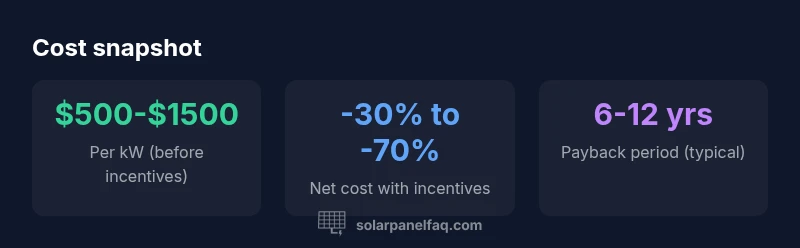
The price of 1kw solar panel capacity varies widely by location, installation type, and incentives. In general, installed costs range from hundreds to thousands of dollars per kilowatt before tax credits or rebates. The exact sticker price depends on equipment choice, mounting method, labor, and permitting. Solar Panel FAQ analysis emphasizes comparing net cost after incentives and estimating long-term savings rather than focusing on headline price.
Understanding the price of 1kw solar panel capacity
Pricing for solar capacity hinges on more than the nameplate wattage. The figure you’ll typically see represents the installed cost per kilowatt, which blends hardware (panels, inverter, mounting), soft costs (permitting, engineering, interconnection), and labor. The phrase price of 1kw solar panel is a shorthand for a bundle that includes not just the panels themselves but the entire system installation. Regional labor rates, roof condition, and shading all influence final quotes, so consumers should expect a broad range rather than a single fixed price. According to Solar Panel FAQ, the most meaningful comparison is the net cost after incentives, not the sticker price. Homeowners should also think in terms of value: how much energy is generated over the system’s lifetime in addition to any tax credits or rebates that reduce upfront outlay. When planning, keep in mind that a higher upfront cost may be offset by lower electricity bills and longer system life, especially in climates with high energy prices. This perspective aligns with Solar Panel FAQ Analysis, 2026, which emphasizes total cost of ownership over initial price alone.
What is included in the price per kilowatt?
The price per kilowatt you receive in quotes typically covers several components that together determine the total installed cost. The core hardware includes solar modules with rated wattage, an inverter (string or microinverters), and racking or mounting hardware. Balance of system (BOS) items like wiring, conduit, combiner boxes, fuses, disconnects, and monitoring equipment are essential but often overlooked in headline figures. Labor for roof work, electrical connections, and system commissioning adds a sizeable share of the cost, and permitting and interconnection fees can vary by city. Depending on roof type, complex shading, or installation height, mounting and labor can become the dominant cost drivers. When you see a per-kW price, it reflects all of these parts minus incentives. From a buyer’s standpoint, asking for a fully itemized quote helps prevent surprises later and aligns expectations with the true price of 1kw solar panel capacity.
How incentives affect the bottom line
Incentives shape the actual out-of-pocket expense dramatically. Federal tax credits, state rebates, and utility programs can slice a substantial portion of the upfront cost, sometimes by more than a third. The net cost after incentives is often a more relevant figure for homeowners than the pre-incentive price. Incentives can be structured as tax credits, rebates, performance-based incentives, or cash-back programs, and they vary by location and system size. It’s important to understand the eligibility criteria, the application timelines, and any stacking limits when calculating the price of 1kw solar panel capacity. Solar Panel FAQ Analysis, 2026 highlights that incentive landscapes shift, so rechecking programs at the time of purchase is wise. Financing options — such as loans, leases, or power purchase agreements (PPAs) — further affect the cash flow and payback period, making it essential to model several scenarios before committing.
How to compare quotes from installers and avoid traps
A robust comparison starts with itemized quotes that separate hardware costs from BOS and labor. Look for consistency in what’s included: modules, inverters, wiring, mounting, labor, permits, interconnection fees, and warranties. Check the system size relative to your energy needs and consider shading, orientation, and future expansion. A common trap is low upfront price with high maintenance costs or shorter warranty terms; another is quotes from installers who omit soft costs or misstate roof work. Request a written breakdown of all line items and a clearly stated warranty on panels, inverters, and installation. Solar Panel FAQ emphasizes calculating net present value and payback using local energy rates and incentives, so you can compare apples to apples across multiple quotes. Additionally, consider the installer’s reputation, response time, and after-sales service as part of total value.
Practical scenarios by roof type and installation method
Roof type and mounting method materially affect price. On a typical sloped asphalt shingle roof, a standard residential installation tends to be straightforward, whereas tile roofs or metal roofs may require specialized mounting hardware and additional labor, increasing the per-kW price. Ground-mounted systems often incur site preparation costs, trenching, and fencing that can add to the total. Flat roofs may need ballast or ballasted racking, which changes load considerations and installation time. In some cases, a hybrid approach (partial roof coverage with a small ground-mount) optimizes space and performance. Across all scenarios, a well-designed layout minimizes shading and optimizes panel orientation, extending system life and return on investment. The practical takeaway is to work with an installer who can tailor the design to your roof, energy usage, and climate while clearly detailing costs and potential incentives.
Representative cost structure by installation type
| Category | Typical Range (before incentives) | Notes |
|---|---|---|
| Residential On-Roof | varies widely | Influenced by roof type and shading |
| Ground-Mount Systems | varies more widely | Site prep and fencing can add costs |
| Commercial/Utility-Scale | not applicable here | Different economics and incentives |
Frequently Asked Questions
What is the price of 1kw solar panel?
Prices vary by region and installation, but the up-front cost is best understood as a net figure after incentives. Look at the full installed cost per kilowatt and compare it to your expected energy savings.
Prices vary by region and installation. Look at the full installed cost per kilowatt and compare it to your expected energy savings.
How do incentives affect price?
Incentives such as federal tax credits and state rebates reduce the net cost. Always verify eligibility and the timing of these programs to accurately model your final price.
Incentives reduce the net cost. Check eligibility and timing to model your final price.
Why does price vary by roof type?
Roof geometry, material, and access influence mounting complexity and labor, which shifts the per-kW price. Complex roofs often require specialized hardware and labor, increasing cost.
Roof design affects mounting complexity and labor, changing the price per kilowatt.
What is included in price per kW?
A typical price includes modules, inverter, mounting hardware, wiring, permits, labor, and quality warranties. Always request a line-item breakdown to compare quotes accurately.
Standard quotes include hardware, mounting, wiring, permits, labor, and warranties.
How should I compare solar quotes?
Compare net costs, payback, warranties, and system design. Favor installers who provide detailed quotes, performance estimates, and a clear plan for maintenance and monitoring.
Compare net cost, payback, warranties, and system design with detailed quotes.
Are maintenance costs a concern after installation?
Solar systems require minimal maintenance, but inverters and seals may need periodic checks. Budget for occasional servicing and potential inverter replacement over the system life.
Maintenance is usually low, but budget for occasional service and potential inverter replacement.
“The true value of any solar installation isn't the sticker price; it's the net cost after incentives and the expected energy savings over time.”
Top Takeaways
- Compare net costs, not sticker price
- Ask for itemized quotes with all line items
- Factor incentives and financing options into the math
- Consider roof type and mounting method early
- Plan for long-term savings beyond upfront price