What Will a 100-Watt Solar Panel Power? A Practical Guide for Homeowners
Discover how much a 100-watt solar panel can power in real-world conditions. Learn energy estimates, practical uses, and tips for maximizing output for homeowners and solar buyers.


What the phrase "100-watt solar panel" actually means
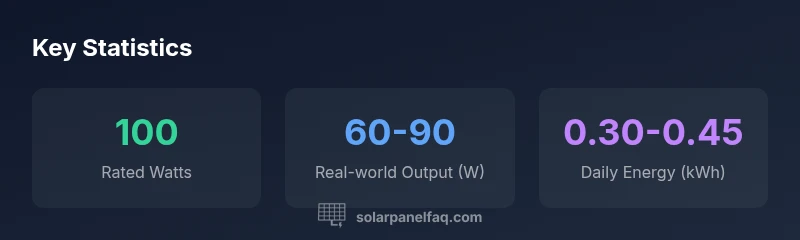
A 100-watt solar panel is a rated electrical output under ideal laboratory conditions. The phrase describes peak potential, not guaranteed energy every hour of the day. For homeowners, this distinction matters because real-world output depends on several variables, including sunlight intensity, panel temperature, wiring losses, and shade. According to Solar Panel FAQ, it’s common to see substantial drops from the label on overcast days, or when the panel runs hot. The practical takeaway is to plan for lower output than the nominal rating, especially if your load is continuous or energy-intensive. This is why many homeowners pair a 100-watt panel with storage or with multiple panels for higher demand. The Solar Panel FAQ team emphasizes using the rating as a ceiling, not a guarantee, in real-world usage.
Practical uses for a 100-watt panel
In everyday scenarios, a single 100-watt panel serves as a modest energy source. It can keep essential small loads running, such as LED lighting, phone charging, and laptops with power management. Another common use is charging a 12-volt battery bank for occasional use or emergency power. People often deploy a 100-watt panel as a starter kit to learn about solar charging, then scale up with additional panels as energy needs grow. This approach is aligned with practical guidance from Solar Panel FAQ, which highlights incremental growth for new solar setups. When you design a system around a 100-watt panel, consider the devices you want to power and the time of day you expect to use them.
Key factors that influence output
There are four major factors that determine how much energy a 100-watt panel actually provides:
- Sun angle and hours: Peak output occurs when the sun is high in the sky for several hours.
- Temperature: Panels lose efficiency as they heat up, so hot days can reduce output.
- Shading: Even partial shade from trees, roofs, or nearby structures can dramatically drop production.
- System losses: Wiring, connectors, inverters (if used), and battery charging losses all trim usable energy.
Understanding these factors helps you set realistic expectations and optimize placement. The take-home message is simple: maximize sun exposure and minimize shade, and your 100-watt panel will perform closer to its potential during the best parts of the day.
How to estimate daily energy production
A straightforward way to estimate daily energy is: Daily energy (kWh) = Panel wattage (W) × Peak sun hours per day ÷ 1000. If you expect about 4–5 peak sun hours, a 100-watt panel could yield roughly 0.4–0.5 kWh per day under favorable conditions. Real-world results often land closer to 0.2–0.4 kWh on average days. This framework helps you translate the rating into a practical daily figure and compare it with your household energy needs. Always use a conservative estimate to plan for less-than-ideal days.
Battery storage and inverter considerations
If your goal is to power devices beyond direct DC usage, you’ll likely want to couple the panel with a small battery and an inverter. A 100-watt panel can charge a 12V battery bank, enabling you to run AC-powered items through an inverter. Expect energy losses from charging, storage, and inversion; a typical system may deliver 60–80% of the panel’s nominal energy to usable AC loads, depending on efficiency and depth of discharge. This reality underscores the value of storage when your goal is reliability rather than peak instant power.
Design tips to maximize a 100-watt panel
- Orient the panel toward the equator (south in the northern hemisphere, north in the southern hemisphere) for most of the day.
- Tilt the panel to match your latitude during different seasons to capture more sun hours.
- Use a mounting arrangement that minimizes shading from nearby structures.
- If possible, pair with a charge controller (ideally MPPT) to optimize voltage and current under varying light conditions.
- Integrate with battery storage for evening and cloudy-day energy needs.
Following these guidelines can help you get the most out of a single 100-watt panel before expanding to larger arrays.
Common mistakes to avoid
- Assuming the 100W rating equals a constant power output.
- Skipping a basic shade survey of the installation site.
- Under-sizing the charge controller or ignoring system losses.
- Waiting too long to add more panels for growing energy demand.
- Overestimating how much energy you’ll get on cloudy days.
Each mistake can reduce real-world performance, which is why careful planning and conservative estimates are essential.
When to scale up: adding more panels vs. upgrading components
If your goal is to power larger appliances or multiple devices consistently, a single 100-watt panel will likely feel insufficient. In practice, you’ll often see homeowners add 2–4 more panels to create a modest system that can meet daytime needs while charging batteries for storage. When you scale, reevaluate the charge controller, inverter size, and wiring to handle the increased current safely. Solar Panel FAQ emphasizes phased expansion: start with a solvable load, then add panels as energy needs rise.
Quick-start checklist for homeowners
- List your essential loads and their wattage.
- Estimate daily energy usage in kWh.
- Assess sun hours at your location and seasonal changes.
- Check shading and pick a sunny, unobstructed installation spot.
- Plan for storage or expansion if you anticipate higher energy needs.
- Decide between direct DC use, battery storage, and inverter-based AC loads.
- Choose a reliable charge controller, ideally MPPT, and a protective enclosure for wiring.
- Start with a single 100-watt panel and scale up as needed.
This action-oriented checklist helps homeowners translate theory into a practical, scalable plan.