How Long Can a 100W Solar Panel Run? A Practical Guide
Explore how long a 100W solar panel can run, with practical examples, sun-hours factors, and a calculator to estimate daily runtime for common loads.


How long can a 100 watt solar panel run
A 100W solar panel is rated to deliver up to 100 watts of power under standard testing conditions. In real-world use, that rating is a guideline, not a guarantee. The actual energy you get depends on sun angle, irradiance, temperature, dust, and the health of the panel. In practice you’ll see partial output when the sun isn’t at its peak, and losses from wiring, connectors, and the inverter further reduce delivered energy. For homeowners, the 100W label helps size a portable kit or a small off-grid setup, but it does not translate to hours of uninterrupted run time by itself. According to Solar Panel FAQ, understanding these limits helps you set realistic expectations and plan smarter with backup storage or grid-tied options. This context matters when you estimate how long a 100W panel can run a given device.
How many peak sun hours does a 100W panel get?
Peak sun hours are a useful idea for quick planning. They represent an average of sun intensity over a portion of the day and are not the same as clock hours of sun. In practice, locations near the equator or deserts may harvest 5–6 peak sun hours on a bright day, while northern latitudes or cloudy regions could see 2–3 hours or less. Seasonal changes also affect these values. When you plan around peak sun hours, you can estimate energy production more realistically: energy = panelWattage × peakSunHours. Keep in mind that real-world factors like shading, temperature, and aging reduce actual output below the ideal calculation. The Solar Panel FAQ approach emphasizes using conservative estimates and a buffer for variability to avoid overestimating runtime.
Estimating runtime with examples
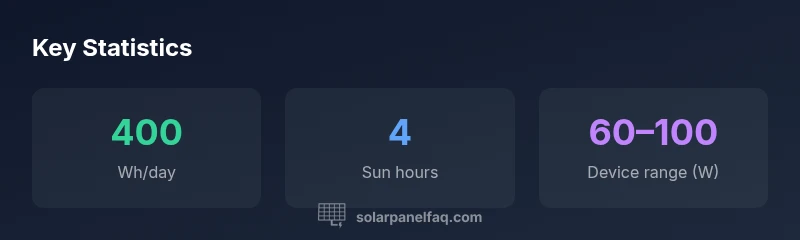
To estimate runtime, you can use the simple relation: runtime (hours) = panelWattage × sunHoursPerDay / deviceWattage. Example 1: a 100W panel, 4 peak sun hours/day, powering a 60W device yields about 6.67 hours per day (100 × 4 ÷ 60 = 6.67). Example 2: the same panel powering a 100W device yields about 4 hours per day (100 × 4 ÷ 100 = 4). Example 3: if sun exposure increases to 5 hours/day and the device is 80W, runtime ≈ 6.25 hours (100 × 5 ÷ 80 = 6.25). These figures are daily runtimes and assume a direct connection with minimal losses; real systems with batteries, inverters, and wiring will be somewhat lower. When you expand to monthly or seasonal planning, consider storage and shading effects to refine the numbers.
Real-world factors that impact runtime
Runtime is sensitive to more than just wattage. Here are the top factors:
- Sun exposure: The angle, duration, and intensity of sunlight determine how much energy is generated.
- Temperature: Higher temperatures can reduce panel efficiency and output.
- Shading and dirt: Partial shading, soiling, or snow dramatically reduces output.
- System losses: Wiring resistance, connectors, and inverter losses can shave off a portion of energy.
- Panel aging: Over time, degradation reduces peak performance.
- Orientation and tilt: Proper alignment toward the sun increases daily energy capture. In practice, allow for a 10–30% performance margin to account for these factors, and consider a battery or grid-tied setup to store excess energy for later use. These realities underscore why a fixed “hours of operation” number is rarely absolute for every device.
Using a calculator to estimate runtime
A purpose-built calculator makes this easier by letting you input panel wattage, sun hours, and device wattage. With a 100W panel and 4 peak sun hours, you can quickly see how long a given device could run per day. The calculator also helps you experiment with different loads, sun conditions, and potential battery storage scenarios. As you adjust inputs, the output updates to reflect the current estimate, keeping you in control of planning without guessing.
Practical tips to maximize daily runtime
- Keep panels clean and unobstructed to maximize energy capture.
- Optimize tilt and orientation toward the sun’s path for your location and season.
- Use energy-efficient devices and appliances to stretch runtime.
- Pair a 100W panel with a small battery bank to store energy for cloudier periods.
- Plan loads during peak sun hours for the most efficient use of generated energy.
- If you need continuous operation, consider a larger array or a grid-tied system with storage.