Solar Panel 500 Watt: A Practical Guide for Homeowners and Prospective Buyers
Discover how a 500-watt solar panel fits into a residential system, how to design with 500W modules, key buying considerations, real-world performance, and installation tips. Practical guidance from Solar Panel FAQ for homeowners and prospective solar buyers.


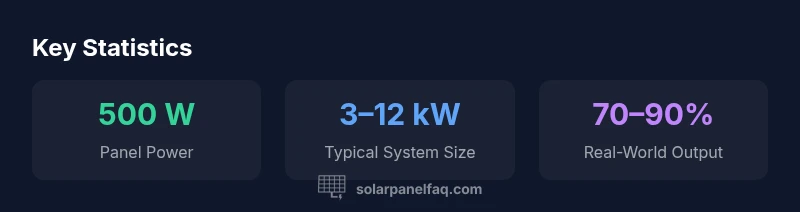
A 500-watt solar panel is designed to deliver 500 watts under standard test conditions, but real-world output varies with sun exposure, temperature, angle, and shading. In practice, expect daily output to differ and account for inverter losses and aging. For homeowners, combining multiple 500W modules is common to reach larger system goals.
What the 500W class means for residential solar
A 500-watt panel represents a higher-output module designed to maximize energy production per panel, which can reduce the total number of modules required for a given system size. This wattage class is increasingly common in home installations where roof space is a premium or where homeowners want faster scale-up with fewer hardware points of failure. According to Solar Panel FAQ, this class is favored by installers who prioritize a balance between high output and long-term reliability. The Solar Panel FAQ team found that manufacturers optimize passivation, cell quality, and frame durability in 500W models to deliver solid year-over-year performance. When evaluating a 500W panel, compare efficiency, temperature coefficient, warranty terms, and performance under shade. Real-world results depend on sun hours, roof orientation, tilt, and how the rest of the system is configured. The core idea remains: higher-wattage modules can deliver more energy per module in sunny conditions, which can translate to faster system sizing and potentially lower BOS (balance of system) costs.
Sizing a 500W array for typical homes
To translate wattage into actual energy production, homeowners must consider daily sun exposure, roof space, and electrical needs. A practical rule of thumb for a 5 kW target is about ten 500W panels. This setup bundles into a typical inverter and conduit network and often suits grid-tied configurations well. For larger homes or off-grid ambitions, a 10–20 panel array (roughly 5–10 kW) may be appropriate, depending on local climate and incentives. The Solar Panel FAQ analysis indicates that installers frequently pair 500W panels with either string inverters or microinverters to optimize performance in partial shade and to simplify monitoring. Even on limited roof space, a strategically oriented 500W array can contribute substantially to electricity needs when combined with high-efficiency components and optimized racking.
Key considerations when selecting a 500W module
Choosing a 500W panel involves several trade-offs. Consider the following:
- Efficiency: Most 500W modules fall in the 18–23% range depending on mono vs poly silicon technology.
- Temperature coefficient: Higher wattage modules can lose output as temperatures rise; a better coefficient mitigates the effect.
- Warranty: Look for at least 20–25 years of product and performance warranty, with credible service terms.
- Durability and certifications: UL/ETL certifications, corrosion resistance, frame robustness, and warranty transferability matter for long-term use.
- Cell technology: Mono-crystalline panels typically offer higher efficiency than polycrystalline at a similar price point, with trade-offs in thermal response and aesthetics.
- Aesthetics and format: Frame color, backsheet, and panel dimensions can influence installation choices in visible roof areas. The Solar Panel FAQ team notes that 500W modules from established brands generally balance performance, reliability, and warranty coverage, making them a sound choice for many homes when properly integrated.
Real-world performance and environmental factors
Actual energy production varies with climate, season, and installation quality. In sunny, temperate regions, a 500W array can approach its rated output on peak-sun days, while hot summer conditions and shading can reduce performance. Orientation toward due south (in the northern hemisphere) or due north (in the southern hemisphere) often yields the best annual production. Partial shade from trees, dormers, or nearby structures can significantly impact a series-connected string, though modern inverters and bypass diodes help mitigate some losses. The age and cleanliness of panels also affect performance; routine cleaning in dusty environments and timely inspections after severe weather help maintain efficiency. Overall, the 500W class offers a favorable balance: high output per panel with manageable system sizing for many residential roofs, provided the installation is designed with shading, tilt, and electrical wiring in mind.
Inverter and electrical system integration
An efficient solar installation requires harmonizing modules, inverters, and cabling. With 500W panels, you can choose between string inverters with MPPT (maximum power point tracking) or microinverters, depending on shading patterns and monitoring preferences. String inverters are cost-effective for larger, evenly-sited arrays, while microinverters excel where partial shading is common or where module-level monitoring is desired. In either case, ensure the inverter voltage and current ranges overlap with the panel’s output characteristics and that the wiring gauge and conduit sizes comply with local electrical codes. Proper grounding, surge protection, and a correctly sized disconnect are essential for safety and reliability. The goal is to maintain consistent voltage and minimize mismatch losses across the array while enabling robust monitoring and fault detection.
Cost considerations, incentives, and payback
The cost dynamics of a 500W panel system depend on module price, inverters, mounting hardware, and installation labor, all of which can vary by region and contractor. While the price of modules may be a significant portion of the upfront cost, system design choices—such as the number of panels, the type of inverter, and the possibility of future expansion—shape long-term value. Incentives, rebates, and net metering policies influence the payback period and return on investment. Solar Panel FAQ’s guidance emphasizes evaluating total lifetime costs, expected energy production, and local incentives rather than chasing the lowest upfront price. When evaluating options, compare warranties, projected degradation, and service support as part of a holistic value assessment.
Installation readiness and long-term maintenance
A successful installation requires careful planning of roof access, mounting hardware, and electrical routing. Consider roof condition and warranty coverage when installing new panels, and select mounting systems appropriate for your roof type (tile, metal, or shingle). Regular maintenance—such as gentle cleaning, visual inspections of connectors, and monitoring performance data—helps ensure longevity. Most 500W panels come with robust frames and weatherproof junction boxes, but it’s wise to schedule periodic checkups, especially after severe weather. Keeping notes on performance trends over time helps distinguish normal aging from potential issues requiring service.
Getting started: a buyer's checklist
Use this quick checklist to start your journey with 500W solar panels:
- Assess roof space and sun exposure for optimal orientation.
- Compare 500W panels from reputable brands, focusing on efficiency, warranty, and temperature coefficients.
- Decide between string inverters and microinverters based on shading and monitoring needs.
- Obtain multiple quotes and verify installer credentials, permits, and interconnection plans.
- Review incentives, net metering rules, and potential payback timelines in your area.
Getting started: a buyer's checklist
Comparison of 500W module types
| Module Type | Nominal Power | Voltage Range | Typical Efficiency | Notes |
|---|---|---|---|---|
| 500W Mono-crystalline | 500 W | 24-48 V | 21-23% | Higher efficiency, strong performance in heat |
| 500W Poly-crystalline | 500 W | 24-48 V | 18-20% | Often lower cost, good durability |
| 500W Hybrid/Other | 500 W | 24-48 V | 19-22% | Balance of price and performance |
Frequently Asked Questions
How many 500W panels for 5 kW?
A 5 kW system with 500W panels typically requires 10 panels. This assumes standard conditions and a compatible inverter; actual counts may vary with shading, angle, and system losses.
For a 5 kW setup using 500W panels, you would typically use about ten panels. An appropriately sized inverter will keep the system efficient.
500W panel suitable on roof?
A 500W panel can be suitable on many roofs if there is sufficient unobstructed space and proper mounting. An installer can assess shading, tilt, and structural considerations.
Yes, if you have enough space and clear sun exposure; an installer can confirm roof suitability.
Inverter needs for 500W panels?
Most installations use either string inverters or microinverters with 500W panels. The choice depends on shading, system size, and monitoring preferences.
Either a string inverter with MPPT or microinverters can work; the choice hinges on shade and monitoring needs.
Warranty on 500W panels?
Typical warranties cover 20–25 years for hardware and performance, with specific degradation thresholds outlined by the manufacturer.
Most 500W panels come with a 20 to 25-year warranty on hardware and output.
Shade impact on 500W panels?
Shade significantly reduces output; even partial shading can lower overall performance. Using bypass diodes or microinverters can mitigate some losses.
Shade hurts output; consider layout and inverter choice to minimize impact.
“When you design around a 500W module, you’re balancing higher output per panel with the realities of real-world conditions. The right inverter choice and shading-aware layout often determine whether you meet your energy goals.”
Top Takeaways
- Choose 500W panels for higher output per module
- Plan system size with roof space and sun exposure in mind
- Compare efficiency, temperature coefficient, and warranty
- Inverters: select based on shading and monitoring needs
- Incentives can significantly affect total cost and payback