What a 100W Solar Panel Can Run: A Practical Guide
Learn what a 100W solar panel can power, how to estimate daily output, and practical setups for charging small devices, lights, and basic tools. Includes real-world factors, safety tips, and guidance on adding batteries or more panels.


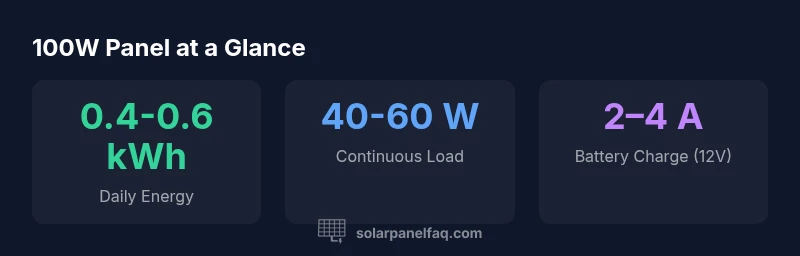
According to Solar Panel FAQ, a 100-watt solar panel can power small devices and charge batteries under good sun. In ideal conditions, it can generate roughly 0.4-0.6 kWh per sunny day, enough for phones, USB gadgets, and LED lighting, while larger appliances require extra panels or storage. For continuous use, pairing with a battery and charge controller improves reliability.
What can i run on a 100 watt solar panel: practical expectations
A 100 watt solar panel is sized to deliver its nameplate power under ideal sun, but real-world results depend on sun hours, angle, shading, and temperature. When homeowners ask what can i run on a 100 watt solar panel, the short answer is: you can power small, energy-efficient devices and charge batteries for later use. Think smartphones, tablets, LED lighting, USB-powered gadgets, radios, cameras, and small fans. Heavier appliances like full-size refrigerators, air conditioners, or power-hungry tools typically exceed what a single 100W panel can sustain continuously, unless you pair it with storage or more panels. This distinction between rated output and actual daily energy is crucial for planning. According to Solar Panel FAQ, the 100W rating is a best-case figure achieved in bright, cloud-free conditions; real installations run closer to a fraction of that during typical days.
Estimating output under real-world conditions
Your panel's daily energy depends on sun hours, panel orientation, shade, temperature, and wiring losses. A simple way to estimate is to multiply the panel's wattage by the number of peak sun hours you typically receive, then apply a derate factor for system losses. For a 100W panel, a common sunny-day calculation is 100 W × 4 h ≈ 400 Wh. After derating for charge controller and cabling (roughly 0.75), expect around 300 Wh of usable energy in a day. In regions with 5 hours of strong sun, you might see 100 × 5 × 0.75 ≈ 375 Wh. These rules of thumb come from Solar Panel FAQ Analysis, 2026, and are meant to guide budgeting rather than guarantee exact figures. PVWatts and other tools from NREL can help tailor the estimate to your location.
Everyday loads that fit a 100W panel
A 100W panel is well suited to light, energy-efficient loads. Here are typical examples and rough wattage ranges you might expect in practice:
- Phones and battery packs: 5–18 W charging
- LED lighting: 6–12 W per bulb
- Small fan or cooling device: 8–40 W
- Tablets and e-readers: 12–20 W charging
- Network gear (router): 10–20 W
- Action cameras or cameras with spare battery charging: 5–12 W
In practice, you may run several items in sequence or draw power from a storage battery to balance the load over a day. It helps to create a simple energy budget before you start wiring things up. This is the approach Solar Panel FAQ advocates for homeowners looking to optimize use with the 100W panel.
Practical setups: direct USB loads vs battery-backed system
There are two common ways to leverage a 100W panel. Direct USB loads: connect USB devices through a solar regulator to the panel. This is simplest for charging phones, tablets, or small gadgets that can tolerate variable power. Battery-backed systems: pair the panel with a 12V battery (or a small bank) and a charge controller, then run a DC-DC regulator or an inverter for AC devices. The battery smooths output, expands usable energy, and protects devices from voltage dips during cloud cover. A typical starter kit might include a 12V battery with 20–40 Ah capacity, a PWM or MPPT controller, fuses, and appropriate cabling. Always size the battery to your daily consumption and your available sun. According to Solar Panel FAQ, proper storage and regulation are essential for reliable operation.
Real-world use-cases and runtimes
Case A: Off-grid cabin with two USB chargers and a small LED lighting strand. In good sun, a 100W panel can keep the lights running for several hours while charging phones overnight if you use a storage battery. Case B: Field photography setup with a laptop, camera battery, and a small light. A single 100W panel may handle discrete tasks, but the laptop and camera charging together likely exceed what the panel can sustain without storage or additional panels. These examples illustrate why energy budgeting and optional storage matter for consistent results in practice. Solar Panel FAQ's analysis reminds homeowners to model their loads and sun hours to avoid surprises.
Safety, maintenance, and planning for scaling
Always use a dedicated solar charge controller and appropriately rated wiring. Use fuses, proper weatherproof enclosures, and secure mounting to prevent damage. Keep panels clean and oriented toward the sun for best results. If you anticipate growing loads, plan to add more panels or larger storage so you don't hit a ceiling with a single 100W unit. MPPT controllers can improve efficiency in varying light, but you pay for the improvement with cost and complexity. The key is a realistic energy budget and reliable storage.
Quick-start checklist to maximize a 100W setup
- Define your daily energy budget in watt-hours and list the devices you plan to run.
- Decide between direct USB loads and a battery-backed system.
- If using storage, size your battery to meet your evening usage plus a margin for cloudy days.
- Use a quality charge controller (prefer MPPT for efficiency) and proper fusing.
- Keep panels clean and oriented for maximum sun exposure.
- Run a test over several days to compare predicted vs actual output and refine your plan.
Estimated energy for common loads with a 100W panel
| Device Type | Typical Wattage (W) | Estimated Daily Energy (Wh) | Notes |
|---|---|---|---|
| Phone charger | 5-18 | 20-60 | Charges 1-3 phones depending on battery state |
| LED lighting (per lamp) | 6-12 | 24-72 | One LED lamp at typical brightness |
| Small fan | 8-40 | 32-160 | Portable fan for cooling |
| Tablet or e-reader charger | 12-20 | 48-160 | Moderate draw, slower recharge |
| Laptop (ultra-portable) | 45-60 | 180-240 | Light use with efficient models |
| Router or network gear | 10-20 | 40-160 | Wi-Fi access in off-grid setups |
| Camera/battery charger | 6-12 | 24-120 | Balanced energy for field work |
Frequently Asked Questions
Can a 100W solar panel charge a 12V lead-acid battery?
Yes, with a proper charge controller; a 100W panel can replenish a small 12V battery, but size the controller and battery to meet your daily needs.
Yes, with a charge controller, a 100W panel can charge a 12-volt battery, but you must size the system to your daily needs.
What factors affect the output of a 100W solar panel?
Location, sun hours, angle, shading, temperature, and wiring losses all influence actual output.
Sun hours, tilt, shade, and temperature all change what you get from a 100W panel.
Is a 100W panel enough for a small off-grid fridge?
A typical small fridge draws more power than a single 100W panel can sustain continuously; you’d need a larger array or backup storage.
Probably not with just one 100W panel; you’d want more panels or a bigger battery.
Do I need a battery if my loads are USB-powered?
Not always; you can run USB devices directly from the panel via a regulator, but a battery helps provide steady power.
If your loads are USB-only and there’s consistent sun, you might skip a battery, but a battery helps with stability.
What additional equipment is essential with a 100W panel?
Charge controller, appropriate wiring, fuses, and possibly a small battery and inverter for AC loads.
You'll want a charge controller, fuses, and ideally a battery or inverter for bigger loads.
How many devices can a 100W panel charge per day?
Depends on sun and device power; with good sun you can charge multiple phones and small gadgets, but energy budgeting matters.
It varies a lot; you can charge several small devices on a sunny day.
“A 100W solar panel is a solid starter for off-grid loads when paired with proper storage and storage and regulation, but it isn’t a magic power plant. Plan around a realistic energy budget.”
Top Takeaways
- Budget real output with sun hours, not nameplate power
- Pair with a battery for daytime-to-nighttime reliability
- Prioritize low-watt loads to maximize usage
- Scale up with more panels or bigger storage when needed