What Solar Panels to Get: A Practical Guide
A practical guide to choosing solar panels for your home. Compare panel types, efficiency, warranties, and costs, plus a step-by-step approach to sizing, roof fit, and installation.


To choose what solar panels to get, start by assessing your roof space, climate, and budget, then compare panel types by efficiency, warranty, and cost per watt. Prioritize monocrystalline panels for efficiency, but polycrystalline can be cost-effective in larger rooftops. Ensure the system size matches your annual electricity use and check local incentives.
Why choosing the right solar panels matters
Your choice of solar panels affects how much energy your system produces, how long it lasts, and how much you’ll pay over time. For homeowners, the goal is to maximize the return on investment while fitting the roof and lifestyle. According to Solar Panel FAQ, the most important trade-offs are efficiency, warranty, and system size. Higher efficiency panels generate more electricity in limited space, which matters on smaller roofs or shaded sites. However, they often come with a higher upfront cost.
Beyond efficiency, consider panel materials, manufacturing quality, and certifications. Look for products that have withstood real-world testing and have a long track record in the residential market. A reliable warranty and a solid service network can prevent surprises years after installation. Keep in mind that local climate and solar irradiance influence performance; the same panel may produce differently in hot sun or overcast days. In the end, the best choice balances roof space, energy goals, and budget. This decision also affects future upgrades, such as adding battery storage or expanding capacity. Solar Panel FAQ analysis shows that homeowners who plan ahead and compare multiple options typically achieve a smoother installation and better long-term results.
Solar panel types explained
Solar panels come in several main types, each with its own strengths and trade-offs. Monocrystalline panels are cut from a single crystal and tend to deliver higher efficiency and better performance in heat. Polycrystalline panels are made from multiple crystals; they are usually less expensive per watt but slightly less efficient and space-efficient. Thin-film panels are versatile, flexible, and lightweight, but typically offer lower energy density and shorter lifespan. When choosing, consider roof space, expected sun exposure, and how much you value fit and aesthetics. Reputable brands are often the best bet for warranty coverage and long-term reliability, even if the upfront cost is higher. See how panel materials and manufacturing quality influence longevity and performance in real-world conditions.
Efficiency, degradation, and price: what to prioritize
Efficiency determines how much electricity a panel can produce for a given roof area, which matters most when roof space is limited or shading is present. Degradation (how performance declines over time) and warranty length affect long-term reliability and total system value. Price per watt is a practical way to compare options, but it should be weighed against expected energy production, installation costs, and incentives. In practice, homeowners should balance efficiency with cost, choosing a panel type that fits their roof, climate, and budget. Certifications and independent tests add peace of mind, especially when shopping across brands. Remember that the lowest sticker price isn’t always the best long-term value if it sacrifices durability or support.
Sizing your system and how panels fit your roof
Accurately sizing a solar array starts with your annual electricity use. Gather 12 months of utility bills to estimate total kWh per year. Then determine how many watts you need per day and how much space your roof can accommodate. Consider roof orientation and shading to avoid hotspots and underperforming sections. Layout plays a critical role: you may fit more panels on a south-facing roof with minimal shade, or you might need to optimize a smaller, partially shaded surface. Finally, factor in future plans like battery storage or expansion so the layout remains adaptable as energy needs evolve.
Roof orientation, shading, and mounting considerations
Orientation and tilt influence how much sun your panels receive. South-facing roofs in the northern hemisphere typically yield the best performance, while east/west faces can work with a slight tilt if space is constrained. Shading from trees, vents, or chimneys dramatically reduces output; even partial shade can disproportionately affect the whole string in some configurations. Mounting options—roof, ground, or roof-integrated—affect installation cost, aesthetics, and roof integrity. If shading is unavoidable, microinverters or optimizer-based systems can help preserve performance in partial shade. Fire safety clearances, wind load, and roof integrity are practical concerns that a professional should verify before installation.
Warranty, long-term reliability and certifications
Most reputable solar panels come with a lengthy, though variable, warranty covering product workmanship and performance. Look for a product warranty that reflects confidence in durability, and an installation warranty that covers labor and mounting hardware. Certifications such as IEC or UL listings indicate compliance with safety and performance standards. A robust warranty and a strong service network reduce long-term risk and provide peace of mind as your system ages. When evaluating options, ask for the exact warranty terms, what is included or excluded, and how claims are processed.
How to compare brands and read specs
When comparing brands, focus on: (1) Pmax or nominal power rating (the higher, the more potential output); (2) efficiency and temperature coefficient (how performance changes with heat); (3) warranty length and terms (what is covered and for how long); (4) certifications and third-party testing; and (5) customer service and installation support. Read product datasheets carefully and check for real-world performance tests. Use independent reviews and site visits to validate claims. Finally, obtain multiple quotes to understand how different installers interpret the same panel specs and ensure consistent expectations.
Tools & Materials
- Safety gear (gloves, glasses, harness for roof work)(Protective equipment for working on a roof or ladder)
- Ladder or scaffolding(Stable access to the installation area)
- Measuring tape and chalk/marker(Accurate roof layout and panel placement)
- Power drill and appropriate bits(Secure mounting hardware and rail assemblies)
- Multimeter or voltage tester(Check electrical readiness and grounding)
- Roofing sealant and flashing supplies(Ensure weather-tight sealing around penetrations)
- Torque wrench(Precise mounting torque for rails and clamps)
Steps
Estimated time: 4-8 weeks
- 1
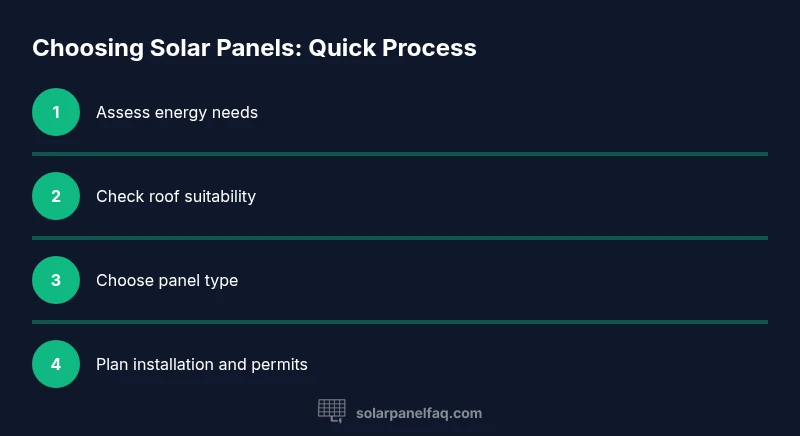
Assess energy needs
Gather 12 months of electricity bills and compute your annual usage. Convert that to daily energy needs to set a target system size. This step lays the foundation for all other decisions. Why this matters: a properly sized system avoids underproduction or wasted capacity.
Tip: Collect the latest 12 months of data and note any seasonal usage spikes (air conditioning, heating). - 2
Check roof suitability
Inspect roof space, orientation, and shading. South-facing roofs with minimal shade usually offer the best results in many climates. If shading is unavoidable, plan for optimized configurations or microinverters.
Tip: Map shading at different times of day and seasons to guide panel placement. - 3
Choose panel type
Evaluate monocrystalline, polycrystalline, and thin-film options based on space, budget, and aesthetics. Monocrystalline generally offers better efficiency, while polycrystalline can be more affordable for larger roofs.
Tip: Consider solar panel warranty and the installer’s track record with your chosen type. - 4
Plan system size and layout
Estimate the number of panels and layout on your roof, accounting for shade and tilt. Decide on string connections, and whether a microinverter or a central inverter better suits shading patterns.
Tip: Use a layout tool or simple diagram to visualize panel grouping and cable routes. - 5
Select inverters and mounting
Choose inverters compatible with your panel string configuration and desired monitoring. Pick mounting hardware that matches your roof type and wind load requirements.
Tip: If shading is present, consider microinverters to optimize performance per panel. - 6
Get quotes and check warranties
Request quotes from multiple installers, review warranty terms for both products and workmanship. Ask about service intervals, maintenance, and what happens with underperforming panels.
Tip: Ask for a written warranty comparison sheet and a projected payout timeline. - 7
Plan installation and permits
Coordinate installation with a licensed electrician or solar installer. Ensure permits, utility interconnection, and inspections are understood and scheduled.
Tip: If you DIY, verify local codes, electrical separation, and safety requirements; otherwise hire a pro.
Frequently Asked Questions
What should I consider first when choosing solar panels?
Begin with your energy goals, roof space, and budget. Compare panel types by efficiency and warranty, then assess how the system size aligns with your annual electricity use.
Start with your energy goals, roof space, and budget, then compare panel types and warranties to size your system.
Is more expensive panel always better?
Not always. Higher upfront price may correlate with efficiency and durability, but long-term value also depends on warranty, installation quality, and energy yield on your roof.
Not always. Higher price may mean better durability, but long-term value depends on yield and warranty.
Do I need to replace my roof before installing panels?
If your roof is near the end of its life or has structural issues, address that before mounting panels. Otherwise, panels can often be installed on an existing roof with proper sealing.
Replace or repair if your roof is near the end of its life; otherwise, installation can proceed with proper sealing.
Can I install solar panels myself?
DIY installation is possible in some cases, but it involves electrical work and roof safety. Most homeowners benefit from hiring a licensed installer for safety and code compliance.
DIY is possible for some, but most homeowners hire a licensed installer for safety and code compliance.
How many panels do I need for a typical home?
The number depends on your energy use and roof space. Start with your annual kWh and plan panel count around your achievable roof coverage, then adjust for budget and incentives.
It varies with energy use and roof space; start with your annual kWh and plan around your roof coverage.
What is the difference between panel types?
Monocrystalline panels offer higher efficiency and space efficiency, polycrystalline are usually cheaper with slightly lower efficiency, and thin-film provides flexibility at lower energy density. Your climate and roof shape guide the best choice.
Monocrystalline are more efficient; polycrystalline are cheaper; thin-film is flexible but less energy-dense.
Watch Video
Top Takeaways
- Assess energy needs before choosing panels
- Prioritize panel type and warranty balance
- Size the system to your annual usage
- Account for roof space and shading in layout
- Get multiple quotes and verify warranties