Which Solar Panel to Use: A Homeowner Guide 2026
A practical, step-by-step guide to choosing which solar panel to use for your home, balancing efficiency, cost, warranty, roof fit, and climate with expert guidance from Solar Panel FAQ.


To choose which solar panel to use, balance efficiency, cost, and durability with your roof and energy goals. Start by assessing roof type, shading, and budget, then compare panel types and warranties. Solar Panel FAQ's guidance emphasizes real-world performance and installer compatibility, not just wattage.
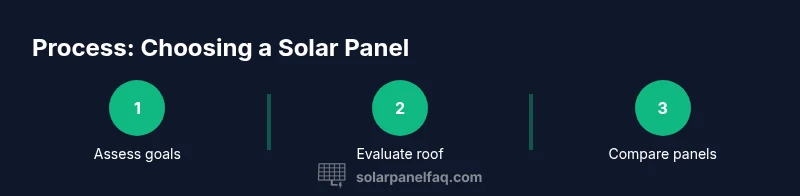
How to decide which solar panel to use: a practical framework
If you’re wondering which solar panel to use for your home, the answer should be tailored to your site, energy goals, and budget. According to Solar Panel FAQ, the most reliable approach begins with three questions: what are you trying to power, how much shade can your roof tolerate, and what is your willingness to invest upfront for long-term savings? This block lays out a framework that blends product science with real-world conditions, so you can make an informed choice without getting overwhelmed. You’ll see how panel efficiency, temperature behavior, warranty terms, and system design interact, and you’ll learn how to translate those factors into a concrete shopping list. In residential settings, the decision is rarely “the best wattage” alone; it’s about getting the best value after considering roof geometry, roof age, and installer capabilities. The Solar Panel FAQ team emphasizes a practical, defensible path rather than chasing labels.
Key takeaway: start with goal, roof, and budget; then evaluate product type and warranty.
Panel types explained: monocrystalline, polycrystalline, and thin-film
Solar panels come in a few common families, each with trade-offs that matter for which solar panel to use. Monocrystalline panels are built from highly pure silicon and typically offer the highest efficiency and best space utilization, making them a popular choice in homes with limited roof area or high energy demand. Polycrystalline panels are usually less expensive per watt but slightly lower in efficiency, which can still make sense on larger roofs with ample space. Thin-film panels, including cadmium telluride and other technologies, are flexible and perform better in extreme temperatures or shaded conditions, but they generally deliver lower efficiency and shorter warranties. When you’re deciding, compare the efficiency ratings, temperature coefficients (how the panel performs as it gets hotter), and the expected degradation over time. The goal is to align the panel’s performance profile with your local climate and roof layout.
Tips: don’t rely on sticker wattage alone; check real-world performance data and warranty terms.
Assessing your roof and site conditions: shading, orientation, and temperature
Roof conditions dramatically influence which solar panel to use. Begin by mapping shade across the year; a single tree or rooftop obstruction can dramatically reduce output. Consider orientation and tilt: in the northern hemisphere, southern-facing roofs with a favorable tilt maximize year-round production. Temperature plays a subtle role too; some panels lose efficiency as temperatures rise, so a slightly larger array may be required in hotter climates. If your roof has limited space or heavy shading, thin-film panels or panels with good low-light performance might be worth exploring. Don’t overlook roof age and structural integrity—an aging roof can complicate installation and warranty coverage.
Practical step: take photographs and measure your available roof area; note shading at different times of day and seasons.
Matching panels to goals: cost, warranty, and size
Once you understand roof constraints, scope your energy goals and budget. Efficiency matters most where space is tight; if you have ample roof area, cost-per-watt and warranty length may drive the decision more than peak efficiency. Review product warranties: a typical panel warranty covers 25 years for performance and material defects; look also for workmanship warranty from the installer. Consider the system size you need versus the available area; sometimes a slightly less efficient panel with a longer warranty and better temperature performance yields greater long-term value. Don’t forget about balance-of-system costs—inverters, mounting hardware, permitting, and potential roof penetrations all affect total cost.
Checklist: quantify desired annual kWh, estimate system size, and compare price-per-watt alongside warranty terms.
Authoritative sources and real-world guidance
To ground your decision in evidence, consult authoritative sources on solar panel technology and installation. Energy.gov’s solar resources outline performance considerations and incentives, while NREL provides independent testing data on efficiency and climate effects. The Solar Panel FAQ analysis underscores the importance of site-specific design and warranty coverage. For readers seeking background research and industry context, you can also review SEIA’s consumer-facing guidance.
Note: Always cross-check multiple sources and prioritize data that reflects your climate and roof.
Practical checklist: avoiding common pitfalls
Before committing, run through a practical checklist to avoid common pitfalls when choosing which solar panel to use. Confirm roof compatibility with a licensed installer, verify that the chosen model has a solid performance warranty, and ensure the installer can provide a complete system design and permitting support. Beware of ultra-low-priced panels with questionable warranties and subpar installation service—these often cost more in the long run due to maintenance and lower performance. Finally, request a side-by-side comparison of at least three panel types, including real-world performance estimates for your location.
Pro tip: document every warranty detail and keep a copy of all manufacturer and installer documents for future guarantees.
Tools & Materials
- Measuring tape (at least 20 ft)(For estimating roof area and panel placement)
- Recent electricity bill(Helps estimate energy needs and potential savings)
- Laptop or smartphone with internet access(For comparing panels, warranties, and incentives)
- Shading map or sun path app(Identifies peak shading times and best panel placement)
- Safety gear (gloves, non-slip shoes, harness)(Roof work requires fall protection and PPE)
- Notebook and pen(Record observations and comparisons)
- Roof access and ladder safety equipment(If planning on on-roof work, ensure stability and supervision)
Steps
Estimated time: 60-90 minutes for planning, plus 1-2 days for quotes and site assessments
- 1
Define goals and constraints
State your energy goals (e.g., cover 50% of usage or reduce bills by 70%), and note roof space and structural limits. This sets the evaluation criteria and prevents endless chasing of features.
Tip: Write down your target kWh and budget range. - 2
Assess roof and site conditions
Survey roof orientation, tilt, shading, and age. Document obstruction timing (seasonal shading) and confirm roof structure is sound for mounting.
Tip: Take photos from multiple angles and note shade patterns at different times. - 3
Learn about panel types
Summarize the main panel families—monocrystalline, polycrystalline, and thin-film—focusing on efficiency, space needs, price, and warranty.
Tip: Create a quick pros/cons table for each type. - 4
Compare warranties and reliability
List warranty terms: product, performance, and workmanship; note expected degradation rates and service support. A longer, clearer warranty often saves headaches later.
Tip: Check if warranties transfer to new homeowners. - 5
Estimate system size and budget
Using your roof area and target energy, estimate necessary system size (in watts) and balance against installed cost per watt.
Tip: Ask installers for a simple cost-per-watt estimate. - 6
Select a panel and plan installation
Choose a panel type and specific model with a compatible inverter and mounting system. Prepare a request for proposal (RFP) to compare installers fairly.
Tip: Ensure installers provide a full design, permits, and post-install support.
Frequently Asked Questions
What is the most efficient solar panel type?
Monocrystalline panels often offer the highest efficiency, but the best choice depends on space, climate, and budget. Always compare real-world performance and warranty terms.
Monocrystalline panels are typically the most efficient, but you should weigh space and climate with warranty terms.
Do cheaper panels save money long-term?
Cheaper panels can save upfront but may degrade faster or carry shorter warranties. Consider price-per-watt, anticipated degradation, and total system cost over the warranty period.
Cheaper panels may save upfront but could cost more over time due to degradation and shorter warranties.
How do I know if my roof is suitable?
Assess orientation, shading, roof age, and structural capacity. A professional assessment can confirm mounting feasibility and expected performance.
Check roof direction, shade, and age; a pro can confirm mounting feasibility.
What warranties should I look for?
Look for product warranty (panel defects), performance warranty (output over time), and workmanship warranty from the installer.
Make sure there are product, performance, and workmanship warranties.
Should I mix panel brands?
Mixing brands can complicate warranties and performance tracking. It’s usually best to stay with a matched set or ensure warranty clarity across brands.
It's usually better to stick to a consistent set for warranties.
Is thin-film viable for homes?
Thin-film panels can be useful in certain shading or temperature conditions, but they are less common for typical residential installs due to lower efficiency.
Thin-film panels work in some cases but aren’t the default choice for most homes.
Watch Video
Top Takeaways
- Define energy goals and roof constraints.
- Compare panel types by efficiency and price.
- Check warranties and installer reliability.
- Account for shading and climate effects.
- Choose a brand with solid support and post-install service.