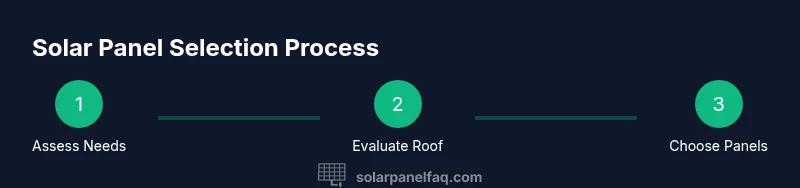
What Solar Panel For: A Practical Home Guide
A practical guide to decide what solar panel for your home, size your system, compare technologies, and navigate incentives with clear steps and checklists.


If someone asks what solar panel for, the answer depends on your roof, energy goals, and budget. Start by defining daily energy use and available roof space, then match panel wattage and array size to meet those needs. Most homeowners begin with panels in the 300–370W range and pair them with a compatible inverter and racking system.
What affects your solar panel choice
When you consider what solar panel for your home, you must weigh several practical factors. Roof orientation and shading top the list: a south-facing, unobstructed roof typically yields the most energy over the year. The roof’s pitch affects how strongly panels perform; steeper angles can harvest sun more efficiently in certain latitudes, while flat or low-slope roofs may require mounting hardware that optimizes tilt. Climate matters as well; harsher heat can slightly reduce module efficiency, and cloudier regions may demand more total capacity to reach the same daily output. The age and condition of your roof are not cosmetic concerns: many installers require a roof that can support the panels for the life of the system. Budget constraints drive decisions about panel type, warranty length, and the number of panels. Finally, incentives and grid rules at the local level can influence upfront costs and long-term savings. As Solar Panel FAQ analysis shows, aligning system design with site conditions often yields more reliable production and better long-term value.
How to size a solar array
Sizing a system begins with your household’s energy footprint. Gather 12 months of utility bills to determine annual kWh usage and compute a daily average. Then estimate sun exposure for your location—days with longer sun hours mean you can meet your needs with fewer panels. Apply a derating factor to account for real-world losses from shade, temperature, wiring, and inverter efficiency; a common range is 0.75–0.85. Divide your daily kWh needs by the product of sun hours and the derating factor to approximate the required system size in kilowatts (kW). Convert this to the number of panels by dividing by the nominal panel wattage. Keep in mind future changes in energy use (like EV charging) and always add a small contingency. This approach keeps your sizing practical and reduces the risk of over- or under-producing power.
Panel technologies: Monocrystalline vs polycrystalline vs thin-film
Panel technology affects efficiency, size, and cost. Monocrystalline panels offer the highest efficiency and the best space utilization, making them a common choice for limited roof area. Polycrystalline panels are typically less expensive and perform well in bright, hot climates, though they are slightly less efficient. Thin-film panels are flexible and lightweight with lower efficiency, useful for special installations or unique roof shapes but often require more space. When choosing what solar panel for your home, balance panel efficiency with available roof area, budget, and aesthetics. Consider temperature coefficients (how efficiency changes with heat) and long-term reliability; warranties and performance guarantees can be as important as upfront price. By comparing efficiency, durability, and cost, you can tailor your selection to your specific roof and climate.
How to choose wattage per panel and total system size
Wattage per panel influences how many units you need and how quickly you reach your target capacity. Higher-wattage panels reduce the number of modules required, which can simplify installation and wiring. A typical residential panel today falls in the 300–370W range, though newer offerings push higher values. Your total system size should reflect not only current energy use but also projected growth (like an EV or heat pump). Multiply the number of panels by their wattage to estimate total system capacity in watts, then convert to kilowatts (divide by 1,000). Ensure that your inverter capacity can comfortably handle the peak output and that the electrical service in your home can accommodate the extra load. Don’t forget to reserve space for future expansion if your budget allows.
Inverter and mounting considerations
Inverters transform DC from solar panels into AC usable by your home. Microinverters optimize each panel individually, which can improve performance under partial shading and simplify design for roof constraints. String inverters are common, cost-effective options but can be affected by shading on any panel in the string. A hybrid approach—strings with optimizers or microinverters—offers a balance of cost and performance. Mounting hardware must be rated for your roof type and climate, with concerns like wind uplift and snow loads addressed by code-compliant racking. When planning, verify compatibility between panels, inverters, and mounting hardware, and ensure a clear warranty path for both hardware and energy production. A well-meshed system reduces the risk of underperformance and ensures smoother operation over its lifetime.
Roofs, shading, and orientation best practices
Shade is a critical factor in deciding what solar panel for your home. Even small shade from trees or chimneys can dramatically reduce output if not properly mitigated. Conduct a shade study at different times of day and seasons to assess impacts. Orientations other than true south can still work well depending on latitude, but adjust expectations for energy yield. Tilt should be set to optimize annual production for your location, not just peak summer performance. For flat or curved roofs, specialized mounting solutions can preserve aesthetics while maximizing irradiance. A clean roof with good air flow and no loose shingles typically provides the best long-term results. Incorporating a shading-aware layout from the outset helps avoid costly adjustments after installation.
Costs, incentives, warranties, and reliability
Understanding the economics of solar is essential when you ask what solar panel for your home. Costs vary with panel type, wattage, and installation complexity, but the long-term savings depend on system size and efficiency. Local incentives and utility programs can significantly affect payback, often through tax credits, rebates, or net-metering arrangements. Warranties for panels and inverters are a key reliability factor and should cover at least 25 years for performance and 10–12 years for inverters. Review supplier reputations, past installation projects, and service commitments. A solid warranty and service plan reduce risk and help ensure steady performance over time. Always verify estimate clarity, expected annual energy production, and maintenance responsibilities with your installer.
Selecting a reputable installer and maintenance plan
Choosing what solar panel for your home is only part of the decision; the installer matters just as much. Look for NABCEP-certified technicians or equivalent local credentials, clear written proposals, and a transparent billing process. Ask for third-party performance data and a system commissioning report after installation. A maintenance plan should include periodic inspections, inverter checks, and module cleaning guidance. Discuss monitoring options to track energy production and identify performance issues early. A good installer offers ongoing support and a clear path for warranty claims. Finally, ensure the contract includes permit handling and grid-connection paperwork, saving you time and reducing risk of delays.
Practical scenarios to illustrate sizing
Consider two common home scenarios to visualize how sizing affects what solar panel for your home. Scenario A uses a compact roof with abundant sun; you might favor higher-wattage modules to minimize system footprint, paired with a microinverter for maximum performance under partial shading. Scenario B involves a larger roof with southern exposure but frequent tree shading in late afternoon; you could design a mixed-string configuration with optimizers to maintain output as shade shifts. In both cases, verify energy goals, roof geometry, and local rules before selecting modules and inverters. These examples show that a thoughtful design often yields better results than simply buying the most powerful panel available.
Final pre-purchase checklist
Before committing to a purchase, run through a practical checklist: confirm annual energy usage and peak demand, verify roof condition and mounting feasibility, select a panel technology that matches climate and space, ensure inverter compatibility with your electrical service, review warranties and service terms, and compare multiple quotes. Validate that incentives are applied correctly and that the expected energy production aligns with your goals. Schedule a site visit for a comprehensive assessment and request a written design with performance estimates. Finally, confirm installation timelines, permit requirements, and the post-installation support plan to safeguard your investment.
Tools & Materials
- Energy usage data (12 months of utility bills)(Used to estimate annual kWh and daily usage for sizing.)
- Roof plan and measurements(Include roof orientation, pitch, and square footage for layout.)
- Shading data or analysis tools(Identify trees or structures that cast shadows at peak sun hours.)
- Site survey appointment with a solar installer(Pre-install assessment for roof integrity and mounting feasibility.)
- Calculator or solar design software(Use for estimating system size, panel count, and inverter requirements.)
- Photographs of roof and mounting area(Helpful for preliminary design and remote quotes.)
- Local incentive documentation(Collect tax credits, rebates, and interconnection rules.)
Steps
Estimated time: 2-6 weeks
- 1
Gather energy data
Collect 12 months of electricity bills and calculate your average daily usage. Note any seasonal spikes and future plans (like EV charging) that could raise consumption.
Tip: Having accurate data prevents under- or over-sizing your system. - 2
Assess the site
Map out roof orientation, shading patterns, and available space. Check roof condition and access for installation, ensuring adequate clearance for panels and components.
Tip: Shade analysis early prevents layout rework later. - 3
Estimate system size
Use daily usage, sun-hours, and a derating factor to approximate needed kW. Convert to panel count by dividing by panel wattage.
Tip: Plan for modest growth to accommodate future needs. - 4
Choose panel type and wattage
Select a technology (monocrystalline, polycrystalline, or thin-film) based on space, cost, and climate. Pick wattage per panel to fit the number of modules you want.
Tip: Higher wattage can reduce hardware footprint but may cost more upfront. - 5
Decide on the inverter setup
Choose microinverters for shading resilience or a string inverter for cost efficiency. Verify compatibility with chosen panels and service capacity.
Tip: Consider future monitoring needs when selecting an inverter. - 6
Check incentives and warranties
Review local rebates, tax credits, and net metering rules. Compare panel and inverter warranties and the installer’s workmanship coverage.
Tip: Warranties often outlast promotions—prioritize long-term protection. - 7
Solicit multiple quotes
Get at least 3 quotes, with detailed designs, production estimates, and installation timelines. Check references and prior installations.
Tip: A detailed design reduces price surprises later. - 8
Finalize permits and interconnection
Your installer should handle building permits and utility interconnection paperwork. Monitor the approval process and keep a calendar of milestones.
Tip: Delays often come from permitting; stay proactive. - 9
Review maintenance and monitoring
Set expectations for monitoring dashboards, cleaning intervals, and annual inspections. Ensure support contacts and service terms are clear.
Tip: Remote monitoring helps catch performance issues early.
Frequently Asked Questions
What is the most important factor when deciding what solar panel for my home?
The most important factor is how your roof and energy use align with the panel’s size and technology. Space, shading, and future needs determine the best fit more than any single spec.
The most important factor is how your roof and energy needs fit the panel size and technology. Space and shading matter a lot.
How long do solar panels last and what should I look for in warranties?
Most panels are designed to last 25 years or more, with a performance warranty that guarantees a certain output level over time. Look for a long-term warranty on both the panels and the inverter, and check the installer’s workmanship warranty.
Most panels last 25 years or more, with warranties covering output and inverters. Check both panel and installer warranties.
Should I lease solar panels or buy them?
Buying usually offers the best long-term value and ownership of the system, while leasing or power purchase agreements can lower upfront costs. Compare total lifetime costs, maintenance responsibilities, and any residual value at the end of the contract.
Buying typically provides better long-term value, while leasing lowers upfront costs but may have higher long-term expenses. Compare total costs and maintenance.
Do I need a new roof before installing solar panels?
Ideally yes: install on a roof in good condition to avoid rework. If the roof needs replacement soon, plan it prior to installation or choose a mounting method that allows for future access.
If the roof is aging, replace it before installation or plan for it in the design to avoid costly rework.
Can I install solar panels myself?
DIY solar installations are generally not recommended due to safety, building codes, and electrical permits. Hire licensed installers to ensure compliance and warranty coverage.
It's best to hire licensed installers; DIY can risk safety, code violations, and void warranties.
What incentives should I expect and how do they affect payback?
Incentives vary by region and may include tax credits, rebates, or net metering benefits. They can shorten payback, but eligibility and timing differ, so plan with a local expert.
Incentives vary by location and can shorten payback time; check local programs and timelines.
Watch Video
Top Takeaways
- Define energy needs before selecting panels.
- Size the system with climate and space in mind.
- Choose panel technology that matches roof and budget.
- Inverter strategy matters for performance and cost.
- Verify incentives, warranties, and installer credentials.