What Size Solar Panel to Run a House: A Sizing Guide
Learn what size solar panel to run a house with practical inputs, calculations, and a simple calculator to estimate your system size for home solar.


How to determine what size solar panel to run a house
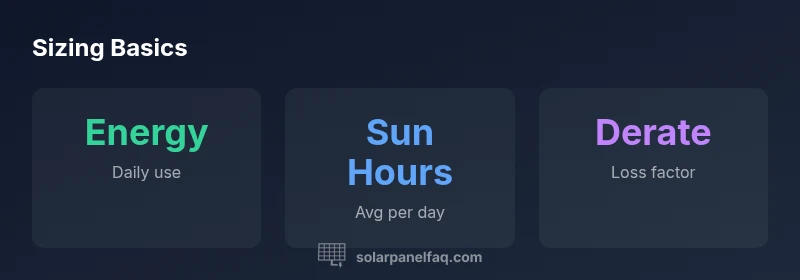
If you're asking what size solar panel to run a house, the answer starts with three inputs: your daily energy use, the average sun you receive at your location, and a derate factor that accounts for system losses (inverter, temperature, wiring). Start by converting your energy use into daily kilowatt hours (kWh). Then divide that number by the product of sun hours per day and the derate factor. The result is a rough system size in kilowatts (kW) that can meet your needs. This rough method is the foundation for a more precise calculation that considers roof space, panel efficiency, and future energy growth.
Beyond these inputs, you should also consider climate, seasonal variations, and panel orientation. A home in a sunny, temperate area will typically require fewer panels than a similar home in a cloudier climate. Roof shading, tilt angle, and the possibility of adding batteries can all shift the required system size. Remember that real-world performance often diverges from ideal estimates, so plan with a safety margin and local guidance from a licensed installer.
Step-by-step: sizing a solar system for a typical home
- Start with your annual energy usage from your utility bills, then divide by 365 to get a daily average in kWh. This gives you a baseline for sizing.
- Check local sun exposure data (average sun hours per day) for your site. This varies by region and season.
- Decide on a derate factor to account for losses (inverter, wiring, temperature). A typical range is 0.75–0.9, with 0.8 being a common starting point.
- Compute system size: System size (kW) = daily kWh / (sun hours per day × derate).
- Compare roof space and panel efficiency. A higher-efficiency panel may reduce the physical footprint but can cost more upfront.
- Plan for future growth by considering potential increases in usage (new appliances, EVs) and whether you want some headroom in the system. A licensed installer can translate these inputs into a concrete design.
Understanding key inputs: loads, sun hours, losses, and safety margins
- Daily energy use (kWh): The most important input. It captures how much energy your home consumes on an average day.
- Sun hours (hours/day): The number of peak sun hours your location receives daily. This varies by climate and season.
- Derate factor (0–1): Accounts for system losses from inverters, wiring, temperature, and aging. A lower value means you need a larger system.
- Roof space and panel efficiency: Fence off the physical constraints. More roof space or higher-efficiency panels can affect the final size.
- Future growth and storage: Anticipate changes in usage and the option to add batteries for storage or demand shifting.
Putting these together helps you approach the sizing with a practical mindset rather than relying on a single number. Always validate with a local installer, who can factor in shading, roof angle, and local codes.
Sizing for different roof types and orientations
Roof orientation and shading are major variables in system sizing. South-facing or unshaded roofs maximize annual production, reducing the number of panels needed. East or west-facing roofs typically produce less energy, increasing the required system size or lowering energy output during peak hours.
- Shading: Even partial shading from trees, vents, or neighboring structures lowers output. Sizing should include a shade assessment and possibly microinverters or optimizers.
- Tilt and exposure: A roof angle close to your latitude often yields the best annual production. Adjustable mounts can optimize tilt but add cost.
- Roof material: Some mounts require more hardware for metal or tile roofs; this can affect overall project cost and installation time.
Considering these factors during the sizing phase helps you avoid over- or under-sizing, leading to better long-term performance and return on investment.
Common sizing mistakes and how to avoid them
- Over-relying on a single number: Real-world performance varies; use a range and add a safety margin.
- Ignoring shading and orientation: The best system size may require more panels if shading reduces output.
- Skipping a professional assessment: A licensed installer can reveal site-specific issues like wiring, permits, and insurance requirements.
- Forgetting future growth: If you anticipate EV charging or additional appliances, plan for headroom rather than a bare minimum.
- Underestimating maintenance and degradation: Panels lose efficiency slowly; factor a future decline in performance (often modeled as 0.5–0.8% per year).
Avoiding these mistakes yields a more reliable, cost-effective solar investment over the system’s life.
Case study: hypothetical home sizing example
Consider a temperate, sunny location and a home with steady daily usage. Suppose daily energy consumption is 28 kWh, average sun hours are 5 hours per day, and you apply a derate factor of 0.8 to account for losses. The sizing calculation would be:
Daily kWh / (sun hours × derate) = 28 / (5 × 0.8) ≈ 7 kW system size. If you select panels rated around 330 W, you would need roughly 20–22 panels (7 kW / 0.33 kW per panel ≈ 21 panels). This example shows how a simple calculation translates to a real-world array, while also highlighting the influence of panel wattage, roof space, and local incentives. Remember, this is a rough target; a site-specific assessment will refine the number and arrangement of modules.
How to use the calculator and interpret results
The calculator simplifies the sizing workflow by converting monthly or daily usage into a recommended system size. Input your average monthly kWh, your site’s sun hours per day, and a plausible derate factor. The calculator then outputs a system size in kilowatts, with a note on assumptions and a suggested range to discuss with an installer. Use the results as a starting point for design rather than a final specification. Cross-check with utility rate structures, available incentives, and the panel wattage you plan to deploy.