How Much Solar Panel for House: A Sizing Guide
Learn how to size solar panels for your home, estimate panel counts, and understand key factors like roof space, sun exposure, and energy use. A practical, educational guide for homeowners exploring home solar sizing in 2026.


How Much Solar Panel for House: A Practical Start
If you’re asking how much solar panel for house, begin with your daily energy use, roof space, and goals for energy independence. According to Solar Panel FAQ, sizing a home solar system is a practical exercise that ties together your energy habits with local sun exposure. The result is a plan you can discuss with an installer in 2026. This guide focuses on understanding the factors, not hype, to help homeowners size confidently.
Key factors influencing system size
The size of a home solar array depends on several intertwined factors. First, your energy use: larger homes with more devices typically require more kWh per day. Second, sun exposure: geographic location, roof orientation, and shading reduce daily production. Third, roof space: the available area limits how many panels you can physically install. Fourth, panel efficiency: higher efficiency panels generate more energy per panel, which can reduce total panel count. Fifth, goals and budget: if you want storage or backup power, you may opt for a larger system for resilience. Finally, local incentives and grid rules affect how much you can economically install. Keep these in mind as you plan your system.
Step-by-step sizing method
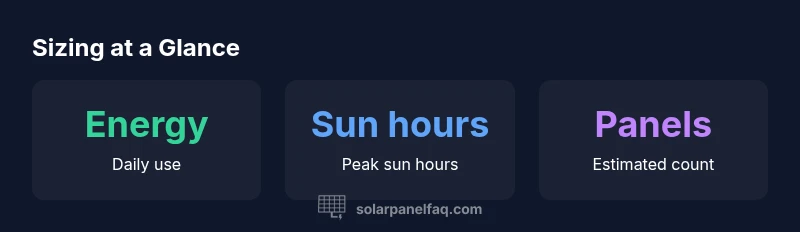
- Estimate daily energy use (kWh) by reviewing your last 12 months of electric bills and calculating a daily average. 2) Find your location’s peak sun hours, which determines how much energy a panel produces on a sunny day. 3) Use a simple formula to estimate panels: PanelsNeeded = dailyUsageKWh / (sunHoursPerDay * (panelWattage / 1000)). 4) Round up to whole panels and add a safety margin for losses (temperature, soiling, and wiring). 5) Validate with a local installer who can factor local conditions, shading, and inverter sizing. 6) Reassess after installation to confirm performance aligns with expectations.
Estimating rooftop space and panel counts
Each panel has a footprint that defines how much roof area is required. A typical residential panel ranges from about 17 to 21 square feet, depending on make and model. Multiply the number of panels by the footprint to estimate total roof space needed, then compare against your available area. Don’t forget about clearance for maintenance, racking, and shading from nearby trees. If space is tight, higher-efficiency panels can reduce the number needed, while longer rows may require extended racking. Always consider slope, orientation, and potential shading from chimneys or vents.
Example scenarios: small, medium, and large homes
- Small home: A compact residence with modest energy use may require a handful of panels, optimized for south-facing exposure and minimal shading. It’s common to prioritize efficient modules to maximize output per area.
- Medium home: A typical suburban house often falls into a mid-sized array category, balancing roof space, cost, and performance. A well-planned layout can cover a significant portion of daytime electricity.
- Large home: For bigger households with high energy demand, a larger solar array is common, potentially paired with storage for resilience. In all cases, a professional assessment helps tailor panel counts to roof geometry, shading, and utility rules.
Financial considerations: cost, incentives, and payback (qualitative)
Costs and incentives vary widely by location and system design. While this guide does not quote specific prices, it highlights that upfront costs are influenced by panel type, installation labor, inverter choice, and any storage added. Incentives, rebates, and favorable net metering policies can substantially affect overall economics. When evaluating a system, consider long-term value: potential energy savings, maintenance needs, and the system's expected lifespan. Solar Panel FAQ analysis emphasizes aligning system size with goals and local conditions to avoid oversizing or under-sizing.
Real-world tips to optimize installation
- Orient roofs toward the optimal direction for your latitude; minimize shading from trees and chimneys.
- Choose high-quality, durable panels with good warranties and performance.
- Plan for future load growth (new appliances, electric vehicle charger) and potential storage needs.
- Get multiple quotes to compare equipment, warranties, and service levels.
- Use a reputable installer who can provide a detailed production estimate and performance guarantees.
Common mistakes to avoid
Avoid over-reliance on a single assumption about sun hours or bills. Don’t underestimate maintenance, like cleaning panels or clearing shade. Rushed design without a professional assessment can lead to underperformance or grid-tie issues. Finally, skimping on warranties or omitting monitoring systems can reduce long-term value. The best practice is a conservative sizing approach with an installer who offers transparent performance modeling.
Maintenance and warranty considerations
A well-maintained system preserves performance and longevity. Routine cleaning, inverter checks, and panel inspections help sustain output. Warranty terms vary by manufacturer and installer, so review coverage for panels, inverters, and mounting hardware. The Solar Panel FAQ team recommends selecting equipment with solid warranties and ensuring your installer provides ongoing monitoring and service options. Keeping your system up to date with local codes and safety standards protects your investment.