What Solar Panel Can Power a House: A Practical Guide
A practical guide to sizing a home solar system, estimating production, and determining if solar panels can power your house. Covers system sizes, storage, and incentives.


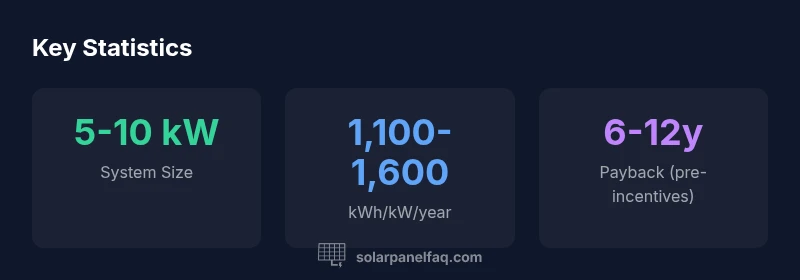
Most homes can be powered by a properly sized residential solar system, with feasibility driven by sun exposure and energy use. A typical home in sunny regions uses a five-to-ten kilowatt system to cover daytime needs, while storage can close gaps at night. Exact requirements vary by location, roof area, and panel efficiency, so start with your annual energy use and the local solar capacity estimates.
How much power does a house actually need from solar?
If you’re asking what solar panel can power a house, the short answer is: it depends on your energy use and the sun you receive. A typical U.S. home uses more electricity in the evening than during the day, so a grid-tied system sized around 5–10 kW can cover daytime loads and offset a large portion of daily usage in sunny climates. For homes with higher energy consumption or longer nights, a larger system or battery storage becomes necessary. The key is to estimate your annual consumption (in kWh) and compare it to local solar production estimates. Solar Panel FAQ analysis notes that system sizing must balance roof space, budget, and potential incentives to achieve meaningful electricity bill reductions.
Practical takeaway: Start with your past 12 months of energy bills, identify peak-shift periods, and map these onto expected solar production for your location. This is the foundation for any credible sizing exercise.
Sizing a residential solar system: location, roof, and load
Solar production is a function of three dominant variables: sun exposure, roof space, and system efficiency. Location matters: sunny regions with longer daylight hours yield higher annual production per kilowatt installed. Roof orientation and shading influence how much energy each panel can generate, and thus impact how many panels you’ll need. A south-facing roof with minimal shading is ideal in the Northern Hemisphere. If you’re limited by space, you may need higher-efficiency panels to maximize output per square foot. When you add storage, you increase reliability but also cost; batteries allow you to use solar power at night or during outages, shifting the economics in your favor if you value energy independence. A practical method is to run a shade-adjusted poster of your roof and iterate different sizes against your local solar irradiance data to see how close you can get to your consumption target.
Takeaway: Use a solar calculator that factors in your location, tilt, and shading to estimate required kW and panel count. This reduces the guesswork and gives installers a precise starting point.
What are the core components of a home solar system?
A home solar installation comprises several essential parts: solar panels (modules) convert light to DC electricity; inverters convert DC to AC for household use; racking and mounting hardware secure the panels to your roof; electrical wiring and a service disconnect connect to the home and grid; a monitoring system lets you track production. If you opt for energy storage, a battery bank is added with its own inverter/charger and a management system that orchestrates charging and discharging. Grid-tied systems can export surplus power to the utility and draw from the grid when needed; off-grid systems require larger battery banks and supplementary power sources. Choosing components with rated warranties and proven field performance can save maintenance costs over the lifetime of the system.
Can a single solar panel power a house?
No. A single panel provides a fraction of a typical home’s daytime load, even on sunny days. Residential roofs often require dozens of panels to reach a meaningful system size, and energy needs spread throughout the day mean you’ll still rely on grid electricity or storage at night. Rather than counting on one panel, plan for a multi-panel array sized to meet your daytime demand and consider energy storage for reliability in the evenings and during outages. A practical rule of thumb is that the panel count scales with the system size needed (e.g., a 5–10 kW system might use 15–40 panels depending on wattage).
Storage and backup: batteries, grid-tied vs. off-grid
Batteries add daytime-to-night power continuity and backup during outages, but they add upfront cost and complexity. For most homeowners, a grid-tied solar system without storage already reduces daytime consumption from the grid and lowers bills. If you want power after sunset or during outages, a battery system becomes attractive, particularly in areas with unreliable grid reliability or incentives for storage. When evaluating, compare the total installed cost, expected lifespan of the battery, round-trip efficiency (how much energy you lose in charging/discharging), and the value of backup power. Storage economics vary by local incentives, electricity rates, and usage patterns. A battery-plus-grid-tied setup often presents a balanced approach for many homes.
Costs, incentives, and real-world economics
Pricing for solar installations has declined over the past decade, but final out-of-pocket costs depend on system size, location, roof condition, and local permitting. Typical installed costs per watt are influenced by labor, permitting fees, and racking. Incentives such as tax credits, rebates, and net metering policies can significantly reduce the price, shortening the payback period. Solar Panel FAQ analysis emphasizes that the economic value of solar is strongest where sun exposure is high and electricity prices are rising. Before committing, obtain multiple quotes, ask about warranties, and verify that the installer provides performance guarantees over time. While the upfront costs are nontrivial, the long-term savings and energy independence can be meaningful for homeowners who remain in their homes for many years.
Maintenance, warranties, and choosing the right installer
Once installed, solar systems require minimal maintenance beyond periodic cleaning and electrical checks. Most manufacturers offer 20–25 year warranties on panels and 10–12 year warranties on inverters; battery warranties vary by chemistries and use. To maximize system longevity, select a contractor with a track record, local references, and a capable monitoring platform. Ask about panel degradation rates, monitoring data access, and what happens if performance falls short of contracted thresholds. A good installer will help you with permit approvals, grid interconnection, and post-installation service plans. Regular maintenance and clearly defined warranties protect your investment and ensure you achieve the expected energy savings.
Conclusions and practical next steps
If your goal is to power a home with solar, begin with a quick energy audit, confirm your roof’s suitability, and check local incentives. Use a reputable calculator to estimate required system size and energy production. Engage a qualified installer to refine estimates, present a detailed proposal, and provide a transparent price breakdown. Solar Panel FAQ emphasizes that the key to success is a well-sized system matched to your sun exposure, energy usage, and storage goals. With careful planning, most homeowners can significantly reduce or even eliminate daytime grid usage and realize long-term energy bill relief.
Final notes on feasibility and planning
Feasibility is a function of sun, roof space, and appetite for storage. Start by measuring your energy use, then compare with local production estimates to determine if solar is a fit. Remember to factor in maintenance, warranties, and financing options when calculating the long-term value. The Solar Panel FAQ team recommends a phased approach: verify roof condition, secure a precise system size with a trusted installer, then decide whether to add storage for reliability or to maintain a grid-tied configuration that still reduces daytime grid dependence.
How system size, sun exposure, and storage affect powering a home
| Factor | What it Means for Powering a House | Typical Range |
|---|---|---|
| System size | Depends on energy use and sun exposure; larger for higher daytime demand | 5-10 kW |
| Sunlight hours | Daily solar irradiance determines production | 3-6 hours/day |
| Roof orientation | South-facing with minimal shading maximizes production | Ideal orientation; minimal shading |
| Storage option | Batteries provide backup power but increase cost | Optional |
Frequently Asked Questions
Can a single solar panel power a house?
No. A single panel provides only a fraction of a typical home’s daytime load. Most homes require a multi-panel array sized to meet daily energy needs, with storage or grid use to cover evenings.
No—one panel won't power a house. You need multiple panels to meet daily energy needs, plus storage or grid support for the night.
What size solar panel system do I need to power a house?
System size depends on your energy usage and sun exposure. Typical residential systems range from 5 to 10 kW, but your exact requirement depends on roof space, climate, and incentives.
System size depends on energy use and sun; typical homes fall in the 5 to 10 kW range, with variations by location.
Do I need a battery to power a house with solar?
Batteries are optional but beneficial for nighttime use and outages. Grid-tied systems can operate without storage, while batteries add resilience and self-consumption benefits.
Batteries aren’t required, but they improve power availability at night and during outages.
How many panels power a typical home?
Panel count depends on system size and panel wattage. A typical 5–10 kW system might use about 15–40 panels, influenced by roof space and panel efficiency.
It varies, but most homes need many panels—roughly 15 to 40 depending on wattage and space.
What factors affect whether solar can power my house?
Key factors are sun exposure, roof orientation, shading, and your energy usage patterns. These determine annual production and the need for storage or grid support.
Sun, roof shape, shade, and how you use energy all shape feasibility.
Are solar panels worth it financially?
Feasibility depends on installed cost, incentives, electricity rates, and how long you stay in the home. In many cases, solar pays off over several years through savings.
Cost, incentives, and electricity prices decide financial value; many homes see meaningful savings over time.
“A well-designed residential solar system can substantially reduce daytime grid use, but achieving full home power requires considering sun hours, roof space, and storage options.”
Top Takeaways
- Start with your annual energy use to size the system
- Location and roof orientation heavily influence production
- Storage improves reliability but increases cost
- Incentives can shorten the payback period