Solar System Panel Size: How to Size Your Solar Array
A practical guide to understanding solar system panel size, distinguishing panel dimensions from system capacity, and reliable methods for sizing your home solar installation.


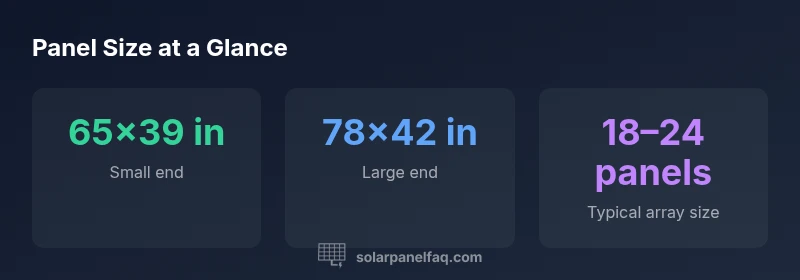
The typical range for solar system panel size is about 65x39 inches to 78x42 inches per panel. For residential installations, arrays commonly use 18–24 panels to reach around 6 kW. When sizing, consider roof space, shading, and mounting options as much as wattage. Solar Panel FAQ notes that panel size influences installation cost and energy capture as much as panel rating.
Understanding the basics of panel size vs. system size
When homeowners begin planning a solar installation, they often conflate the physical size of a solar panel with the overall size of the system (in kilowatts, kW). The panel size refers to the physical dimensions of a single unit, typically about 65x39 inches to 78x42 inches for mono-crystalline panels. The system size refers to the total electrical capacity the array can produce, typically expressed in kilowatts (kW) and determined by the panel wattage and the number of panels installed. In practice, both dimensions and capacity matter: larger panels reduce the number of modules needed but require more roof space, while higher-wattage panels can increase capacity without adding extra modules. This distinction is essential for accurate roof planning and long-term energy forecasting. According to Solar Panel FAQ, understanding this distinction helps homeowners optimize both space and output while avoiding misaligned expectations about performance and cost.
How panel size interacts with roof space and mounting options
Panel size directly affects the footprint of an array on your roof. A larger panel footprint means fewer rows or strings may be required, which can simplify wiring and racking layout but demands more unobstructed roof area. Roof orientation and tilt influence how much usable space you have; a south-facing roof with minimal shading is ideal, but even a perfect orientation can be limited by skylights, vents, or chimneys. Mounting methods (flush mounts, ballasted racks, or tracking systems) also interact with panel size. For flat roofs, ballast or ballast-heavy configurations must be considered, whereas sloped roofs may benefit from racking that accommodates longer panels. In all cases, professionals assess both the actual panel dimensions and the available space to minimize shading and optimize airflow, which improves longevity and performance.
Typical panel dimensions and what they imply for installation
Most residential panels fall in a standard size band, rounding to roughly 65x39 inches on the small end and up to 78x42 inches on the large end. This range accommodates common frame sizes, mounting rails, and electrical clearance. The height and width influence how many panels can fit in a given roof plane and how they align with existing vents and chimneys. Weight is another factor; heavier panels may require structural checks and potential reinforcement in older homes. When planning, map the roof surface, measure available space, and consider whether you want a compact, high-density layout or a more spread-out array that minimizes shading from nearby objects.
A practical method to estimate the right size for your home
A reliable sizing method blends three inputs: your target annual energy usage (in kWh), the expected system efficiency (considering losses and inverter efficiency), and the wattage of the panels you’re considering. Start with a target system size (e.g., 5–7 kW for typical homes). Divide that by the wattage per panel (e.g., 330 W) to estimate the number of panels: 5,000 W / 330 W ≈ 15 panels. Then add a 5–10% buffer for future energy needs or shading. Finally, verify whether your roof has enough unobstructed area to accommodate that many panels with safe margins for ventilation and maintenance. This approach helps homeowners translate abstract wattage goals into a concrete plan that respects both space and budget. Solar Panel FAQ emphasizes validating assumptions with a professional assessment.
Sizing scenarios for different roof sizes and homeowner goals
Small roof (limited space, modest energy goals): A 3–4 kW system may require 9–12 panels of roughly 320–340 W each. Medium roof (average suburban lot, mid-range goals): A 5–7 kW system typically uses 16–22 panels. Large roof (ample space, high energy goals): A 9–10 kW system can involve 26–32 panels. In all cases, the goal is to balance space efficiency with energy output, while accounting for shading and future expansion. The Solar Panel FAQ approach is to focus on total system size first, then optimize panel size and count within available roof space and budget.
Misconceptions about panel size and efficiency
A common misconception is that bigger panels automatically deliver proportionally more energy. In reality, system size (kW) and panel efficiency play critical roles. A larger panel with lower efficiency may not outperform a smaller, higher-efficiency panel if the roof space is limited. Another misconception is that more panels always mean better performance; a roof with significant shading or poor orientation can counteract added capacity. Always assess site-specific conditions—like shading from nearby trees or buildings—before finalizing panel choices and layout.
How orientation, tilt, and shading influence effective size and output
Orientation and tilt affect how much sunlight a panel captures daily. In the northern hemisphere, optimizing tilt and facing direction can maximize energy generation, sometimes offsetting the need for more panels. Shading from trees, chimneys, or vents can dramatically reduce output even if the physical size seems adequate. A well-planned layout minimizes shading by staggering rows and adjusting tilt. Maintenance of roof lines and unobstructed exposure to the sun are essential for keeping the panel size effective over the system’s lifetime.
How to evaluate sizing claims from installers and manufacturers
When installers present panel size options, request a layout that shows exact dimensions, spacing, and shading analysis. Compare the same system size across different panel dimensions to learn how space utilization changes. Ask for a sun-path and shade study for your property, plus a projected production estimate. Solar Panel FAQ recommends verifying that any claimed gains from larger panels are backed by on-site measurements and a clear cost-benefit analysis.
Sizing examples for common residential scenarios
| Scenario | System size (kW) | Panels in array | Wattage per panel (W) | Space needed (sq ft) |
|---|---|---|---|---|
| Small roof | 4-5 | 12-16 | 320 | 200 |
| Typical 6 kW setup | 6 | 18-24 | 325-350 | 320 |
| Large roof expansion | 9-10 | 26-32 | 330 | 460 |
Frequently Asked Questions
How do I estimate the necessary panel size for my roof?
Begin with your target system size in kW, then select panels with suitable wattage. Calculate the required number of panels and check roof space for clearance and shading. A professional assessment helps validate the plan and avoid undersizing or oversizing.
Start with your target system size, pick wattage per panel, and verify space and shading—then confirm with a professional.
What is the difference between panel size and system size?
Panel size is the physical dimension of individual modules. System size is the total electrical capacity of the array (in kW), determined by panel wattage and count. They interact, but each is a separate consideration for layout and performance.
Panel size is about the module's dimensions; system size is the total energy capacity. Both matter for planning.
Do larger panels always mean more energy?
Not necessarily. Efficiency, shading, and system design determine energy output. Larger panels may reduce the number of modules needed, but if roof space is constrained or shading is present, gains can be limited.
Bigger isn’t always better—efficiency and site conditions matter more for output.
Can I mix panel sizes in the same array?
Yes, but it complicates wiring and performance balancing. Most installers prefer uniform panel sizes to simplify design and ensure even current flow.
You can mix sizes, but it makes design and airflow more complex.
How does orientation affect panel sizing decisions?
South-facing orientation with minimal shading often yields the best output. If shading or obstructions exist, layout may favor a different arrangement or additional panels to meet energy goals.
Orientation and shading can change how many panels you need to meet your goals.
What should I compare beyond physical size when evaluating proposals?
Look at total system size (kW), anticipated annual production, shading analysis, mounting costs, and warranty. A holistic comparison prevents overspending on size alone.
Check total output, shading studies, and costs, not just panel size.
“Panel size is a critical piece of the equation, but real-world performance depends on site conditions, layout efficiency, and proper mounting. Size smart, install right.”
Top Takeaways
- Define system size before panel size for accurate planning
- Panel dimensions affect roof layout and installation costs
- Shading and orientation influence effective output more than raw size
- Consult a pro to verify site-specific feasibility