Solar Panel Size and Wattage: A Practical Guide
Learn how to determine the right solar panel size and wattage for your home. This step-by-step guide covers energy needs, sun exposure, roof space, and validation methods for a reliable, cost-effective solar setup.


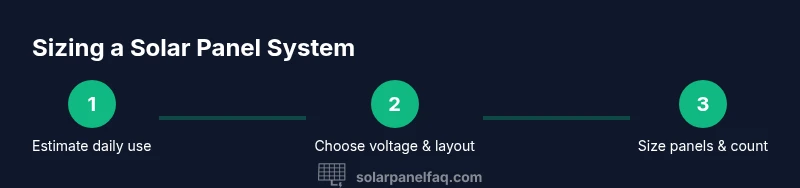
To size solar panel size and wattage, start by estimating your daily energy use, pick a target system voltage, calculate total wattage needed, and divide by a typical panel wattage to determine the number of panels. Account for losses and roof space, then validate with a sizing calculator or pro. According to Solar Panel FAQ, this approach helps homeowners plan a reliable, cost-effective system.
Understanding Solar Panel Size and Wattage
Solar panel size refers to the physical dimensions of the panel, while wattage indicates its power output under standard test conditions. In most residential systems, you balance panel wattage with roof space, energy goals, and system voltage. Higher wattage panels deliver more electricity per panel, but they also require more roof space and may be more expensive per watt. Solar Panel FAQ's guidance emphasizes starting with a clear energy target and a realistic space assessment. When you size a system, you’re aiming to meet your daily energy needs while allowing for system losses, shading, and future growth. The relationship is not one-to-one: a larger panel might not yield proportionally more energy if it sits in shade or faces poor orientation. Sizing is a balancing act between performance, cost, and space, guided by local sun exposure and inverter compatibility. This section sets the stage for practical calculations that homeowners can perform with common tools.
How Wattage and Panel Size Relate to Your Home
Wattage ratings describe how much power a panel can produce under ideal conditions. The total system size is the sum of all panel wattages in your array, but the actual energy you harvest depends on roof space, orientation, shading, and temperature. In residential settings, you’ll often compare panels in the same wattage class (for example, around 320–430 watts per panel) to fit your available rooftop area. The goal is to reach the desired daily output without oversizing beyond what your roof and budget can handle. Remember that performance degrades with shade and heat, so layout and placement matter as much as the panel spec. Solar Panel FAQ analysis emphasizes using real-site constraints—sun hours, roof geometry, and budget—when selecting panel wattage and number of modules.
Step 1: Estimate Your Daily Energy Use
Begin by collecting your electricity usage data from past bills. Calculate the average daily energy consumption in kilowatt-hours (kWh). If you have seasonal variation, consider the higher month as a planning benchmark. This step anchors everything that follows: once you know how much energy you need daily, you can translate that into a target system size. Keep in mind that your calculation should account for typical household changes and possible future expansions. The goal is a practical target that balances comfort, cost, and return on investment.
Step 2: Select Inverter Voltage and Configuration
Your inverter or charge controller determines the practical system voltage. Common residential setups use configurations that optimize efficiency and wiring practicality. A higher system voltage reduces current, which can lower conductor losses and make longer wiring runs more manageable. Decide whether to design for a string (series) arrangement, parallel strings, or a mixed approach based on roof space, shading patterns, and the inverter’s input limits. This choice affects how many panels you can safely connect in a single circuit and how you wire them for safety and performance.
Step 3: Calculate Total System Wattage
With daily energy use and sun exposure in hand, estimate the total system wattage you need. A simple approach is to express daily energy as daily watt-hours, then divide by the average sun-hours per day for your location. Apply a derating factor to reflect real-world losses from wiring, temperature, and soiling. The formula becomes: Total System Wattage ≈ (Daily kWh × 1000) ÷ (Sun Hours × Derate). This yields a target wattage that you must realize with the panel count and wattage choices you make next.
Step 4: Pick Panel Wattage and Determine Panel Count
Choose a common panel wattage within the typical residential range (for example, 320–400 watts per panel). Divide your total system wattage target by the panel wattage to estimate the number of panels. Round up to ensure you meet or exceed your energy goals, and add a small buffer for future growth and occasional underperformance. If roof space is limited, you might opt for higher-wattage panels and tighter spacing, keeping in mind heat and shading considerations. This step blends practical space planning with economics to hit your target.
Step 5: Plan Roof Layout and Orientation
The most productive layout minimizes shading and aligns with the sun’s path. Consider roof orientation, tilt angle, and seasonal sun exposure to maximize energy capture. If necessary, use microinverters or power optimizers to mitigate shading and partial shading across strings. A well-planned layout can improve performance without increasing the number of panels. Don’t overlook existing roof conditions, such as tiles or debris, that could affect installation and long-term maintenance. A thoughtful plan now reduces future service calls and performance loss.
Step 6: Account for Losses and Real-World Performance
No installation performs exactly as the nameplate suggests. Temperature, aging, soiling, and wiring losses reduce actual output. Apply a conservative derating factor, usually around 0.8–0.9, to reflect these realities. Temperature coefficients mean higher panel output on cool days and reduced output on very hot days. Plan for shading and potential panel mismatch, and consider a slightly larger system than the bare calculation to keep energy generation steady through the year. This foresight can prevent post-installation shortfalls.
Step 7: Validate Your Design With Tools or a Pro
Use online sizing calculators, or consult a qualified solar installer to sanity-check your math. A pro can confirm the wiring, voltage, and safety clearances and offer local insight on roof aging, snow load, and regulatory requirements. Validation reduces the risk of oversizing or undersizing the system and helps ensure you respect local incentives and permitting rules. Even a quick second opinion can catch issues your initial estimates might miss.
Step 8: Common Mistakes and How to Avoid Them
Avoid assuming a fixed number of panels without considering roof space and sun exposure. Don’t skip shading analysis or overlook temperature effects on performance. Resist mixing very different panel wattages in the same string without proper electrical planning. Finally, don’t ignore safety: working on a roof or near electrical components requires protection and proper procedures. With careful planning, you’ll end up with a reliable, efficient solar setup that meets your needs today and can scale in the future.
Tools & Materials
- Solar energy use worksheet or energy calculator(Have your last 12 months of electric bills or a monthly average estimate.)
- Measuring tape(For estimating roof area and panel placement.)
- Safety gear (gloves, safety glasses)(Basic safety before roof work.)
- Digital multimeter(Check wiring and voltage if testing existing wiring.)
- Pencil and notebook or digital note device(Record calculations and assumptions.)
- Sun hours data or solar resource map(Location-based sun exposure guide for planning.)
Steps
Estimated time: 1-2 hours
- 1
Estimate Your Daily Energy Use
Gather past electric bills and calculate the average daily kWh. If seasonal variation exists, identify the higher month for planning. This step anchors the sizing by showing how much energy your system must reliably produce each day.
Tip: Use twelve consecutive months to smooth out seasonal swings; document your assumptions. - 2
Choose an Inverter Voltage and Configuration
Decide whether your system will operate in a higher or lower voltage configuration based on inverter options and wiring practicality. Higher voltage reduces current and can simplify long runs, but you must match inverter inputs and safety clearances.
Tip: Consult your inverter’s max input and consider future expansion when selecting voltage. - 3
Calculate Total System Wattage
Convert daily energy needs into a target wattage using sun-hours for your location and a conservative loss factor. This forms the ceiling for the total panel wattage your array must achieve.
Tip: Use a derating factor to reflect real-world losses; this helps avoid under-sizing. - 4
Pick Panel Wattage and Determine Panel Count
Select panel wattages from the common residential range and divide your total target wattage by the panel wattage. Round up to ensure energy goals are met, and account for space and future growth.
Tip: Higher wattage panels may reduce roof clutter but can require improved mounting hardware. - 5
Plan Roof Layout and Orientation
Map out panel placement to minimize shading and optimize sun exposure. Consider orientation, tilt, and potential use of microinverters or optimizers for shaded areas.
Tip: Run a shade analysis across seasons to identify problematic spots. - 6
Account for Losses and Real-World Performance
Apply factors for temperature, aging, soiling, and wiring. Plan for performance drift over time and design a modest reserve in capacity.
Tip: Schedule periodic cleaning and inspection to maintain efficiency. - 7
Validate Your Design With a Calculator or Pro
Cross-check your results with a sizing calculator or a licensed installer. A professional review confirms wiring, safety, and permit readiness.
Tip: Ask for a breakdown of assumptions and a schematic of the planned wiring. - 8
Document Assumptions and Next Steps
Write down all calculations, assumptions, and chosen components so future work or upgrades are straightforward. This creates a reference you can revisit when your energy needs change.
Tip: Keep digital copies of all plans and receipts for warranties and incentives.
Frequently Asked Questions
What is the difference between panel size and wattage?
Panel size refers to physical dimensions, while wattage indicates output power. Size affects fit on your roof, while wattage determines how much energy a panel can produce. Both factors together inform system capacity and layout.
Panel size is the physical footprint; wattage is energy output. Both matter for fit and energy goals.
How many panels do I need for a typical home?
There is no one-size-fits-all answer. The number depends on your daily energy use, roof space, and sun exposure. A sizing calculation or professional assessment provides a realistic panel count.
The number varies with energy needs and roof space; get a sizing estimate for your home.
Does roof orientation impact wattage output?
Yes. Orientation toward the sun and the tilt angle influence how much energy your panels generate. Proper orientation minimizes shading and maximizes performance.
Orientation matters a lot for output; aim for optimal sun exposure.
What is a derating factor and why is it used?
A derating factor accounts for real-world losses from wiring, temperature, and aging. It helps create a more realistic size target so the system meets energy goals.
Derating accounts for losses so your system actually meets energy goals.
Is a higher system voltage better for a home installation?
Higher system voltage can reduce current, lowering wire sizes and losses. However, it requires compatible inverters and safer handling—plan with a professional.
Higher voltage can help with efficiency, but requires proper equipment.
Watch Video
Top Takeaways
- Define energy goals before choosing panels
- Panel wattage and count must align with roof space
- Account for losses and real-world performance
- Validate design with calculators or professionals
- Plan for future growth and maintenance