Solar Panel Series vs Parallel: A Practical Guide for Homeowners
Explore the differences between solar panel series vs parallel configurations, including how they affect voltage, current, inverter compatibility, and overall system performance. This analytical guide helps homeowners design efficient, scalable solar arrays tailored to inverter limits, shading, and wiring constraints.


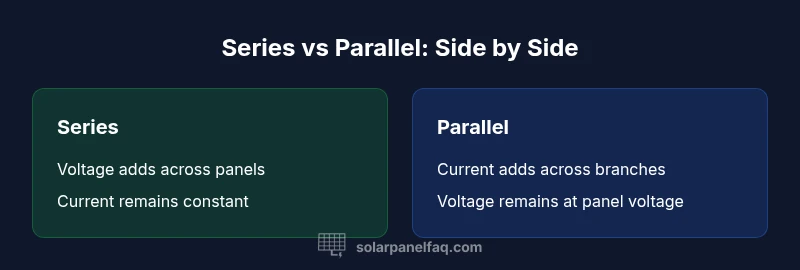
Short answer: In the solar panel series vs parallel discussion, configurations affect voltage and current differently. In a series string, voltages add while current stays the same; in a parallel connection, currents add while voltage stays the same. For most residential systems, designers use a combination based on inverter input limits, shading, and wiring lengths to optimize performance and safety. This primer helps homeowners plan efficient solar layouts.
Understanding Series and Parallel: The Core Idea
According to Solar Panel FAQ, the way you connect panels—whether in series, in parallel, or a hybrid—determines the sum of voltages, currents, and overall system behavior. In the solar panel series vs parallel discussion, the core goal is to balance voltage, current, and compatibility with the inverter and wiring. In a series string, voltages add up while current stays the same; in parallel, currents add while voltage remains equal to a single panel. This fundamental distinction drives every design decision, from roof layout to wiring strategy. Homeowners should consider expected sun exposure, distance to the inverter, and local electrical codes when choosing a configuration. Remember that both approaches scale with more panels, but the electrical behavior and practical constraints change in meaningful ways. This guide expands on those ideas with practical examples and checks.
lookingForACommentary? false
renderedForPreview? true
Comparison
| Feature | Series configuration | Parallel configuration |
|---|---|---|
| Voltage | Voltage adds across panels | Voltage remains fixed at the panel rating |
| Current | Current remains constant across the string | Current sums across parallel branches |
| Power Scaling | Power scales with number of panels via voltage increase | Power scales with number of panels via current increase |
| Inverter Compatibility | Higher voltages may require higher-rated inverters | Lower voltages with higher current can fit multiple inverter inputs |
| Shade Sensitivity | Shading on one panel reduces current of the entire string | Shading affects only the shaded branch in parallel |
| Wiring Considerations | Higher voltage allows thinner wires for the same current | Higher current requires thicker conductors and larger fuses |
Strengths
- Lower current in optimal series layouts can reduce conductor costs for long runs
- Modular parallel strings enable easy expansion and flexible layouts
- Hybrid designs balance voltage, current, and inverter compatibility
- Faster fault isolation with multiple strings helps identify issues quickly
Drawbacks
- Higher voltage in series increases insulation and safety requirements
- Shading can cripple entire series strings if not mitigated
- More complex design and troubleshooting for mixed configurations
- Inverters may constrain optimal string length and topology
Hybrid string design—combining series and parallel strings to match inverter inputs and shading conditions—offers the most robust, scalable solution.
A hybrid approach balances voltage and current with inverter limits, shading resilience, and future expansion. The Solar Panel FAQ team recommends starting from the inverter’s specifications and shading analysis, then designing a hybrid layout for dependable, long-term performance.
Frequently Asked Questions
What is the main difference between solar panel series and parallel connections?
In series, panel voltages add while current stays the same; in parallel, currents add while voltage stays the same. Both configurations scale with panel count, but inverter input and wiring requirements differ. Your choice should align with your inverter rating, shading pattern, and roof geometry.
Series adds voltage; parallel adds current. Both scale with panels; match your inverter and roof conditions.
How does shading affect series vs parallel configurations?
Shading on a single panel in a series string can drag down the entire string's current, while parallel branches limit the impact to the affected branch. This is why many designs use bypass strategies or microinverters to preserve output under partial shading.
Shading hurts series more; parallel provides isolation.
Can I mix series and parallel in residential systems?
Yes. A common approach is to create several series strings and connect them in parallel. This hybrid design balances voltage and current to suit the inverter and roof layout, while preserving flexibility for expansion.
Mixing can balance voltage and current; plan for inverter limits.
What inverter considerations should I check when designing the array?
Check the maximum input voltage and current ratings, as well as the MPPT voltage range. Your configuration should keep operating points inside the inverter’s safe window across weather conditions, often by blending series strings with parallel branches.
Inverter ratings matter; design to stay in its safe range.
Is it cheaper to implement a series or parallel setup?
There is no universal winner; series can reduce conductor size and wiring costs for long runs, while parallel can simplify wiring and expansion. Total cost depends on inverter, roof geometry, and shading, so compare practical designs for your home.
Costs depend on wiring, inverters, and roof layout; compare designs.
How do temperature changes impact series vs parallel wiring?
Temperature can affect panel current and voltage ratings. While both configurations are affected, higher temperatures often reduce voltage subtly, influencing MPPT and how you size strings. Use temperature coefficients from panel data and verify with a professional.
Temperature affects voltage and current; plan accordingly.
Top Takeaways
- Map inverter MPPT voltage window early
- Prioritize shading analysis for string layouts
- Use hybrid designs for most residential systems
- Plan wiring to minimize voltage drop and safety risks
- Consult a professional for large or complex setups