How to Put Solar Panels in Parallel
Learn how to connect solar panels in parallel safely. This guide covers concepts, safety, step-by-step wiring, and common mistakes to help homeowners expand solar capacity without changing system voltage.


You can put solar panels in parallel to increase current while keeping system voltage the same. According to Solar Panel FAQ, parallel wiring is ideal for expanding capacity when panels have matched voltages. You’ll need identical or closely matched panels, a properly rated combiner, correct gauge conductors, and overcurrent protection, plus careful adherence to electrical codes and safe installation practices.
What parallel wiring means for solar panels
When you learn how to put solar panels in parallel, you wire the panels so that each panel shares the same voltage, while the currents add up. The practical effect is higher available current without increasing the voltage that enters the charge controller or inverter. Parallel connections are common when you want to increase system capacity without reconfiguring your whole array, or when you’re integrating new panels with older ones that already produce the same voltage. A key rule is to use panels with very similar electrical characteristics to minimize mismatches that can waste energy through unequal current sharing. In most residential setups, parallel strings are connected through a combiner box and then fed through a DC disconnect before reaching the inverter. It’s worth noting that while voltage remains constant in parallel, the overall current is determined by the number of panels and their current ratings. This means careful planning around conductor size and protection devices becomes essential to maintain safety and efficiency.
Electrical basics: voltage, current, and safety
In a parallel configuration, the voltage across each panel is the same. The total current equals the sum of each panel’s output current. This is straightforward in theory but practice requires attention to tolerances. Cold temperatures can increase a panel's voltage slightly, while shading or mismatch can cause one string to carry more current and heat up. A good mental model is to treat the array as multiple parallel branches feeding a common bus. Use Ohm’s law to estimate loads, but rely on manufacturer ratings for real values. When wiring, ensure all conductors, connectors, and devices are rated for the maximum DC voltage and current. Always wear PPE and work with power off when handling DC circuits. The goal is to minimize voltage drop along runs and prevent hot spots that reduce efficiency and shorten component life. Remember, anything that increases current can also increase conductor losses if wires are too small.
When to choose parallel vs series and matched voltages
Series wiring increases voltage, keeping current roughly constant; parallel wiring increases current, same voltage. For home PV, you usually pick parallel when your inverter/charge controller expects a certain voltage (e.g., 12V, 24V, or 48V) and you want to maximize current capacity. If you configure for series, you must match panels' voltage ratings and the system's voltage rating. Matching helps avoid power loss due to mismatch. In a practical home scenario, if you plan to expand capacity later or if you have multiple roof orientations, parallel is often simpler. Also consider shading: if one panel is shaded, in parallel the shaded panel reduces current of the whole string less drastically than in series.
Required components and wiring paths
To wire panels in parallel, you need several key components and a clear wiring pathway. Essential items include panels with closely matched electrical characteristics, a combiner box to merge positive and negative leads, a DC disconnect for safe de-energization, MC4 connectors or equivalent weatherproof connectors, and conductors rated for DC use with appropriate insulation. You’ll also want a reliable inverter or charge controller compatible with the resulting current and voltage, plus protective devices like fuses or breakers sized for the total current. Plan raceways or conduit runs that minimize excess length, reduce voltage drop, and simplify future maintenance. Label all conductors and keep a clean, organized layout to aid inspections and troubleshooting. Safety gear such as gloves and eye protection should always be used when handling live DC systems.
Step-by-step overview (high-level before detailed steps)
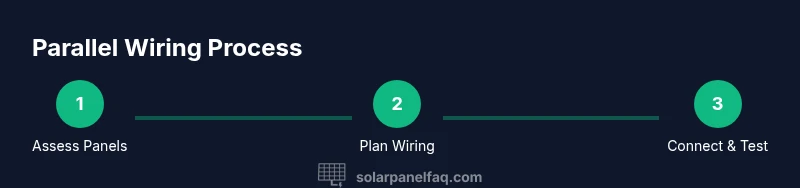
This section outlines the logical sequence of actions you’ll perform: assess panel voltages and compatibility, plan the parallel wiring layout, install protective components (fuse/disconnect), connect panels in parallel via proper connectors, test continuity and insulation resistance, and finally commission the system with monitoring. The goal is to ensure a safe, code-compliant installation that reliably increases current without changing the system voltage. Use the detailed step-by-step instructions to execute each action with care and precision.
Safety and code considerations you must follow
Solar installations involve DC power that can deliver dangerous current. Always disconnect power before handling conductors. Follow local electrical codes, including any permit requirements, check for utility interconnection rules, and abide by the National Electrical Code (NEC) or your local equivalent. Keep panels in good condition, avoid defective components, and ensure weatherproof enclosures and proper sealing to prevent moisture ingress. If you’re unsure about any step, consult a licensed electrician. Fire safety, arc protection, and proper overcurrent protection are critical for long-term reliability and homeowner safety.
Practical sizing: conductors, fuses, and protection
Conductor sizing for parallel panels depends on the total current and run distance. Choose conductors that can safely carry the aggregated current with a margin for voltage drop and temperature. Place fuses or breakers close to the panels to interrupt fault currents quickly. Use a properly rated interrupting device on the DC side and ensure all terminations are secure and corrosion-free. Label every branch circuit and keep a wiring diagram accessible for future maintenance. Adhering to these practices minimizes energy losses and reduces the risk of overheating or electrical fires.
Common mistakes and how to avoid them
Avoid mismatched panels, which can force current to flow unevenly and reduce system performance. Don’t rely on high-voltage DC without proper PPE and insulation. Reuse of non-compliant connectors or damaged cables increases the risk of corrosion or arcing. Skipping a dedicated combiner box or DC disconnect complicates maintenance and enhances safety risks. Finally, never assume a parallel string can be treated like a single panel; always verify voltage and current sums with a multimeter before energizing.
Real-world scenario: two panels in parallel
Consider two nearly identical panels connected in parallel to a 12V nominal system. Each panel contributes its current, so the total current capacity doubles while the common voltage remains close to the panel rating. As long as both panels are in good condition and well-matched, the inverter or charge controller will draw the combined current without needing a higher voltage input. This simple case illustrates the principle: parallel wiring boosts current capacity while preserving voltage, enabling greater energy capture during peak sun conditions.
Troubleshooting checklist
If you notice reduced performance after installation, recheck panel voltages to confirm they’re matched. Inspect all connections for corrosion, looseness, or moisture ingress. Verify that fuses/breakers are correctly rated and that the combiner box is properly sealed. Use a multimeter to measure open-circuit voltage and short-circuit current on each panel to identify mismatches. Finally, consult your inverter/charger’s manual to ensure input parameters align with the parallel configuration.
Tools & Materials
- Matched solar panels (same or very similar ratings)(Avoid large mismatches; aim for similar Vmp and Voc ranges)
- Combiner box(Rated for DC operation and the total current)
- DC disconnect switch(Placed between the combiner and inverter/charge controller)
- MC4 or weatherproof connectors(Quality connectors to minimize resistance and leaks)
- DC-rated electrical conductors(Insulated copper wire, appropriately rated for DC use)
- Appropriate fuses or overcurrent protection(Sized for the total expected current and distance)
- Inverter or charge controller compatible with parallel current(Check input current rating and voltage range)
- Conduit, weatherproof enclosures, and mounting hardware(Protects wiring from the elements and ensures neat routing)
- Multimeter or solar clamp meter(For voltage, current, and continuity checks)
- Personal protective equipment (PPE)(Gloves, eye protection, and non-conductive tools)
Steps
Estimated time: 60-120 minutes
- 1
Assess panel voltages and match ratings
Compare Vmp, Voc, and Isc ratings of all panels. Ensure voltages are close enough to operate together and avoid significant mismatches. This step prevents inefficiencies and excessive current in one branch.
Tip: Use a trusted meter to record each panel’s open-circuit voltage and short-circuit current before connecting. - 2
Plan the parallel wiring layout
Sketch a layout showing how panel leads will route to the combiner box, from there to the DC disconnect, and finally to the inverter/charger. Minimize run length and ensure protection devices are positioned near the source.
Tip: Keep positive-to-positive and negative-to-negative traces as short as possible to reduce losses. - 3
Install combiner box and protect the array
Mount the combiner box in a weatherproof location. Install appropriate fuses or breakers close to the panel inputs. Verify the box has adequate rating for the total current.
Tip: Seal all knockouts and use grommets to prevent cable abrasion. - 4
Connect panels in parallel using weatherproof connectors
Connect all positives together and all negatives together inside the combiner. Ensure MC4 connectors seat securely and the polarity is correct on every branch.
Tip: Label each branch to simplify future maintenance and troubleshooting. - 5
Install DC disconnect and route to inverter/charger
Place the DC disconnect between the combiner and the inverter/charger. Route wires through conduit and keep the path orderly to ease inspection.
Tip: Do a low-voltage test before energizing to confirm proper polarity. - 6
Test continuity, insulation, and safety
With power off, check continuity across the joined conductors. Use a megohmmeter or insulation tester if available. Inspect for loose connections and verify proper grounding where required.
Tip: Document readings and compare against baseline values after commissioning. - 7
Commission and monitor performance
Power the system and monitor the current from each branch and the total output. Confirm that the inverter/charger reports expected input and there are no fault codes.
Tip: Install a monitoring device or software to track long-term performance.
Frequently Asked Questions
Can I mix different brands of panels in parallel?
Mixing different brands is not recommended because IV curves can differ, causing inefficiencies and uneven current sharing. Use panels with similar ratings when wiring in parallel.
Mixing brands in parallel is not recommended because the current may not share evenly, reducing overall efficiency.
Do I need a junction box or combiner box?
Yes. A combiner box helps organize multiple panel outputs, provides a centralized point for fusing, and makes inspection easier. Ensure it is rated for the total current.
Yes. A combiner box is recommended to safely merge panel outputs and protect the circuit.
What about DC disconnects?
A DC disconnect is recommended at the array for safety during maintenance and to quickly de-energize the system if needed.
Yes, a DC disconnect near the array is a smart safety step.
Can I run parallel panels on a 12V system?
Parallel increases current but keeps voltage at the panel rating; ensure your inverter/charge controller supports the higher current and that conductors are sized accordingly.
Parallel strings keep the same voltage and increase current; make sure your controller can handle it.
What size wires and fuses do I need?
Wiring depends on total current and run distance. Use conductor gauges and fuses rated for the combined current and length, following code guidance.
Choose the right wire size and fuse rating based on current and distance, following code guidance.
Is parallel wiring safe for beginners?
Parallel wiring can be safe for beginners if you follow safety rules, use proper PPE, and adhere to local codes. When in doubt, consult a licensed electrician.
Parallel wiring can be safe for beginners if you follow safety rules and codes, and consider professional help if unsure.
Watch Video
Top Takeaways
- Parallel wiring increases current while voltage stays constant
- Match panel ratings to avoid mismatches and heat buildup
- Use a properly rated combiner box and fuses for safety
- Follow local codes and document every connection
- Test thoroughly with a meter before energizing