Science Project Solar Panel Car: Build a Sun-Powered Vehicle
A comprehensive, step-by-step guide to the science project solar panel car, teaching energy conversion, circuitry basics, and iterative design using safe, beginner-friendly materials.


By the end, you will build a simple science project solar panel car that actually runs on sunlight. Gather a small solar panel, a lightweight chassis, a DC motor, and basic wiring, then assemble the system and run tests outdoors. This guide covers parts, wiring basics, safety considerations, and ways to iterate for better performance.
Overview: What is a science project solar panel car and why it matters
A science project solar panel car is a small, sun-powered vehicle designed to demonstrate how light can be converted into motion. Students and hobbyists use a compact solar panel to generate electricity that powers a motor connected to wheels. The goal is not peak speed but understanding energy conversion, basic circuitry, and the engineering process behind design decisions. The science project solar panel car makes abstract ideas like voltage, current, resistance, and torque tangible, especially when students measure how changes in sunlight, angle, and weight affect performance.
According to Solar Panel FAQ, hands-on projects like this bridge classroom theory and real-world energy concepts. You’ll learn to ask questions, form hypotheses, collect data, and iterate designs, all while staying safe and curious. This kind of project aligns with educational goals for middle- and high-school learners and can be scaled up or down depending on age and equipment.
Learning outcomes typically include: understanding how a solar cell converts light to electricity, grasping the basics of direct-drive versus geared systems, comparing different materials for weight and strength, and practicing careful testing and data logging. While the core idea is simple—sunlight powers a motor—the learning depth expands with experiments, documentation, and creative improvements.
If you’re new to solar technology, start with a minimal setup and a clear plan. Keep expectations modest: even a small solar panel can move a lightweight car slowly under bright sun. As you gain confidence, you can add features like a switch, a battery buffer, or a simple gearing layout to explore efficiency and power transfer. This project is as much about inquiry as it is about building a car.
For families and classrooms, documenting results with photos, sketches, and a short report helps reinforce the learning objectives and provides a neat record of progress. The science project solar panel car is a versatile entry point into electronics, physics, and engineering practices that remain accessible while still challenging.
Core components and materials
A well-organized hardware list keeps the build smooth and safe. For a basic science project solar panel car, you’ll want a compact solar panel, a small DC motor, a lightweight chassis, wheels with axles, basic wiring, and a simple mounting surface. Add optional items like a switch, a diode, or quick-connects to simplify testing and reduce risk. Keeping parts modular makes it easier to iterate and compare different configurations. The goal is to keep things light, simple, and repeatable so you can observe cause-and-effect when you adjust variables like light intensity or wheel friction.
A typical starter set includes:
- Small solar panel (compact, 0.5–2W)
- DC motor (3–6V)
- Lightweight chassis (wood, plastic, or foam)
- Wheels and axles (2–4 wheels)
- Wire pieces (22–24 AWG)
- Optional: on/off switch, diode for direction control, simple battery as a buffer for smooth operation
These components emphasize safety and accessibility. Use non-conductive fasteners and keep your wiring neat to avoid shorts. If you’re teaching kids, pre-cut and pre-strip wires, and supervise any soldering or crimping activities. The goal is to learn, not to build a high-speed race car, so focus on clean connections and documentation.
Safety considerations and best practices
Before you begin, set up a safe workspace away from water and heat sources. Work with supervision if children are involved. When wiring, unplug power sources before changing connections and avoid touching exposed conductors. Keep batteries and capacitors in a designated, cool area away from the vehicle while testing light-driven operation. Always start with a dry run to ensure parts fit properly and won’t detach under motion.
Best practices include labeling wires, testing continuity with a multimeter, and using insulated tools. A small, bright sun is a great test condition, but it’s also unpredictable; plan for shaded or cloudy conditions and note how performance changes. If a wheel binds or a motor overheats, pause, inspect connections, and adjust mounting tolerances. Safety is about preventing short circuits, loose components, and pinched wires that can cause accidents during demonstrations.
Build-and-test workflow: plan, build, test, and iterate
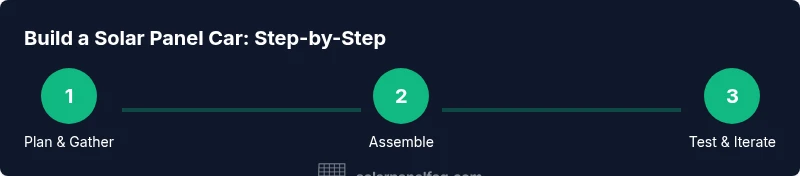
The build-and-test workflow emphasizes an iterative cycle: plan, build, test, observe, and revise. Start with a simple schematic showing how the solar panel connects directly to the motor or through a simple gear train. Then assemble the chassis, attach the wheels, and mount the motor in a stable position that minimizes vibration. After wiring the panel to the motor (with a switch for easy demonstrations), place the car in bright light and observe how it moves. Record what changes when you tilt the panel or adjust the wheel alignment.
A successful loop looks like this: hypothesize how a change will affect speed, implement the change, test under identical sunlight conditions, and compare results against the baseline. Keeping a data log helps students see patterns and justify improvements. You’ll practice critical thinking and measurement skills, which are valuable beyond the classroom.
Data collection and experimentation ideas
To turn the build into a science investigation, plan a few simple experiments. Vary the angle of the solar panel to find the maximum forward motion under consistent sunlight. Compare performance on a lightweight versus heavier chassis to examine the effect of weight on acceleration. Try direct-drive against a minimal gear setup to learn how drive systems influence torque and speed. Document each test with a short video or photo and a few measured observations, such as travel distance in a fixed time or how far the car travels before stalling.
Data collection ideas include:
- Time-to-distance measurements under direct sunlight
- Observations of motor noise, heat, and stall points
- Comparisons between shaded and full-sun conditions
- A simple graph of distance versus tilt angle or weight
These experiments help quantify learning and reveal how energy input translates into motion, a core concept of physics and engineering. Solar energy, electronics, and mechanics all come together in this small, hands-on project.
Extensions and real-world connections
Once you’ve mastered the basic build, you can extend the project with additional features to explore more advanced ideas. Add a lightweight battery as an energy buffer to smooth power delivery, or experiment with different motor and wheel combinations to study efficiency. Build a miniature track or obstacle course to challenge stability and steering concepts. Connect the project to a larger discussion about solar technology’s role in everyday life, such as charging devices or powering off-grid models.
Think about real-world questions: How does panel size influence output? How does temperature affect solar cell efficiency? What happens when a panel is not facing the sun directly? Document observations, compare results with peers, and present a short explanation of what you learned. This keeps the learning journey engaging and relevant to real solar applications.
Tools & Materials
- Small solar panel (compact, 0.5–2W)(Prefer panels with 5–6V output for direct motor drive.)
- DC motor (3–6V)(Choose a low-amp, high-torque motor for better performance.)
- Lightweight chassis (wood, plastic, or foam)(A simple flat base makes assembly easier.)
- Wheels and axles(4 wheels is stable; ensure smooth rotation.)
- Wire pieces (22–24 AWG)(Insulated ends; keep wiring neat.)
- On/off switch (optional)(Helpful for safe testing and demos.)
- Diode (optional for direction control)(Prevents reverse current from the motor back into panel.)
- Soldering iron or quick connects (optional)(Use under supervision.)
Steps
Estimated time: 3-5 hours
- 1
Plan the design
Decide how the solar panel will face the sun, choose direct-drive or simple gearing, and plan mounting locations for the panel and motor. Sketch a basic layout to visualize the setup before assembly.
Tip: Create a simple diagram with labeled parts to guide assembly. - 2
Prepare the chassis and wheels
Mount the base, attach axles, and ensure wheels spin freely without rubbing. Check that the center of gravity is balanced for stability during testing.
Tip: Spin each wheel by hand to confirm smooth rotation before wiring. - 3
Mount motor and drive connection
Secure the motor to the chassis and connect it to the wheels either directly or via a short gear train. Keep the motor aligned with the wheel axis to prevent binding.
Tip: Use lightweight mounting brackets and avoid over-tightening screws. - 4
Wire the solar panel to the motor
Connect the panel’s positive and negative leads to the motor circuit. Install a simple on/off switch to control power during demonstrations; keep wires neat and away from moving parts.
Tip: Keep leads short to minimize resistance and voltage drop. - 5
Test in sunlight and adjust
Place the car in bright light and observe motion. Adjust the panel angle and track alignment to maximize forward movement.
Tip: Experiment with 15–30 degree tilts to find the best exposure. - 6
Iterate and document
Record results, compare changes, and refine your design. Update your notes with what worked and what didn’t, then retest a refined version.
Tip: Take photos and write a quick log with dates and measurements.
Frequently Asked Questions
What is the basic principle behind a solar panel car?
A solar panel converts sunlight into electrical energy that powers a motor connected to wheels, turning light into motion. This demonstrates energy transfer and basic circuitry in a tangible way.
Solar panels turn light into electricity to run the motor and move the car.
Do I need a battery for a solar panel car?
For a simple demonstration, you can drive directly from the panel when sun is bright. A small rechargeable battery can smooth power under variable light conditions, but it adds complexity.
You can run it directly on the panel in bright sun; a small battery helps when light changes.
What materials are best for beginners?
Choose lightweight chassis materials, safe wiring, and simple metal-free fasteners. Avoid hazardous tools and use child-safe components. Supervision is recommended for younger learners.
Stick to safe plastics and wood; keep wiring simple.
How can I improve speed or efficiency?
Increase panel area, reduce weight, ensure direct drive where possible, and minimize wheel friction. Try different gear ratios and check for binding.
Lighten the car, use a bigger panel, and minimize drag.
How much sun does it need to run?
Direct sunlight provides the best power for the motor. Diffuse or cloudy conditions will reduce speed and may stall the car.
Bright sun gives the best results; indoors you’ll get slower motion.
Are there safety concerns I should know?
Work with supervision, avoid short circuits, and unplug wires when not testing. Keep the setup stable and away from small children’s reach.
Be careful with wires and hot components; keep the setup stable.
Watch Video
Top Takeaways
- Plan safely with supervision.
- Understand energy conversion from light to motion.
- Test under real sun to assess performance.
- Iterate designs to improve efficiency.