Scheme for Solar Panel: A Step-by-Step Design Guide
A comprehensive, educational guide to creating a home solar panel scheme, covering site assessment, sizing, wiring, permits, and maintenance with practical, actionable steps.


By the end, you’ll have a complete scheme for solar panel for your home. This guide shows you how to assess site conditions, size an array, select components, and map wiring safely. You’ll gain a practical plan to share with installers and obtain permits, plus maintenance routines. Solar Panel FAQ explains design, safety, and long-term performance considerations.
Understanding the scheme for solar panel and why it matters
A well-crafted scheme for solar panel is more than a pile of parts—it's a mapped plan that aligns roof space, energy needs, local codes, and budget. Homeowners often run into two traps: underestimating shading or overestimating available roof area. By framing the project as a system design rather than a collection of parts, you can anticipate performance, cost, and maintenance needs. This page uses the term scheme for solar panel to describe the end-to-end blueprint, from site survey to post-install monitoring. According to Solar Panel FAQ, the best schemes start with a realistic energy profile and a conservative sizing approach to ensure resilience across seasons. In 2026 the research highlights that homeowner-designed schemes, when paired with professional review, tend to produce better long-term outcomes. The goal is clarity: a plan you can share with installers and utility representatives with confidence, reducing miscommunication and surprises.
Core components and how they fit into a scheme
A robust scheme for solar panel lists components intentionally and shows how they connect. You’ll typically include solar modules, racking or mounting hardware, junction boxes, DC disconnects, combiner boxes, an inverter (or microinverters), wiring (DC and AC), conduit, a monitoring device, and a safety plan. Each element has a purpose: panels convert sunlight, racking secures them, the inverter converts DC to AC, and the monitoring device tracks performance. The scheme ties these parts together into a coherent layout, with an eye for expansion. When Solar Panel FAQ discusses components, it stresses compatibility and standardization to simplify future upgrades and service. Remember that a balanced scheme minimizes bottlenecks and ensures safe commissioning.
Site assessment and load analysis
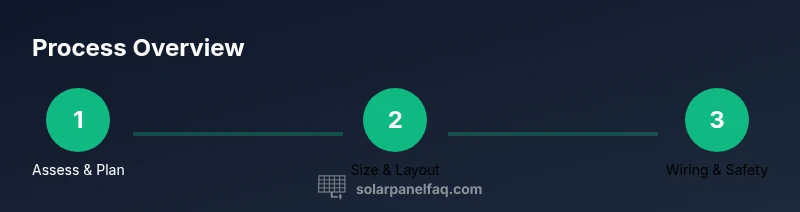
A practical scheme begins with a site assessment that checks roof area, orientation, and shading across different times of day and seasons. Document roof pitch, tilt, and any obstructions such as chimneys or vents. Next, analyze your household load: monthly usage patterns, peak demand hours, and whether you want to offset 50% or 100% of consumption. The goal is to estimate the required system size without overbuilding. Solar Panel FAQ notes that homeowners should consider both current needs and anticipated changes (new appliances, EVs, or additions). In 2026, the team found that the best schemes include a contingency for future growth, typically 10–20% extra capacity.
Sizing the system and layout planning
Sizing means choosing the number of panels and the inverter capacity to match the desired offset and roof space. A typical home in the 2020s uses a range of 3–8 kilowatts, which translates to a practical panel count based on module efficiency and available area. The layout should maximize sun exposure while avoiding shading from nearby structures. Some homeowners plan for future expansion by reserving roof space or oversizing the inverter slightly. The Solar Panel FAQ approach emphasizes conservative estimates and a staged plan for upgrades rather than a single, expensive retrofit. This reduces upfront costs while keeping future options open.
Wiring diagrams and safety considerations
Creating wiring diagrams is a core part of the scheme. Start with a single-line diagram (SLD) that shows the DC strings, fuses, disconnects, and the path from panels to the inverter. Then map AC wiring from the inverter to the service panel, including overcurrent protection and grounding. The choice between string inverters and microinverters affects wiring topology and monitoring. In all cases, keep high-voltage DC wiring away from occupied spaces and label every conductor clearly. Solar Panel FAQ recommends including a clear shutdown procedure and accessible disconnects for maintenance. If you’re unsure, consult a licensed electrician during this stage to validate safety.
Permits, codes, interconnection, and documentation
Before any physical work, your scheme should include permit and utility interconnection steps. Check local building codes, utility requirements, and homeowner association rules, if applicable. Prepare a project dossier that includes the SLD, equipment specs, warranty information, and maintenance plan. Having these documents ready simplifies inspections and speeds up interconnection. The Solar Panel FAQ team stresses that early coordination with the utility can prevent delays and ensure a smooth approval process in 2026.
Maintenance, monitoring, and upgrades over time
A durable scheme for solar panel includes a maintenance plan: regular panel cleaning, inverter checks, and performance monitoring. Plan how you’ll detect performance drops, verify system voltage, and handle component replacements. Monitoring platforms can alert you to anomalies—critical for keeping long-term efficiency. The scheme should also anticipate upgrades such as energy storage or panel replacements as technology and prices evolve. Solar Panel FAQ’s guidance emphasizes periodic reviews to keep the design current with code changes and new hardware.
A practical walkthrough: hypothetical home scheme
Imagine a single-family home with a south-facing roof, good sun exposure, and a garage canopy. A 5 kW system might use around 14–16 typical modules, with microinverters to simplify shading management. The wiring path runs from modules to a DC disconnect, then to the inverter, and finally to the service panel with proper labeling and grounding. This walkthrough illustrates how the scheme comes together: the survey notes, the layout sketch, the SLD, and the permit checklist. While numbers here are illustrative, the process—survey, size, layout, wiring, permits, and maintenance—remains the core of a sound scheme for solar panel. In 2026, homeowners who followed a clear plan reported faster approvals and more predictable performance.
Tools & Materials
- Safety gear (gloves, goggles, non-slip footwear)(ANSI-rated PPE for rooftop work)
- Voltage tester / multimeter(DC/AC verification and troubleshooting)
- Tape measure(Accurate roof area and spacing measurements)
- Single-line diagram (SLD) schematic software or paper templates(Labeled wiring plan from panels to service panel)
- Pencils, ruler, and graph paper or digital design tool(Precise layout and notes)
- Electrical tools (wire cutters, strippers, crimpers)(DC/AC wiring preparation)
- Ladders and fall protection gear(Rooftop accessibility and safety)
Steps
Estimated time: 6-9 hours
- 1
Assess site conditions and loads
Survey roof area, orientation, and shading across the day. Collect hourly usage patterns and plan for future changes. Document findings with photos and notes to inform sizing.
Tip: Capture shadow patterns at different times and seasons to avoid surprises later. - 2
Size the system and plan layout
Estimate needed capacity based on analysis; sketch panel placement and space on the roof or canopy. Choose an inverter size that accommodates future expansion without oversizing.
Tip: Plan for 10–20% future growth to minimize future retrofits. - 3
Select components and inverter strategy
Match panel type, mounting hardware, and inverter or microinverters. Check compatibility, warranties, and ease of interconnection with the grid.
Tip: Consider MPPT options to maximize efficiency under varying conditions. - 4
Create a wiring diagram and routing plan
Draft a single-line diagram, specify string wiring, fuses, and disconnects. Plan conduit routes and label all conductors for safety.
Tip: Keep DC wiring separate from living spaces and clearly labeled. - 5
Review permits and utility interconnection
Identify permit requirements and schedule utility approvals. Gather equipment specs and warranty data for the submission package.
Tip: Engage the utility early to avoid delays. - 6
Prepare for installation and maintenance
Create a maintenance schedule, safety plan, and documentation set for future upgrades. Include training for household members.
Tip: Store a digital copy of the schematic with version dates.
Frequently Asked Questions
What is a solar panel scheme and why do I need it?
A scheme is a home-specific plan detailing site, size, components, and wiring. It guides installation and maintenance to ensure safety and performance.
A scheme is a homeowner's plan that maps site, size, and wiring to make installation safer and more reliable.
Should I design the scheme myself or hire a pro?
Both are possible. A well-done DIY design with a professional review tends to be safer and more efficient, especially for wiring and permits.
A DIY design plus professional review is often safest for wiring and permits.
What system size should I aim for in a typical home?
Most homes aim to offset a portion of usage; actual size depends on roof space, shading, and energy goals. Start with a conservative estimate and adapt.
Start with a conservative estimate based on roof space and energy goals, then adjust.
What permits are usually required for a residential solar scheme?
Permits cover electrical work and interconnection. Your plan should include the SLD, equipment specs, and safety documentation for the permit package.
You’ll typically need electrical and interconnection permits; include a complete schematic.
How can I estimate costs or savings from the scheme?
Costs depend on equipment and labor; savings depend on consumption and local tariffs. Use conservative projections and discuss incentives with installers.
Costs vary; savings depend on usage and tariffs—use conservative projections.
How often should I update my solar scheme?
Review the scheme whenever major changes occur (roof, loads, or codes). Schedule regular checks every few years.
Review and update the scheme whenever major changes happen, or every few years.
Watch Video
Top Takeaways
- Define a clear scheme for solar panel before buying parts.
- Size and layout with future expansion in mind.
- Safety and compliance are non-negotiable.
- Maintenance keeps performance consistent over years.