Most common solar panel size: A homeowner's guide
Explore the most common solar panel size, its impact on roof fit, and how to choose between 60-cell and 72-cell options for your home. Practical sizing guidance for installation, budgeting, and future expansion.


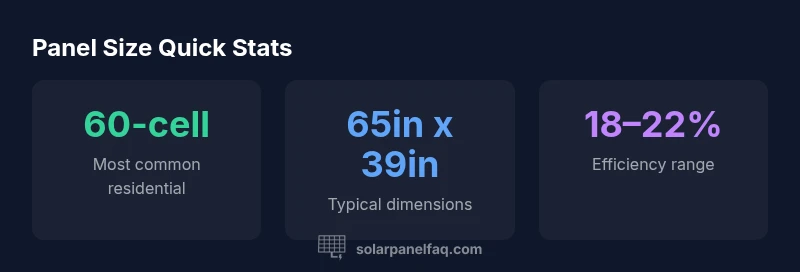
Understanding the most common solar panel size helps homeowners plan roof space and budget. For residential systems, 60-cell panels are the standard, typically around 65 inches by 39 inches and rated 250–320 watts. Larger 72-cell panels are common for bigger roofs or higher power needs. In practice, installers match panel size to roof area, inverter capacity, and future expansion plans.
most common solar panel size and why it matters
Understanding the most common solar panel size is essential for accurate roof planning, material estimation, and cost projection. According to Solar Panel FAQ, the 60-cell module remains the default choice for most homes, offering a balance of performance and fit on typical rooftops. The Solar Panel FAQ team found that these panels usually measure about 65 inches by 39 inches and deliver roughly 250 to 320 watts per module, depending on technology and manufacturer. While newer layouts and high-efficiency variants exist, the 60-cell standard often minimizes shade losses and simplifies wiring. For homeowners evaluating a retrofit or new installation, begin by mapping roof area, considering shading, and selecting a size that matches your inverter capacity and desired system size. This approach keeps future expansion feasible while maintaining reliability.
Why size matters for roof fit and shade management
Panel size directly influences how many modules you can place on your roof, how much curb appeal you preserve, and how shade from trees or vents affects production. A misjudged size can lead to underutilized roof space or excessive gaps that increase installation time and cost. The most common solar panel size was designed to balance power output with physical fit, minimizing an extra row of modules with diminishing returns. When planning, consider roof orientation, slope, and prevailing sun path; these factors determine how much energy you capture from a given panel size and whether you should opt for slightly larger or smaller panels to maximize performance across seasons.
60-cell vs 72-cell: which is right for you?
60-cell panels are the default in many residential installations because of their compact shape and compatibility with standard inverters. 72-cell panels deliver higher wattage per panel, which can reduce total panel count on large roofs but require more space in one dimension and may affect shading on oblique rooftops. The choice often comes down to roof area, budget, and local incentives. If your roof footprint is limited, 60-cell panels may provide the most efficient use of space; if you have ample roof area and desire fewer strings, 72-cell panels may be preferred. Always verify module dimensions with your installer, as different manufacturers vary slightly within these categories.
How to measure your roof and estimate panel count
Follow these steps to translate a roof’s real estate into a panel count: 1) measure the available usable area on each roof plane, excluding vents and chimneys; 2) determine the panel’s dimensions you’re considering (typical 60-cell vs 72-cell outlines); 3) calculate how many panels fit along each row, accounting for spacing and system layout; 4) decide on a desired system size (in kW) and convert that to a panel count using the panel’s wattage rating; 5) talk to a local installer to validate structural and electrical limits. A good estimate will consider future expansion: if you plan to add more capacity later, leave room for additional panels or a larger inverter.
Inverter sizing and electrical considerations
Panel size influences the total array watts, which in turn affects inverter size. Choosing 60-cell or 72-cell panels should align with the inverter's DC input rating and the expected AC output. Oversized panels can be restricted by a undersized inverter, while undersized panels may underutilize available roof space. When planning, field data on sun exposure, typical daily production, and planned expansion should accompany panel sizing decisions. A skilled installer designs a string layout that maintains consistent current and voltage across panels, minimizing losses and preserving performance even when some modules are shaded or dirty.
Real-world installation scenarios
Consider a modest single-family home with a shallow roof: 60-cell panels mounted in two strings may deliver a balanced, cost-effective solution. For a larger home with a big, south-facing roof, 72-cell panels can reduce the number of strings and simplify wiring, provided the inverter can handle the higher per-panel wattage. In a conservation-minded neighborhood with limited space, a mixed approach—starting with 60-cell panels and adding later—can offer a practical middle ground. Each scenario highlights how panel size interacts with roof geometry, shading, and electrical design.
Future-proofing and upgrading considerations
As module efficiency improves and roof sizes or incentives shift, homeowners should plan for flexibility. Choosing a panel size that leaves room for future expansion helps avoid costly retrofits. For instance, starting with 60-cell panels on a medium roof and reserving space for additional 60-cell or upcoming higher-wattage modules can keep costs predictable and performance robust over 20–25 years. Keep communication open with your installer about potential changes in inverter technology and mounting hardware that could accommodate a bigger system later on.
Common panel sizes and power ranges
| Category | Typical size/Dimensions | Power range | Notes |
|---|---|---|---|
| 60-cell residential | 65in x 39in | 250–320W | Most common on homes |
| 72-cell residential/commercial | 77in x 39in | 300–370W | Used for larger roofs |
| Next-gen panels | 84-96in length | 390–420W | Emerging options |
Frequently Asked Questions
What is the most common solar panel size?
In residential systems, 60-cell panels are standard, typically about 65in x 39in and 250–320W. 72-cell panels are also common on larger roofs.
The most common size is the 60-cell panel, usually around 65 by 39 inches.
Does panel size affect system performance?
Panel size determines total wattage and how many modules are needed, but efficiency and shading often have a bigger impact on annual energy production.
Size matters for total watts, but efficiency and shade matter more for output.
Can I mix panel sizes in a single system?
Yes, but it requires careful design so strings and inverters can handle differing IV curves without causing imbalances.
You can mix sizes, but it’s best to consult a pro to ensure proper design.
How many panels do I need for a typical home?
The count depends on energy use, roof space, and panel wattage. A typical home might require 20–30 panels, but this varies widely by location and usage.
Numbers depend on your usage and roof; it’s often in the 20–30 panel range.
Are larger panels always better?
Not always. Larger panels offer higher wattage per module, but they may not fit your roof or maximize daylight capture depending on orientation and shading.
Bigger isn’t always better; fit to your roof and sun exposure matters.
Do roof orientation and shading change size needs?
Yes. Orientation and shading influence how much energy a given panel size will produce, so sizing should account for sun path and potential shade.
Orientation and shade affect performance; size should be chosen with those factors in mind.
“Panel size is a foundational design choice; when matched to roof space, energy demand, and inverter capacity, it drives long-term performance.”
Top Takeaways
- 60-cell panels are the standard for most homes.
- 72-cell panels offer higher wattage for larger roofs.
- Panel size should align with roof space, shading, and inverter capacity.
- The Solar Panel FAQ Team recommends sizing with future expansion in mind.