How to Use Solar Panels for Home: A Practical Guide
Learn how to use solar panels for home to power essentials, cut energy bills, and plan a safe, effective solar setup with a step-by-step approach for homeowners in 2026.


Using solar panels for home lets you power essential loads, reduce electricity bills, and build resilience during outages. This quick answer highlights the key steps: confirm safety shutoffs, verify inverter and metering connections, and align your daily loads with sun hours. Before you begin, understand local interconnection rules and warranty considerations, then follow the step-by-step guide for practical, real-world results.
Understanding how solar panels for home work
Solar panels convert sunlight into electricity through photovoltaic (PV) cells. These cells generate direct current (DC) that is transformed into alternating current (AC) by an inverter, making the power usable in household circuits. A home solar system may be grid-tied, meaning excess energy can push to the utility and draw from it when needed, or it can feature storage to buffer periods without sun. The overall goal is to maximize energy produced during daylight hours and use that energy to cover daytime loads, with any excess routed to the grid or stored for later use. When you ask how to use solar panels for home, you are learning how to align generation with daily needs, monitor performance, and manage safety across all components, from panels to the main service panel. This approach helps homeowners reduce reliance on utility power and improves energy resilience in 2026.
According to Solar Panel FAQ, the simplest path starts with understanding how the system converts light into usable electricity and how it powers your home. A well-planned setup considers your daily consumption, local sun exposure, and interconnection rules to ensure reliable, legal operation. As you move forward, you’ll tailor the configuration to your home’s unique roof and load profile, balancing production with demand.
Roof readiness and site assessment
Site assessment is the foundation of a successful solar deployment. Begin by evaluating roof orientation, shading, age, and structural integrity. In the northern hemisphere, a south-facing slope with minimal shading yields higher production, though east or west orientations can still be effective with a smaller system. Shading from trees, chimneys, or nearby structures should be mapped for every hour of the day and across seasons. The roof must be able to support the weight of panels and mounting hardware long-term, with appropriate flashing and weatherproof seals. Structural health is non-negotiable: if a roof is near the end of its life, replacement should happen before installation. Additionally, determine the best mounting approach (fixed vs. ballast vs. ground-mounted if roof access is limited). A thorough site survey saves problems later and helps you estimate system size and placement with accuracy.
Solar Panel FAQ emphasizes safety and planning in this stage; involve a licensed electrician or qualified solar installer for detailed shading studies and structural assessment. Collect roof measurements, sunlight exposure maps, and electrical panel access points to feed into your design. With a clear site plan, you can optimize panel orientation, cable runs, and access for cleaning and maintenance.
Key system components and safety basics
A home solar system comprises several core components: PV modules (panels), an inverter (or microinverters), mounting hardware, electrical wiring, a combiner box, disconnects, and monitoring equipment. PV panels capture sunlight and produce DC electricity. If you choose a string inverter, several panels are connected in series; microinverters place a device under each panel, potentially increasing reliability in shaded conditions. The inverter converts DC to AC for your home circuits. A main service disconnect provides a safe way to isolate the system, while a dedicated meter and net-metering configuration manage inputs to and from the grid. Grounding, proper wiring gauges, and protective devices are critical for safety and code compliance. Solar Panel FAQ notes that understanding each component’s role helps you diagnose issues and communicate with technicians effectively.
For safety, never bypass a disconnect or tamper with wiring while the system is energized. Use insulated tools, wear protective gear, and verify power is off before handling panels or inverters. Read the inverter manual and local code requirements to ensure proper clearances and ventilation.
Grid-tied vs off-grid: choosing your configuration
Grid-tied solar systems are the most common choice for residential users because they offer seamless energy flow, potential net metering, and typically lower upfront costs than off-grid setups. In a grid-tied configuration, your solar production offsets daytime consumption and feeds surplus energy back to the utility, while the grid acts as a virtual storage device. Off-grid systems rely on battery storage and independent inverters, which increases cost and maintenance but provides energy independence during outages. Your decision should consider local interconnection rules, available incentives, service reliability, and your appetite for battery storage. If you live in an area with frequent outages or limited grid reliability, you may favor a hybrid approach that combines grid-tied operation with a modest battery bank. Solar Panel FAQ’s guidance emphasizes consulting local utility policies to optimize interconnection terms and safety.
Sizing your system and matching loads
Accurate sizing hinges on a clear picture of daily energy use and sun exposure. Start by reviewing electricity bills to determine average daily kilowatt-hour (kWh) consumption, then estimate peak sun hours for your location. A common approach is to oversize slightly to account for seasonal variations and panel degradation over time. From there, calculate the number of panels needed to meet a target fraction of daily demand during daylight hours. Include a buffer for cloudy days and future growth in appliances or electric vehicle charging. Don’t forget to account for inverter efficiency and wiring losses. Solar Panel FAQ suggests focusing on realistic daily usage and weather-adjusted projections to avoid oversizing or undersizing.
Document your calculations and assumptions, and use them to guide product selection, mounting configuration, and interconnection strategy.
Daytime energy management: shifting loads and efficient appliances
One practical way to maximize solar output is to shift high-draw activities to times when the system is producing power. For example, run dishwashers, washing machines, and charging stations during daylight hours. Use energy-efficient LEDs, smart thermostats, and advanced power strips to reduce baseline consumption. If you have a battery storage system, you can prioritize critical loads during non-sun hours and use stored energy when grid rates are high. A simple rule of thumb is to match the biggest daytime loads with peak solar production. Trade-offs may arise between comfort and optimization, so start with a household load audit and reconfigure routines to align with sun availability. This approach helps you get the most value from your solar investment and lowers reliance on grid power between sunrise and sunset.
Solar Panel FAQ notes that load matching requires evaluating every device’s runtime and electricity draw, then scheduling usage accordingly.
Battery storage and hybrid options
Battery storage provides resilience and flexes energy use beyond daylight hours. A simple hybrid approach combines a grid-tied system with storage to capture daytime surplus and use it after sunset. Batteries add incremental cost and maintenance, but they can dramatically increase self-consumption and reduce utility dependence during outages. When selecting storage, consider chemistry (e.g., lithium-ion), depth of discharge, cycle life, and safety features. Hybrids with solar, storage, and grid connection are increasingly common for homeowners who want energy autonomy while preserving the option to export excess energy. Always verify compatibility with your inverter and ensure proper thermal management in hot climates. Solar Panel FAQ emphasizes sizing storage to daily usage patterns and desired backup duration.
Monitoring performance, maintenance, and common issues
Continuous monitoring helps you verify performance, detect shading changes, or identify equipment drift early. Use the inverter’s built-in monitoring or a third-party app to track production, consumption, and net metered energy. Schedule regular inspections to check for loose electrical connections, corrosion, degraded panels, and roof integrity. Clean panels lightly with water if needed, but avoid abrasive cleaners that can scratch the glass. Shading from nearby growth or new construction can reduce output, so prune trees or adjust panel placement if feasible. If you notice sustained drops in production, investigate potential issues with the inverter, microinverters, or DC wiring. Always follow the manufacturer’s maintenance guidelines and safety recommendations; Solar Panel FAQ stresses proactive checks to keep systems operating at peak efficiency.
Permits, interconnection, and warranties
Before turning on a solar system, ensure you have the necessary permits and inspections from your local authority. Grid interconnection requirements vary by jurisdiction, and many utilities offer net metering or export credit programs that can affect financial benefits. Keep documentation of warranties for panels, inverters, and mounting hardware, and understand coverage terms for workmanship and system performance. Regular warranty inspections help protect your investment. When in doubt, consult a licensed professional to review permits, interconnection agreements, and warranty terms. Solar Panel FAQ emphasizes keeping records organized and reviewing warranty documents to avoid coverage gaps during system life.
Tools & Materials
- Safety gear (gloves, goggles, closed-toe shoes)(ANSI-rated gloves and protective eyewear; non-slip footwear)
- Multimeter or voltage tester(Used to verify OFF state and test DC/AC levels)
- Insulated hand tools (screwdrivers, pliers, wrenches)(Keep edges and conductors protected)
- Cable cutters/strippers and wire gauges(Ensure proper gauge for DC/AC wiring)
- Inverter manual and wiring diagrams(Keep on-hand for reference during connections)
- Mounting hardware and fasteners(Racking, rails, brackets suitable for roof type)
- Marker/labels and labeling kit(Label circuits, conduits, and disconnects)
- Monitoring device or app(Optional for real-time production tracking)
Steps
Estimated time: 2-3 hours (excluding permit processes)
- 1
Power down and verify safety
Locate the main service disconnect and shut off power to prevent energizing work. Use a voltage tester to confirm OFF state on all relevant conductors before touching any equipment.
Tip: Always wear protective gear and verify power is truly isolated. - 2
Inspect roof and mounting area
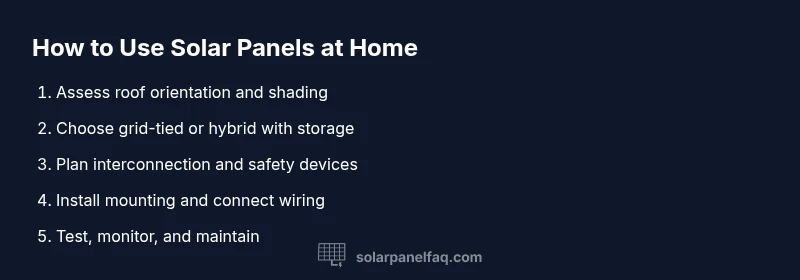
Assess roof orientation, age, and structural integrity. Check for shading throughout the day and identify the best mounting location with minimal obstruction.
Tip: Document shading changes during different seasons. - 3
Gather system drawings and components
Collect panel specs, inverter model, wiring diagrams, and service panel layout. Confirm compatibility and clearance for installation.
Tip: Create a simple schematic of DC and AC paths before wiring. - 4
Plan interconnection and safety devices
Decide on the location of disconnects and cutoffs, grounding scheme, and conduit routing. Ensure compliance with local codes and utility requirements.
Tip: Keep disconnects accessible but protected from weather. - 5
Choose grid-tied or off-grid configuration
If grid-tied, verify net metering eligibility and meter types. Off-grid requires adequate storage planning and charge controllers.
Tip: Coordinate with the utility for interconnection paperwork. - 6
Estimate load and size the array
Review daily usage, sun hours, and panel efficiency to determine panel count and inverter rating. Include a buffering margin for weather and future needs.
Tip: Use a simple spreadsheet to model seasonal changes. - 7
Install mounting hardware and panels
Secure racking and mount panels in the planned orientation. Run cables neatly and label each conductor for future maintenance.
Tip: Have a second person assist to manage safety and alignment. - 8
Connect wiring and inverter
Connect DC wiring from panels to the inverter, then route AC from the inverter to the main panel or disconnect. Verify all connections and clearances.
Tip: Double-check grounding and sealing around penetrations. - 9
Test, commission, and monitor
Power up the system, verify voltage and current readings, and set up monitoring. Record baseline production and consumption data for future comparisons.
Tip: Leave a small test window for production to stabilize before full load use.
Frequently Asked Questions
Can I use solar panels for home without a battery?
Yes, many grid-tied systems operate without batteries, relying on the grid for backup. Without storage, you’ll use solar energy during sun hours and draw from the grid when needed.
You can operate a grid-tied system without batteries; it uses the grid for backup and focuses on daytime production.
Do solar panels work on cloudy days?
Solar panels still generate electricity on cloudy days, but output is reduced. Performance depends on cloud thickness and daylight duration.
Solar panels work in the cloud, but output is lower than bright sun.
How does net metering affect my bill?
Net metering credits you for excess solar energy fed to the grid. Your bill reflects net consumption minus these credits, reducing overall electricity costs.
Net metering credits you for excess power and lowers your bill.
What maintenance do solar panels require?
Keep panels free of heavy debris, inspect mounting and wiring periodically, and check inverters and protective devices for proper operation.
Regular cleaning and periodic inspections keep panels performing.
Are solar panels worth it for a typical home?
Solar panels can provide long-term savings and energy independence, but benefits depend on local sun, incentives, and energy use patterns.
Many homes see long-term value, depending on sun and incentives.
What is the typical payback period?
Payback depends on system size, incentives, and energy prices. It varies widely by location and usage patterns, so a personalized evaluation is best.
Payback varies by where you live and how you use energy.
Watch Video
Top Takeaways
- Assess site and orientation for maximum sun
- Size the system to daily usage and sun hours
- Prioritize safety and code compliance during setup
- Monitor performance and schedule regular maintenance