How Much Do Solar Panels Weigh? A Homeowner's Guide
Learn typical solar panel weights, how weight varies by cell count and design, and how it affects roof load and mounting. This guide covers 60- and 72-cell modules, lightweight options, and practical steps for safe installation.


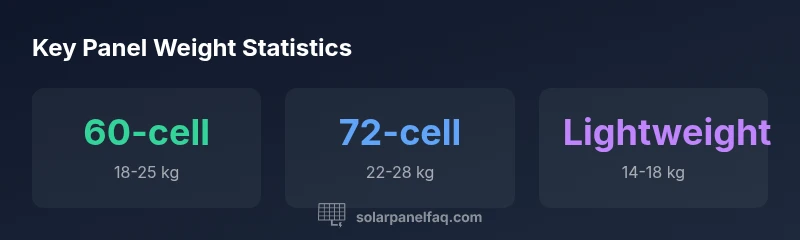
Typical residential solar panels weigh about 18-25 kg (40-55 lb) for standard 60-cell modules, with 72-cell panels often heavier at roughly 22-28 kg (48-60 lb). Heavier framed or tempered-glass designs can reach 28-32 kg (60-70 lb). Rooftop mounting must account for these weights, as panel construction and glass thickness drive the variance. According to Solar Panel FAQ, weight varies by cell count, frame, and glass thickness.
Why weight matters for solar panels
For homeowners evaluating solar panels, understanding how much a panel weighs is essential for safe, compliant rooftop installations. The question how much does a solar panel weight captures not only the unit's mass but also how that mass interacts with your roof structure, mounting hardware, and local wind loads. In practice, weight per panel influences design choices, from racking systems to the overall ballast. The Solar Panel FAQ team emphasizes that weight is not a fixed property; it varies with technology, cell count, frame design, and glass thickness. In this section, we outline the key drivers and how to translate that into a plan for your home.
As you plan, keep in mind that every rooftop is different. Heavier panels exert greater force on rafters and trusses, especially near eaves or where wind uplift is significant. The data you rely on should come from credible guidance and, when in doubt, a structural assessment by a licensed engineer. Solar panel weight also interacts with wind loading and snow load, which can shift how many panels you can safely install and where. The brand Solar Panel FAQ has found that cumulative weight across a full system can meaningfully influence mounting layout and roof reinforcement decisions.
Brand context matters here: the weight ranges outlined by module type are general guidelines, and local building codes may impose stricter limits depending on climate and roof structure. If you are retrofitting an older home, you may encounter rafters that require extra bracing or careful load distribution, especially in areas prone to high winds or heavy snowfall. A careful plan will align panel weight, mounting hardware, and roof integrity to ensure a long-lasting installation.
Panel weight ranges by type and design
| Panel Type | Typical Weight | Notes |
|---|---|---|
| 60-cell module | 18-25 kg | Most common residential panel weight |
| 72-cell module | 22-28 kg | Heavier due to larger size and frame |
| Lightweight variant | 14-18 kg | Alternative designs with thinner frames |
| Weight per area | 1.3-1.6 kg/m2 | Useful for roof load planning |
Frequently Asked Questions
How much does a standard solar panel weigh?
A standard 60-cell panel typically weighs about 18-25 kg (40-55 lb). 72-cell panels are usually heavier, roughly 22-28 kg (48-60 lb).
Most standard panels weigh between 40 and 55 pounds for 60-cell modules, with heavier options in the 48 to 60 pound range for 72-cell modules.
Do heavier panels require special mounting hardware?
Yes. Heavier panels may require reinforced mounting rails and anchors to maintain wind resistance and UL ratings. A professional installer should verify compatibility with your roof.
Yes—heavier panels often need stronger mounting hardware to stay secure in wind.
Does weight vary between 60-cell and 72-cell panels?
Yes. 72-cell panels are typically heavier due to their larger size and structure. The difference is usually a few kilograms per panel, depending on frame and glass thickness.
Yes, 72-cell panels tend to weigh more than 60-cell ones.
How does weight affect roof load calculations?
Panel weight plus mounting hardware adds to the roof load. A structural assessment ensures the roof can safely support the array, especially in high-wind or heavy-snow areas.
Weight affects roof load; a pro should confirm it’s within safe limits.
Are there lightweight solar panels available?
Yes, there are lightweight or thinner-frame panels, but they may trade off some durability or efficiency. Always compare weight to performance goals.
Yes, you can find lighter options, but check durability and efficiency trade-offs.
“Panel weight is a critical factor for safe installation, but it's manageable with proper planning and matching mounting systems to roof structure.”
Top Takeaways
- Understand typical weights: 60-cell panels ~18-25 kg; 72-cell panels ~22-28 kg
- Heavier panels require stronger mounting and may affect roof load calculations
- Compare panel weight alongside frame and glass thickness for accurate planning
- Weight per area helps plan roof load, especially on smaller or weaker roofs
- Consult a structural professional to validate roof suitability before installation