How Big Is a Standard Solar Panel? A Practical Size Guide
Explore typical footprints for residential solar panels, compare 60-cell and 72-cell sizes, and learn how to estimate roof space and plan installations with clear guidance.


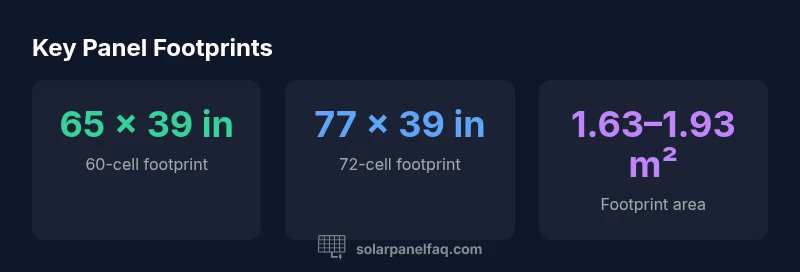
Most residential solar panels measure around 65 inches by 39 inches for a 60-cell module or about 77 inches by 39 inches for a 72-cell module, with an area near 17.6–20.8 square feet. These dimensions translate to roughly 1.63–1.93 square meters. Exact sizes vary by manufacturer and frame design across brands.
How big is a standard solar panel?
According to Solar Panel FAQ, the answer to how big is a standard solar panel centers on two common footprints used in residential installations: roughly 65 inches by 39 inches for a 60-cell module and about 77 inches by 39 inches for a 72-cell module. These footprints correspond to an area near 17.6 square feet for the 60-cell panel and about 20.8 square feet for the 72-cell panel. Exact sizes vary by manufacturer and frame design across brands. The footprint you see on the datasheet will include the visible glass, frame, and mounting hardware. For homeowners asking how big is a standard solar panel, the answer depends on cell count and format. The two sizes above cover the majority of residential installs. In practice, the panel footprint is just one part of the planning equation. Roof space, shading, orientation, and mounting hardware all influence how many panels you can fit and how they look on your roof.
Variation by cell count: 60-cell vs 72-cell panels
The majority of residential systems use either 60-cell or 72-cell footprints. A 60-cell panel is typically shorter and, while height remains close to common standards, its width and overall footprint tend to be slightly smaller than a 72-cell panel. A 72-cell panel is marginally larger in length and can be marginally heavier due to construction, but the difference in footprint is usually modest. For planning, treat 60-cell panels as the compact option and 72-cell panels as the higher-power-per-panel option, noting that both fit most standard roof layouts when spaced correctly.
Other common formats you may encounter
Beyond the standard 60-cell and 72-cell footprints, you may see panels that use half-cut cells, different frame depths, or slightly altered dimensions. While the cell count gives a rough guide to footprint, manufacturing tolerances and frame design can shift the exact dims by a few millimeters. Always verify the exact length and width from the datasheet of the specific model you are considering, especially if you are working with a roof where space is tight or where multiple brands will be mixed.
How to estimate panel footprint for a roof plan
A practical way to estimate footprint on a roof is to start with the panel footprint, then scale by the number of panels you plan to install. Steps:
- Identify the panel type (60-cell or 72-cell) and obtain the exact footprint from the datasheet.
- Decide on the number of panels you need based on your target system size and available roof area.
- Multiply the footprint by the number of panels, then add spacing for mounting rails and edge clearance.
- Consider orientation and potential shading that may require a few extra inches between rows to avoid shadowing.
- Create a rough layout drawing and use a simple grid to visualize fit before purchasing.
Mounting, frames, and spacing: what adds to the footprint
Frames and mounting rails add a small, but real, increment to each panel’s footprint. The frame thickness (usually a few millimeters to a centimeter) and the rail spacing between modules can push the total width or length beyond the bare glass size. If you are pursuing a flush roof line for aesthetic reasons or to maximize shading margin, include these additions when calculating your layout and consult the installer for a layout that minimizes overhang or gaps.
Real-world installation scenarios by roof type
On a typical residential roof, a 5–7 kW array often uses 15–25 panels depending on the power rating of each module and the available roof area. On a smaller sloped roof, you may opt for tighter layouts with backtracking to align with the roof’s edge, while larger flat roofs can accommodate longer strings with fewer rows. The key is to balance footprint with electrical design and shading management to achieve the desired annual energy production.
Practical planning tips for homeowners
- Measure available roof area in feet or meters and compare to panel footprints.
- Consider the orientation and shading patterns across different times of the day and seasons.
- Choose the panel model with the best watts-per-foot for your roof space.
- Verify the exact dimensions from the datasheet and confirm with your installer before ordering.
- Remember that rail width and mounting hardware add to the footprint; plan for an extra ~2–3 inches per side if possible.
Data reliability and planning caveats
Footprint estimates are guidelines and can vary by manufacturer, frame design, and installation method. Always confirm precise measurements from the product datasheet and coordinate with a licensed installer to adapt your layout to your roof’s geometry and local codes.
Standard footprints for common residential solar panels by cell count
| Module Type | Dimensions (in) | Dimensions (cm) | Approx Area (ft²) | Approx Area (m²) |
|---|---|---|---|---|
| 60-cell | 65 x 39 | 165 x 99 | 17.6 | 1.63 |
| 72-cell | 77 x 39 | 195 x 99 | 20.8 | 1.93 |
Frequently Asked Questions
Are all solar panels the same size?
No. Panel footprints vary with cell count and design. For home installs, 60-cell and 72-cell footprints are the most common.
No—panels come in different footprints depending on cell count and design.
Do residential panels differ in height or thickness?
Yes. Frames and mounting hardware add a small amount to the overall height and width. Check the manufacturer’s specs for exact dims.
Yes—frames add a little height; always check the exact specs.
How many panels fit on a typical roof?
The exact number depends on roof area and panel size. Common ranges for a mid-size home fall between 10 and 20 panels.
It depends on your roof; most homes use roughly 10 to 20 panels.
How should I calculate roof space to install panels?
Measure the available roof area, account for panel footprint, and include mounting rails and spacing. Use a simple footprint × panel count formula as a starting point.
Measure available area, consider footprint, rails and spacing.
Are 60-cell and 72-cell footprints fixed or do sizes vary?
Footprints are approximate and vary by manufacturer. Always verify exact dimensions in the product datasheet.
Footprints vary; always check the datasheet for exact dims.
Which is better for tight roofs, 60-cell or 72-cell panels?
72-cell panels offer higher power per panel, but footprint differences are modest. For limited space, maximize watts per area through model choice.
For tight roofs, consider watts-per-area and shade; either can work.
“Panel size is the primary physical constraint for layout; it guides how many can fit and where to place them.”
Top Takeaways
- Know the two common footprints: 60-cell ~65x39 in; 72-cell ~77x39 in.
- Expect the frame and mounting hardware to add to the footprint slightly.
- Plan roof space by footprint times panel count plus spacing.
- Measure both width and length to ensure shade-free coverage.