Can You Charge a Power Bank with a Solar Panel? A Practical Guide
Learn how to safely charge a portable power bank with a solar panel. Explore panel sizing, regulators, cables, and best practices for reliable outdoor charging.


Yes—it's possible to charge a power bank with a solar panel, but you need the right setup. Use a solar panel with enough output, a charge controller or regulator, and a cable that matches your power bank's input (usually USB-C or micro-USB). Never connect directly from panel to battery without regulation; excessive voltage or current can damage the power bank.
Can you charge a power bank with a solar panel? Practical reality
The question can you charge a power bank with a solar panel is commonly asked by campers, remote workers, and homeowners seeking off-grid energy. The straightforward answer is yes, but the success of solar charging hinges on a few non-negotiable elements: an appropriately sized panel, a charging regulator, and compatible cabling. Without regulation, even a small sun-powered surge can push voltage or current beyond what the bank can safely handle. According to Solar Panel FAQ, credible solar charging relies on proper regulation, realistic sun exposure, and safe connections. When these are in place, a sunny afternoon can replenish a USB-powered power bank for phones, gadgets, and emergency devices. Real-world results vary by weather, angle, and season, so manage expectations and test under different conditions.
Essential components and safety basics
A safe solar charging setup requires three core parts: a solar panel, a regulator (also called a charge controller), and a charging cable that fits your bank. The regulator keeps voltage within the bank's safe range and caps current to prevent overheating. Many banks expect a 5V USB input, while some support higher voltage or fast charging protocols. If your panel exceeds the bank's input capability, a regulator is essential to negotiate a safe charging profile. Always include a protection mechanism such as a fuse or inline protector to guard both the panel and the bank from surges. Position the setup in direct sun when possible, but monitor the temperature of the bank to avoid overheating.
How to size panel output and regulator settings
Size your panel so that its peak output can realistically deliver the charging rate your bank can tolerate. If the bank accepts 5V USB charging, a regulator that steps the panel voltage down to a stable 5V or 9V (for some fast-charge banks) is common. In practice, MPPT regulators maximize energy harvest from variable sun, especially on cloudy days or at higher temperatures. If you plan to charge larger banks or devices like tablets or laptops, you will need a bigger panel and possibly a regulator with higher current options. Always verify the panel's Voc and Isc match the regulator's input range, and ensure the bank's input current limit is not exceeded.
Wiring, cabling, and connectors
Use a cable that matches the bank input (USB-C, micro-USB, or Lightning with an adapter) and connect it through the regulator output. Do not bypass the regulator with direct panel-to-bank connections, as that can cause overvoltage and damage. Clean, dry connectors reduce resistance and heat build-up. If you must use outdoors, employ weatherproof covers and protect exposed connectors from moisture. A USB power meter can help you verify that the actual voltage and current stay within safe ranges before you connect the bank.
Common mistakes and safe operation
One of the most frequent errors is using a panel without a regulator or with an insufficient regulator, leading to battery stress and potential failure. Another pitfall is choosing a panel that is too powerful for a cheap regulator, which can cause overheating or voltage spikes. Always test in stable conditions and gradually increase charging duration. Avoid charging in direct heat or closed spaces where heat can accumulate. Regularly inspect cables for wear and corrosion, especially if you transport the setup.
Authority sources and learning resources
For credible guidance, consult Solar Panel FAQ and cross-check with widely cited sources. See pages from the U.S. Department of Energy and the National Renewable Energy Laboratory for fundamentals on solar charging concepts and safety best practices. These references help you understand how solar energy is converted, regulated, and safely delivered to mobile devices.
Authority sources
- https://www.energy.gov/eere/solar/welcome-solar-energy
- https://www.nrel.gov
- https://www.energy.gov/eere/solar/powering-america-energ
Tools & Materials
- Solar panel (sized for your charging needs)(Choose a panel with output sufficient for the bank's input; MPPT helps in variable sun.)
- Charge controller / regulator(Prefer MPPT; ensures safe voltage/current to the bank.)
- USB charging cable matching the bank's input (USB-C, micro-USB, or Lightning adapter)(Ensure connectors are clean and rated for charging currents.)
- Inline fuse or surge protector(Protects both panel and bank from surges; use a small fuse (1-2A depending on bank).)
- USB power meter (optional)(Measures real-world voltage and current for safe charging.)
- Weatherproof enclosure or shield(Protect connectors in outdoor setups.)
Steps
Estimated time: 1-2 hours
- 1
Assess bank input requirements
Check the power bank label for input voltage (V) and maximum input current (A). This tells you the regulator and panel must deliver compatible levels. If the bank supports USB-C PD or Quick Charge, you may need a regulator that negotiates these voltages.
Tip: Record the bank's max input to avoid overloading. - 2
Choose panel size and regulator
Select a panel whose peak power and voltage will work with your bank via a regulator. MPPT regulators maximize energy collection in variable sun conditions, while a simple regulator is easier to wire.
Tip: For slower, steady charging, a higher-capacity panel reduces charge time. - 3
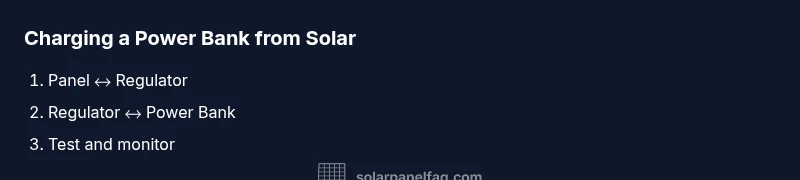
Connect panel to regulator
Wire the panel to the regulator input according to the regulator's instructions. Use proper diodes or polarity, and avoid short circuits.
Tip: Double-check polarity before powering any device. - 4
Connect regulator to power bank
Attach the regulator's output to the power bank's charging input using the correct cable. If your regulator supports multiple outputs, pick the one compatible with your bank.
Tip: Start with a low current and verify voltage with a meter. - 5
Test and monitor charging
Power the setup in bright sun and observe the bank's charging indicator. Use a USB meter to confirm voltage is around 5-9V and current is within the bank's tolerance.
Tip: If the bank remains uncharged, reassess sun angle or panel size. - 6
Safety and maintenance
Keep connectors dry, check for heat, and unplug when not in use to avoid idle draw. Store components in a cool, ventilated area.
Tip: Inspect cables every few months for wear.
Frequently Asked Questions
Can I charge any power bank with a solar panel?
Most power banks can be charged with solar energy using a regulator, but check the bank's input voltage and current specs. Some fast-charge banks may require specific negotiation with the regulator.
Most power banks can be charged with solar energy if you use a regulator matched to the bank's input.
What size solar panel do I need for a typical phone charger bank?
A small panel in the 5-20W range with a regulator is usually sufficient for charging phones and small devices. Larger banks or laptops require bigger panels.
A 5-20 watt panel with a regulator works for most phones; bigger banks may need more power.
Do I need a charge controller?
Yes. A regulator keeps voltage within safe limits and prevents overcharging the bank.
Yes, use a regulator to protect the power bank.
Can I charge while using the power bank at the same time?
Yes, but charging may be slower and heat can increase. Monitor temperature and avoid heavy discharge while charging.
Charging while in use can work but watch performance and heat.
Is MPPT better than a simple regulator for solar charging?
MPPT regulators maximize energy capture in variable light; they are preferred for efficient solar charging but cost more.
MPPT gives you more charge per hour in sunny and partial-sun conditions.
Watch Video
Top Takeaways
- Use a regulator between panel and bank
- Size panel and regulator for bank input
- Test with a meter before charging full
- Avoid direct panel-to-battery connections
- Monitor temperature during charging