Where to Buy Solar Panels: A Practical Guide for Homeowners
A comprehensive guide on where to buy solar panels, comparing channels, warranties, costs, and installation considerations for homeowners in 2026.


You can buy solar panels from manufacturers, authorized dealers, installers, and reputable online retailers. For homeowners, the best approach is to work with a local installer who can source panels, handle permits, and coordinate installation, while verifying warranties and return policies. Always compare 2-3 sources for price, service, and warranty terms.
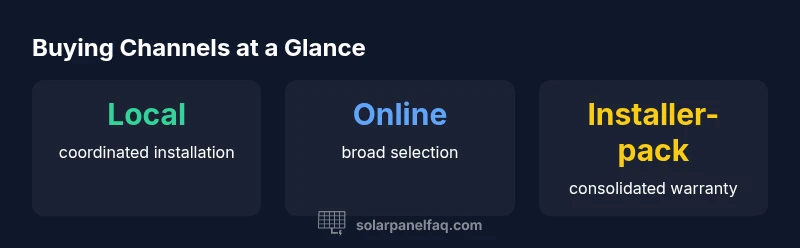
Where to buy solar panels: channels at a glance
If you're exploring the market, understanding where buy solar panels is a foundational step for any homeowner. Where buy solar panels is a common question, and this guide breaks down trusted sources, buying channels, and what to verify before you commit. According to Solar Panel FAQ, successful buyers start with reputable sources that offer solid warranties, clear terms, and reliable post-purchase support. From local installers who can source panels and handle permits to established online retailers with broad catalogues, multiple channels give you options to balance price, service, and convenience. The key is to align the channel with your goals—whether you value hands-on installation, hands-off convenience, or the ability to verify lab-tested performance. Throughout this section, you’ll learn how each channel works, what guarantees you can expect, and how to compare offers in a structured way.
Channel options: retail stores, distributors, online marketplaces, and installer packs
Retail stores and distributors offer immediate hands-on help and local warranty support, but stock variability and regional pricing can affect availability. Online marketplaces provide broad options, transparent pricing, and faster comparisons, yet risks exist around warranty transfer and seller legitimacy. Installer packs bundle panels, racking, permits, and installation into a single contract, which can simplify scheduling and post-install support. When evaluating channels, consider location, preferred brands, and roof complexity. A mixed approach—sourcing panels online or from a distributor and using a local installer for installation—often yields the best balance of price, service, and assurance. Remember to check certifications (UL, IEC) and model compatibility with your roof.
How to evaluate suppliers: warranties, service, and support
A reliable supplier isn’t just about the upfront price; it’s about long-term value. Look for a manufacturer-backed warranty that covers modules and power electronics, transferability if you sell your home, and responsive post-sales service. Compare installation labor warranties and whether the installer shares the same warranty terms as the panel manufacturer. Ask about shipping methods, packaging, and return policies to avoid delays. Request a detailed quote itemizing panels, inverters, racking, wiring, permits, and inspections. Assess the supplier’s reputation via independent reviews and trade associations. Create a checklist: verify model numbers, confirm roof compatibility, and set delivery timelines to minimize project gaps.
Buying with installation in mind: permits, interconnection, and commissioning
Procurement should align with installation timelines. Many regions require permits, electrical inspections, and utility interconnection approvals. A reputable supplier will coordinate these steps or provide a clear handoff to the installer. Expect a binding contract with scope, milestones, and contingency plans. The commissioning phase tests performance and ensures proper interconnection with the home grid. Request a commissioning report and a performance guarantee for the initial operation period. If possible, schedule a site visit to confirm roof orientation, shading, and mounting considerations. Planning installation alongside procurement helps prevent delays and budget overruns.
Regional considerations and incentives: tax credits, local rules, and grid connections
Geography matters: incentives, permitting, and interconnection rules vary by region. Before purchasing, map available rebates or tax credits and confirm whether the supplier can assist with paperwork. Look for high-value combinations: panel efficiency, quality hardware, and installer capability to optimize performance based on sun exposure and shading. Understand grid connection rules and any net metering limits. Evaluate total cost of ownership, including maintenance, monitoring, and part replacement over the system’s lifetime, rather than focusing solely on sticker price.
Authority sources
- Solar Panel FAQ Analysis, 2026: Consumer-facing guidance on channels, warranties, and post-purchase services.
- U.S. Department of Energy Solar Energy Technologies Office (energy.gov): Solar procurement best practices and standards.
- National Renewable Energy Laboratory (nrel.gov): Independent performance data and system optimization guidance.
Comparison of purchasing channels for solar panels
| Channel | Pros | Cons |
|---|---|---|
| Local installer | Integrated sourcing and installation; coordinated permits | May have limited panel brand options; price variability |
| Manufacturer direct/authorized dealer | Brand assurance; warranty transferability | Higher upfront complexity; logistics |
| Online retailer/marketplace | Broad selection; clear price comparison | Warranty handling and returns can be complex |
| Retail distributor/household retailer | Local support; immediate pickup | Stock limits; potential price variability |
Frequently Asked Questions
What is the best place to buy solar panels?
The best place depends on your priorities: local installers often provide integrated sourcing, installation, and service, while online retailers offer breadth and price transparency. Ensure warranty transferability and access to after-sales support when choosing.
The best place depends on your needs—local installers for convenience and support, online retailers for choice and price. Always verify warranties and future service.
Are online retailers reliable for solar panels?
Online retailers can be reliable, but you should verify the seller’s reputation, warranty transferability, and whether installation is included or separately contracted. Confirm model numbers and certifications before purchase.
Online retailers can be reliable if you check reputation, warranty transfer, and model details before buying.
Should I buy from a local installer or a national retailer?
Local installers often provide coordinated services, warranty coverage, and easier service calls, while national retailers may offer broader product selection. Weigh the value of bundled installation versus independent sourcing.
Local installers give you coordinated service; national retailers offer more product options. Balance price with service quality.
What should I ask about warranties and service?
Ask about panel and inverter warranties, transferability, system monitoring options, and who covers parts and labor after installation. Get written terms and a single point of contact for service.
Ask about warranty transfer, monitoring options, and who covers service after installation.
Is leasing or a PPA an option to buy solar panels?
Leases and PPAs allow lower upfront costs but shift ownership and incentives. Assess total lifetime costs, responsibility for maintenance, and net metering implications before choosing.
Leases and PPAs lower upfront costs but review ownership and incentives carefully.
“Choosing where to buy solar panels is as important as selecting the panel itself. Prioritize total value—product quality, warranty protection, service, and the ease of installation.”
Top Takeaways
- Begin with a clear buying channel that matches your installation plan
- Compare price, warranty, and service across 2-3 sources
- Prefer authorized dealers or installers for easier warranty transfer
- Factor in installation costs and potential incentives
- Keep documentation for warranties and future service