Solar Panels for Business: A Practical How-To Guide
A comprehensive guide on planning, sizing, financing, and installing solar panels for business use. Learn site assessment, incentives, vendor selection, and ongoing optimization to cut costs and increase energy resilience.


Installing solar panels for business can dramatically reduce daytime energy costs, increase resilience, and support sustainability goals. Start with a clear load profile, set a realistic system size, and choose a reputable installer to maximize return on investment and minimize risk. This guide helps you plan, finance, and implement a commercial solar project.
Why solar panels for business matter
According to Solar Panel FAQ, solar panels for business have moved from a niche upgrade to a mainstream strategy for reducing operating expenses and elevating sustainability credentials. A properly designed commercial solar system can offset a substantial portion of daytime electricity, stabilizing cash flow against rising utility rates. The Solar Panel FAQ team found that many firms see not just lower bills, but improved energy resilience and corporate reputation when solar is integrated with efficiency upgrades. This section lays the foundation for how to size, site, and finance a project that aligns with a company’s long-term strategy.
Businesses of all sizes can benefit by approaching solar as a capital project with a clear business case. While rooftops are common, ground-mounted or carport installations may better fit certain properties or load profiles. The key is to map energy usage, site constraints, and incentives into a single, actionable plan that covers procurement, permitting, installation, and ongoing performance management.
Keep in mind that incentives, interconnection rules, and utility rates vary by location. Local conditions will shape system size, financial returns, and installation timelines. A well-executed plan reduces risk, maximizes tax credits and rebates, and positions a business to capitalize on future energy market trends. If your organization is new to solar, a staged approach—pilot deployment, performance tracking, and gradual expansion—can minimize risk while building internal buy-in.
description":null},
bodyBlocks2
Benefits of solar for business: cost, resilience, and branding
Solar panels for business deliver several core benefits that matter to executives and facilities managers alike. First, electricity cost savings come from offsetting daytime usage with on-site generation, which reduces exposure to variable utility rates. Second, solar enhances resilience by providing a local power source during grid outages in many regions, especially when paired with energy storage or a robust microgrid strategy. Third, solar signals environmental leadership to customers, investors, and employees, contributing to a stronger corporate brand and meeting stakeholder expectations for responsible energy use.
Beyond these strategic benefits, solar can unlock financial advantages through incentives, depreciation, and favorable financing terms. Depending on jurisdiction, tax credits, accelerated depreciation, and rebates can lower the upfront cost and shorten the payback period. While exact figures vary, many businesses aim for a total cost of ownership that is competitive with or better than conventional grid-supplied power over a typical 5–15 year horizon. The Solar Panel FAQ analysis shows that a thoughtful combination of energy efficiency measures and solar can amplify savings while reducing risk.
wordcount":null},
bodyBlocks3
Site assessment and load analysis: the first step to a successful installation
A rigorous site assessment is essential for sizing and siting a commercial solar system. Begin with a documented energy profile: at least 12 months of utility bills, peak daytime demand, and seasonal usage patterns. Assess roof condition, orientation, shading, and available space for modules, racking, and inverters. If a roof is nearing the end of its life, consider combining a roof replacement with solar to maximize long-term value. The Solar Panel FAQ team recommends engaging a licensed installer early to ensure code compliance and accurate permitting.
Next, determine available space for modules, mounting systems, and wiring routes. Evaluate potential shading from nearby structures, equipment, or vegetation, and explore alternative mounting options such as ground mounts or carports if rooftop capacity is limited. A thorough assessment helps avoid expensive redesigns later and improves the likelihood of achieving projected production targets. Finally, model expected production using your location, system size, and weather patterns to align expected savings with business goals.
The outcome of this phase should be a preliminary system size, an outline of interconnection requirements, and a realistic project timeline. With this foundation, you can move into vendor selection and financing conversations with confidence.
wordcount":null},
bodyBlocks4
System design choices: modules, inverters, and balance of system
System design decisions determine performance, reliability, and cost. Key choices include selecting high-quality modules with strong warranties, choosing inverters suited to your load profile (string vs. microinverters), and designing the layout to minimize shading losses. The balance of system (BOS)—mounting hardware, wiring, combiner boxes, and monitoring hardware—often accounts for a significant portion of total cost but offers important opportunities for efficiency and ease of maintenance.
Consider modular designs that allow gradual expansion as demand grows, or split-system configurations to optimize production during shoulder seasons. For a business with heavy daytime use, a larger system with robust monitoring and performance analytics can help you track return on investment. In many cases, a solar+storage approach improves resilience and provides additional demand-charge savings, particularly for facilities with variable energy use or critical processes.
Finally, demand management should be part of the design—aligning production with consumption to maximize self-consumption and minimize export credits. Your installer should provide an energy production model that reflects your actual load, location, and incentives to ensure the system meets business objectives.
wordcount":null},
bodyBlocks5
Financing, incentives, and the total cost of ownership
Financing a business solar project involves selecting a model that matches cash flow, risk tolerance, and expected savings. Options range from outright purchases to leases and power purchase agreements (PPAs). Each approach has trade-offs between ownership, tax benefits, up-front costs, and ongoing payments. A well-structured plan should align with your organization’s budget cycles, depreciation strategies, and long-range energy goals. The Solar Panel FAQ analysis shows that most businesses benefit from a hybrid approach—combining tax incentives and favorable financing with a staged deployment.
Incentives vary by jurisdiction but commonly include federal and state tax credits, depreciation allowances, and local rebates or performance-based incentives. Utility interconnection costs and potential standby charges can affect the financial picture, so early discussion with the utility and an experienced financial partner is essential. Conduct a sensitivity analysis to understand how changes in energy prices, incentives, and system performance influence the payback period and overall value.
A robust business case should quantify not only bill savings but also avoided risk, brand value, and alignment with sustainability goals. Your finance plan should include a clear timeline for cash flows, tax benefits, and recovery of investment through reduced operating costs over the system’s lifetime.
wordcount":null},
bodyBlocks6
Installation milestones, regulatory steps, and choosing a partner
With design finalized, execution begins. The installation phase includes securing permits, scheduling crew availability, and coordinating with the utility for interconnection. A well-run project follows a tight schedule, minimizes disruption to operations, and ensures safety protocols are followed. Expect inspections at multiple stages to verify code compliance and electrical safety.
Selecting the right installer is critical to project success. Look for a licensed contractor with a proven track record in commercial solar, transparent pricing, and clear warranties. Request case studies and references, verify equipment warranties, and confirm ongoing performance monitoring offerings. A trustworthy partner will provide a detailed project plan, milestones, and a post-installation commissioning checklist to ensure a smooth transition to operation.
After commissioning, monitor performance against forecasts, review energy production quarterly, and adjust energy usage or add storage if needed. A phased implementation allows you to learn and optimize without overcommitting resources. The end result should be a reliable, energy-cost-reducing asset that aligns with your business goals.
Tools & Materials
- Access to electrical service panel and main breaker(Ensure space for new wiring, and verify panel rating matches planned load.)
- Measuring tape and drill/driver with bits(Used for mounting layout and securing equipment.)
- Safety gear(Gloves, safety glasses, hard hat, fall protection as needed.)
- Ladder or scaffolding(Stable setup for rooftop or high-mounted installations.)
- Roof and site assessment tools(Plumb line, inclinometer, and shade analysis tools.)
- Utility interconnection and permit documents(Pre-approval letters, building permits, and electrical permits.)
- Warranties and quotes from installers(Keep all equipment and labor warranties organized.)
- Energy bills and production targets(12–24 months of bills for load analysis and forecasting.)
Steps
Estimated time: Estimated total time: 6-12 weeks
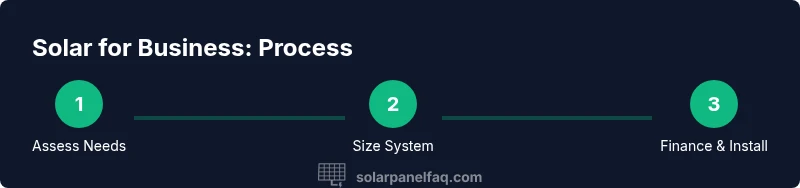
- 1
Assess energy usage and site readiness
Gather 12–24 months of energy bills and document daytime load patterns. Inspect the roof or site for space, orientation, and shading. Identify any maintenance issues that could affect installation.
Tip: Ask your installer for a shading analysis early to avoid oversizing or underperforming panels. - 2
Size the system and model production
Use historical data to estimate a target capacity that aligns with budget and goals. Create a production model factoring local sun exposure and system losses.
Tip: Prefer a modular approach so you can expand later if demand grows. - 3
Explore financing and incentives
Compare ownership vs. leasing vs. PPA options. Gather information on available tax credits, depreciation, and regional incentives.
Tip: Run a sensitivity analysis to see how incentive changes affect ROI. - 4
Secure permits and interconnection
Submit required permits and coordinate interconnection with the utility. Schedule inspections and prepare for potential grid-connection testing.
Tip: Start early to avoid project delays from permitting backlogs. - 5
Select equipment and contractor
Choose modules, inverters, and mounting systems based on quality, warranties, and performance. Verify installer credentials and project plan.
Tip: Ask for a guaranteed performance warranty in writing. - 6
Install and commission the system
Coordinate installation with minimal disruption to operations. Complete commissioning and connect to grid, then verify output matches forecasts.
Tip: Document all safety checks and commissioning results. - 7
Monitor performance and optimize
Set up monitoring to track production, energy use, and savings. Adjust operational practices and consider storage for demand management.
Tip: Review data monthly to catch performance drifts early.
Frequently Asked Questions
What size solar system does a business typically need?
System size depends on the business’s daytime load and available space. Analyze energy bills, peak demand, and goal for offsetting usage. A qualified installer can translate these factors into a practical kW target and expected production.
System size depends on your daytime energy use and space. A qualified installer can help translate your bills into a practical target.
Are there incentives for business solar installations?
Many regions offer federal, state, and local incentives, plus depreciation and favorable financing. Incentives vary by location and timing, so consult your local solar programs and a trusted installer to understand current opportunities.
There are incentives that vary by location. Check federal, state, and local programs or talk to a trusted installer to map current opportunities.
How long does it take to install solar panels for a business?
Typical timelines span several weeks, from planning and permits to installation and commissioning. Weather and utility approvals can affect timing, but a well-planned project minimizes disruption to operations.
Most projects take several weeks from planning to commissioning, with potential delays from permits or weather.
What is the payback period for business solar?
Payback is influenced by load, system size, incentives, and utility rates. It varies widely; a robust plan that maximizes incentives and self-consumption can shorten payback.
Payback varies a lot depending on incentives and how much you use energy during the day.
Do I need a professional installer or can I DIY?
Commercial solar installation should be performed by licensed professionals to ensure safety, code compliance, and warranty validity. DIY work can risk safety and void warranties.
It's safest to use a licensed installer for commercial solar; DIY isn’t recommended.
Will solar panels work during cloudy days?
Solar still generates electricity on cloudy days, but output is reduced. System design and storage can help smooth energy supply when sun is intermittent.
Solar still works when it’s cloudy, just at lower output; storage can help fill gaps.
Watch Video
Top Takeaways
- Assess energy use and site early
- Size system with a data-driven approach
- Factor incentives and financing into ROI
- Choose a reputable installer with solid warranties
- Monitor performance and optimize over time