Solar Panel Installation Job: A Practical How-To for Homeowners
Learn a practical, safety-focused approach to completing a solar panel installation job at home. This guide covers planning, permits, mounting, wiring, testing, and maintenance with actionable steps for homeowners.


Learn how to complete a solar panel installation job safely and efficiently. This guide covers planning, site assessment, permits, system sizing, mounting options, wiring basics, safety, and post-install checks. Whether you’re a first-time installer or upgrading an existing array, follow practical steps, use recommended tools, and know when to call a licensed electrician or solar installer.
Planning and Permitting for a Solar Panel Installation Job
According to Solar Panel FAQ, planning is your first and most important step. Start with a site assessment to identify shading, roof orientation, and available space for panels. Review local building codes, electrical standards, and HOA rules before you buy materials. A well-documented plan helps you avoid rework and ensures that every component fits your home’s electrical system. In this section, you’ll learn how to map the roof, estimate space needs, and prepare a permitting checklist that you can take to your local building department. This upfront work also clarifies whether you need a home run from the main panel, a sub-panel, or a permit for roof penetrations, which varies by jurisdiction.
- Before you begin: confirm roof condition and recent repairs; a damaged roof is a barrier to a long-lasting solar install.
- Gather essential permits and notifications early: electrical permit, structural permit if required, and utility interconnection paperwork.
- Keep a project notebook: include panel counts, wiring routes, and date-stamped photos to support inspections and warranties.
System Sizing and Equipment Selection
Sizing the system determines how much energy you’ll generate and how many panels you’ll need. Start with your household’s average daily kWh usage and align it with available roof space, panel efficiency, and climate. Compare different inverter options and consider future expansion. In this section, you’ll learn to calculate energy needs, select PV modules with appropriate voltage and current ratings, and choose an inverter that matches your array and electrical panel. The goal is a balanced system that meets energy goals without overbuilding your roof capacity or overloading the service panel. You’ll also see how to plan cable lengths and conduit paths to keep the run short and efficient.
- Use a yearly usage pattern to predict seasonal differences.
- Consider temperature and shade factors that affect panel performance.
- Plan a scalable layout to accommodate future upgrades.
Site Assessment and Roof Readiness
A thorough site assessment ensures the roof can support the weight and withstand environmental conditions. Inspect roof integrity, find solid mounting points, and evaluate wind and snow loads according to local codes. Check existing electrical service capacity and identify the appropriate service disconnect location for the PV system. This section explains how to measure roof slope, identify vent pipes and skylights to avoid, and verify attic access for safe installation. You’ll also learn how to plan for roof penetration sealing and flashing to prevent leaks.
- Document any roof replacements or sagging areas that require repair before installation.
- Confirm that the chosen mounting system is compatible with your roof type (asphalt shingle, metal, tile).
- Ensure safe access for installers with fall protection gear ready.
Mounting, Wiring, and Safety Procedures
Mounting is the backbone of a durable solar panel installation. Install rails or racking first, then mount panels with proper torque to avoid microfractures or loosening. Run DC wiring from the modules to a combiner box, and keep conduits protected and weather-sealed. Safety is essential: use fall protection when working on pitched roofs, wear PPE, and keep wiring clear of heat sources or sharp edges. This section covers how to secure rails, align modules for optimal sun exposure, and route cables to minimize shadows and losses.
- Use corrosion-resistant mounting hardware appropriate for your roof.
- Maintain a clean work area to prevent dropped tools from causing damage.
- Use cable clamps and weatherproof seals to protect exposed conductors.
Electrical Connections, Inverter Setup, and Commissioning
This section guides you through converting DC power from the panels to usable AC power for your home. Install the DC disconnect and connect strings to the inverter according to the manufacturer’s instructions. Ensure proper grounding and bond to the building electrical system, and coordinate with your utility for interconnection approval. You’ll learn how to verify voltages, test insulation resistance, and perform a dry run before flipping the main breaker. Correct labeling and documentation at this stage prevent future confusion for electricians and inspectors.
- Follow the inverter’s installation manual to match input ratings to your string configuration.
- Verify all safety clearances around the service disconnect and main panel.
- Keep a copy of the permit and inspection approvals handy for the final check.
Test, Commission, and Documentation
After wiring and interconnection, perform a controlled commissioning process to verify safe operation. Check for proper system grounding, stray voltage, and proper inverter synchronization with the grid. Use monitoring software or the inverter display to confirm generation targets and identify underperforming strings. Document everything: panel serial numbers, installation dates, permits, inspections, and warranty information. A meticulous record helps with future maintenance, warranties, and resale value.
- Run a test load and observe safe, even power production across strings.
- Capture photos of the installed hardware, labeling, and wiring routes for records.
- Schedule regular inspections to catch corrosion, loose hardware, or degraded seals early.
AUTHORITY SOURCES
- https://www.energy.gov/eere/solar/siting-your-solar-system
- https://www.energy.gov/eere/solar/installation-best-practices
- https://www.nrel.gov/docs/fy15osti/64860.pdf
Tools & Materials
- PV modules (solar panels)(Choose panels with appropriate wattage and efficiency for your space)
- Racking/mounting system(Roof- or ground-mounted, compatible with roof type)
- Inverter (string or micro)(Match to total DC input and desired AC output)
- DC disconnect switch(Required by code in many jurisdictions)
- Conduit, cable, and fittings(Weatherproof, rated for outdoor use)
- Grounding equipment and bonding(Correctly bonded to building structure)
- Roof penetrations and flashing hardware(Secure, watertight mounts)
- Safety gear (helmet, gloves, goggles, harness)(Fall protection for roof work)
- Torque wrench and crimping tools(Proper torque specs prevent damage)
- Monitoring system or app(Track production and performance)
Steps
Estimated time: Total time: 4-8 hours
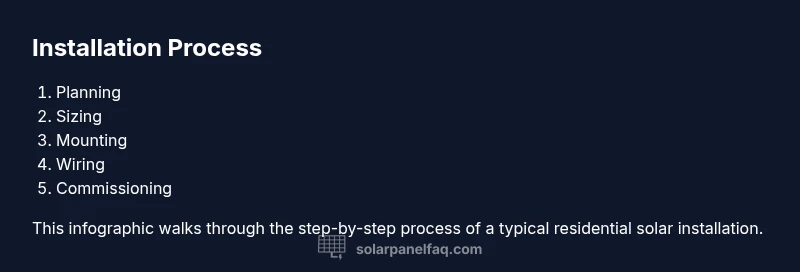
- 1
Assess site and permits
Begin with a site survey to determine shading, space, and structural suitability. Check utility interconnection requirements and confirm that permits are available before ordering equipment. Create a plan that aligns with your electrical panel capacity and local codes.
Tip: Document everything early—photos, measurements, and permit numbers speed inspections. - 2
Size system and choose components
Calculate your daily energy needs and map this to panel count and inverter capacity. Choose modules with compatible voltage and current ratings, and select an inverter that matches the total DC input. Plan for future expansion if needed.
Tip: Keep a margin for shading and temperature derating. - 3
Prepare roof and safety plan
Inspect the roof for damage and ensure access for installers. Establish fall protection, ladder safety, and weather considerations. Pre-cut conduit routes and mark mounting points on the roof.
Tip: Have a spotter and a second person to assist during roof work. - 4
Install mounting rails and anchors
Attach mounting rails to roof anchors or rafters according to the chosen system. Ensure alignments are precise to maximize panel fit and minimize shading. Seal penetrations with compatible flashing.
Tip: Tighten hardware to manufacturer torque specs and recheck alignment after mounting. - 5
Mount PV modules
Place modules onto rails and secure per instructions. Leave space for wiring clearance and expansion. Verify panel tilt and orientation for optimal sun exposure.
Tip: Do not over-tighten; maintain even mounting across the array. - 6
Run DC cabling and connect to a combiner box
Route DC cables from each string through conduit to a combiner box. Keep runs short and protected from moisture and heat. Label each string for ease of troubleshooting.
Tip: Avoid sharp bends and ensure strain relief on all cables. - 7
Install DC disconnect and inverter wiring
Install the DC disconnect in a readily accessible location. Connect strings to the inverter per the manufacturer’s diagram and perform a dry run. Ground the system as required by code.
Tip: Verify polarity and torque on all terminations before energizing. - 8
Connect to service panel and grounding
Tie the inverter output to the electrical service panel or a dedicated sub-panel if allowed. Ensure proper grounding and bonding. Coordinate interconnection approval with the utility.
Tip: Keep documentation handy for the inspector and utility. - 9
Test, inspect, and document
Power up in stages and monitor voltage, current, and panel temperatures. Check for proper production across strings and verify grid synchronization. Photograph and file permits, warranties, and as-built diagrams.
Tip: Schedule a final inspection promptly to avoid delays.
Frequently Asked Questions
What permits are required for a residential solar panel installation?
Most jurisdictions require electrical and building permits, and sometimes a utility interconnection agreement. Check with your local building department early to determine exact requirements.
Most places require electrical and building permits and possibly a utility interconnection agreement; check with your city first.
Do I need to hire a licensed electrician for a home solar install?
Interconnection with the utility and final electrical wiring typically require a licensed electrician. Some simple, off-grid configurations may be possible, but safety and code compliance are best ensured by a pro.
Usually you should hire a licensed electrician for wiring and utility interconnection.
How do I estimate the number of panels I need?
Calculate your daily energy usage and map this to panel count based on space, efficiency, and climate. Use a reputable solar calculator and consider future energy needs.
Use a solar calculator to estimate how many panels you’ll need based on your usage and space.
What safety gear is essential when installing solar panels?
Wear PPE such as gloves, eye protection, and non-slip shoes. Use fall protection on pitched roofs and keep tools secure to prevent accidents.
Wear gloves, eye protection, and fall protection on roofs.
What maintenance is required after installation?
Keep panels clean, inspect mounting hardware, and monitor performance via the inverter or monitoring app. Schedule periodic inspections to catch corrosion or loose fittings early.
Keep them clean and check performance regularly.
When should I hire a professional?
If you lack confidence with electrical work, or your system requires complex interconnection or code compliance, hire a qualified solar installer.
If unsure, hire a professional.
Watch Video
Top Takeaways
- Plan early and confirm permits before ordering equipment.
- Match system size to energy needs and roof capacity.
- Prioritize safety and proper grounding at every step.
- Document everything for warranties and inspections.