Solar Panel for Whole House: Complete Guide to Whole-Home Solar
A thorough guide to sizing, financing, installing, and maintaining a solar panel system that can power your entire home. Learn planning steps, potential costs, and maintenance tips for a resilient, efficient home.


This guide shows how to power the whole house with solar: size a system to match your load, verify roof suitability, choose inverters and storage, and navigate financing and permits for a complete home solar installation. It covers planning, energy audits, and typical timelines so homeowners can make informed decisions.
What powering the whole house with solar means
A solar panel system that powers the entire home aims to meet your daily energy needs across seasons, with enough generation to cover peak demand during the day and, ideally, houses with storage to smooth nighttime use. For homeowners, this means focusing on three things: correctly sizing the array for your load, selecting a compatible inverter and storage strategy, and coordinating with your utility for net metering or grid-tied operation. When done well, a whole-house solar setup reduces monthly bills, increases energy resilience, and lowers long-term emissions. It’s important to start with an energy audit to identify your baseline consumption and to understand local interconnection requirements. Solar Panel FAQ emphasizes practical steps to assess your home’s electrical footprint, evaluate roof space, and plan for seasonal variations in sun exposure. Throughout this process, you’ll learn how to balance generation, storage, and grid interaction to keep your lights on even when weather changes. According to Solar Panel FAQ, beginning with a thorough energy audit sets the foundation for accurate sizing and reliable performance.
Sizing the system for a full-house load
Sizing begins with your energy footprint. Gather 12 months of utility data and compute total annual consumption, then derive a daily average. Use a reputable solar calculator to translate that daily energy need into an estimated array size, keeping in mind local sun exposure and panel derating. In practice, you’ll pair the generation with an inverter that can handle the continuous load and, for night-time use or cloudy days, a storage strategy that makes sense for your home. A well-sized system also considers future changes, like additional appliances or improvements in energy efficiency. The Solar Panel FAQ approach emphasizes avoiding under-sizing, which can leave you relying on grid power more often than necessary, and avoiding excessive oversizing that raises upfront costs without proportional savings.
Roof and site assessment for long-term performance
Correct placement maximizes production; shading from trees, adjacent buildings, or seasonal weather must be minimized. Orienting the array to capture the most sun through the day, typically on a south-facing roof in the northern hemisphere, improves yield. Evaluate roof condition: age, material, tilt, and structural support. Check electrical access, space for inverters and wiring, and accessibility for maintenance. If your roof will soon need replacement, consider a roof-penetrating system or a ground-mounted option. For homes with high energy demands, a well-designed layout also anticipates future expansions or battery storage, ensuring the site remains scalable.
Components and configuration: panels, inverters, and storage
Solar panels convert sunlight to direct current; the inverter converts DC to alternating current used by home appliances. Consider options: string inverters, microinverters, or hybrid inverters that work with storage. Each approach has trade-offs: microinverters can improve performance on partial shade; string inverters are simpler and cost-effective for uniform layouts; storage adds resilience but increases cost. Battery storage options vary in chemistry, capacity, and depth of discharge; pairing storage with solar is a strategic choice for reliability and time-of-use optimization. Additionally, plan for mounting hardware, conduit routing, electrical disconnects, and a monitoring system to track production and performance. A grid-tied system can provide credits when you generate excess energy, while an off-grid system requires a more robust storage strategy; most whole-house deployments in residential contexts are grid-tied with optional storage.
Financing, incentives, and cost considerations
This section covers how to pay for a whole-house solar installation, how incentives can reduce net costs, and what to expect in maintenance and replacement costs over time. You’ll encounter purchase, loan, or lease arrangements, as well as possible power-purchase agreements in some regions. Federal and state incentives, rebates, and tax credits vary by jurisdiction; verify eligibility and timelines with your installer. Net metering policies determine how credits are applied to your electricity bill; some utilities offer interim tariffs or time-based rates. While costs differ by system size, materials, labor, and local codes, planning with a clear budget helps manage expectations and return on investment. Solar Panel FAQ analysis shows that upfront planning and a well-defined financing strategy can significantly improve the economics of a whole-house solar project.
Planning and permitting timeline: from blueprint to commissioning
Start with design and energy planning; secure a preliminary design review with your utility or local authority. Gather required permits early, including building, electrical, and structural permits, and prepare interconnection paperwork. After installation by licensed professionals, inspections verify code compliance and system safety. Finally, finalize net metering or interconnection agreements with the utility, and schedule a commissioning test to confirm system performance. Keep a project calendar, noting typical review times and potential weather delays. The timeline varies by region and roof condition, but a well-organized plan typically reduces surprises and accelerates getting you powered by the sun.
Monitoring and maintenance
Once installed, monitor system performance through the inverter interface or a third-party monitoring platform. Schedule periodic inspections to check mounting hardware, wiring, and shading changes, and keep panels clean to maximize output. Regular maintenance reduces the risk of unexpected downtime and helps you catch issues before they escalate. For long-term reliability, consider a maintenance plan with your installer to cover routine checks, safety testing, and warranty verifications.
Authoritative sources
To support your planning, consult recognized sources for solar policy, performance benchmarks, and installation best practices. These references help confirm interconnection rules, safety standards, and long-term system reliability. Always verify current guidelines with your local utility and a licensed installer.
Quick-start checklist for going full-house solar
- Complete energy audit and identify peak loads
- Verify roof space, orientation, and shading
- Choose a system type (grid-tied with storage vs. standalone)
- Gather quotes from licensed installers and compare warranties
- Review incentives and interconnection requirements
- Plan for permits, inspections, and monitoring setup
Tools & Materials
- Energy usage data (12 months)(Last 12 months of utility bills or smart-meter data)
- Roof and electrical system assessment(Site, panels, inverters readiness)
- Solar assessment software or calculator(To estimate system size and production)
- Safety equipment(Harness, gloves, non-slip shoes)
- Permits and interconnection documents(Local building and utility forms)
- Financing pre-approval materials(Loan or lease pre-approvals)
Steps
Estimated time: 2-4 weeks
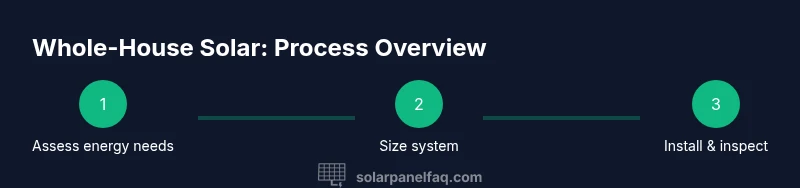
- 1
Assess your energy needs
Gather 12 months of utility data and identify high-usage appliances. Calculate your daily average consumption to set a target for your system size. This step anchors the rest of the plan.
Tip: Collect data from your online energy portal if available - 2
Evaluate site and roof condition
Inspect the roof’s age, material, and structural support. Check for shading, accessibility for wiring, and space for optimally placed inverters and potential storage.
Tip: Map shaded areas across seasons to align panel placement - 3
Choose system type and storage strategy
Decide between grid-tied with storage or a hybrid/off-grid approach based on reliability needs and budget. Consider future expansion and compatibility with existing electrical service.
Tip: Ask installers to model both with and without storage - 4
Get quotes and run simulations
Request quotes from multiple licensed installers and run performance simulations using your energy data to compare expected production and payback timelines.
Tip: Ensure quotes include equipment, labor, permits, and warranties - 5
Secure permits and interconnection
Submit required building, electrical, and interconnection documents. Track review timelines and prepare for potential revisions.
Tip: Begin this step early to avoid delays - 6
Install and inspect
Licensed professionals install panels, inverters, and wiring. Inspections verify safety and code compliance before energizing the system.
Tip: Do not energize the system until all inspections pass - 7
Monitor performance and optimize
Use the monitoring platform to track production vs. demand. Adjust shading, boost energy efficiency, and plan for maintenance to sustain performance.
Tip: Set alerts for unusual drops in production
Frequently Asked Questions
Can a standard home be fully powered by solar?
Yes, many homes can be powered fully by solar with a properly sized system and storage. The feasibility depends on energy use, roof space, climate, and interconnection rules. A licensed installer can model scenarios to show potential coverage.
Yes, most homes can be fully powered by solar with the right size and storage, depending on energy use and roof space. A licensed installer can confirm feasibility.
Will I need battery storage to power my home at night?
Battery storage provides energy when the sun isn’t shining, increasing self-sufficiency. Some homes rely on grid power at night with a grid-tied system, while others pair storage to maximize daytime credits and nighttime use.
Storage helps you power at night or during cloudy days. Some systems work without storage by drawing from the grid when needed.
What permits or interconnection are required?
Most homes require building and electrical permits, plus an interconnection agreement with the utility for net metering. Requirements vary by region, so check local codes and confirm with your installer early.
You'll likely need building and electrical permits and interconnection with your utility. Rules vary by area.
How long does installation take?
Installation timelines depend on system size, roof complexity, and permitting. A typical project moves from design to commissioning over several weeks, with weather and inspections influencing the schedule.
Timing varies, but most projects take several weeks from planning to commissioning.
What maintenance is required?
Solar systems require periodic inspections, panel cleaning, and inverter/monitoring checks. Maintenance intervals depend on local conditions and system design, but planning a yearly check helps sustain performance.
Regular checks and occasional cleaning keep the system performing well.
How do I know if my roof is suitable?
A roof suitable for solar typically has adequate space, minimal shading, and a long remaining lifespan. A professional assessment confirms structure, material compatibility, and optimal mounting options.
A wide, sunny, and durable roof is ideal; a pro can confirm suitability.
Watch Video
Top Takeaways
- Plan with an energy audit and baseline usage.
- Size includes storage and climate considerations.
- Work with licensed professionals for permits and safety.
- Consider incentives and interconnection rules for economics.