What is the average cost of a solar panel in 2026?
A data-driven guide to solar panel costs, including installed price ranges, per-watt costs, incentives, and how to budget for a typical 6–8 kW home solar system in 2026.


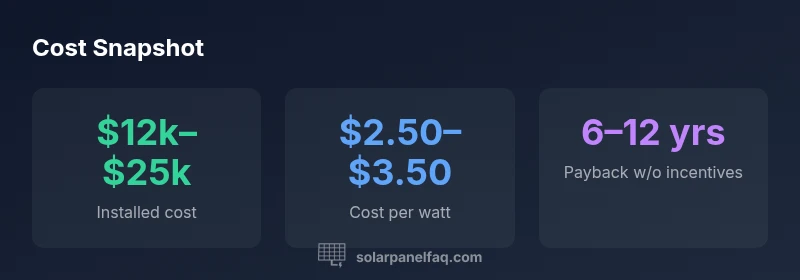
The average cost of a solar panel installation for a typical home in 2026 ranges from roughly $12,000 to $25,000 before incentives, with a installed price per watt commonly in the $2.50–$3.50 range. Costs vary by system size, roof configuration, and location, and federal and state incentives often lower the upfront price.
What is the average cost of a solar panel?
When homeowners ask what is the average cost of a solar panel, they usually mean the total installed price for a typical 6- to 8-kilowatt home system. In 2026, the installed price for a standard residential solar project typically ranges from $12,000 to $25,000 before any tax credits or rebates. This broad range reflects differences in panels bought (monocrystalline vs polycrystalline), system size, roof configuration, and installer labor rates. It’s useful to distinguish between panel cost (the solar panels themselves) and the full installed cost, which includes inverters, racking, wiring, permits, and professional installation. The per-watt pricing is another common way to quote costs; for installed systems, this often lands in the $2.50 to $3.50 per watt range, though aggressive offers can dip lower and premium, high-efficiency panels can push the high end higher. To set expectations, incentives—federal ITC credits and state rebates—can substantially lower the net price. In regions with competitive solar markets, installer competition can pressure prices downward, while in regions with complex permitting or higher labor costs, the installed price can spike. Understanding these variables helps homeowners compare quotes accurately and avoid surprises later in the process.
How installers price solar projects
Most installers publish a price per watt or a bundled installed price. A price-per-watt quote can help normalize differences in system size, but be sure to ask what is included: panels, inverter, racking, wiring, permits, and labor. Some quotes itemize each element, others present a single number. Brand and efficiency matter: premium panels with higher efficiency and longer warranties typically cost more upfront but may offer greater energy yield over time. Labor quality and roof access also influence cost significantly—homes with steep roofs or complex layouts can require more time and safety measures. Always request a written breakdown and verify local taxes, permit fees, and potential interconnection costs, which can add hundreds to thousands of dollars to the total.
The role of system size and roof orientation
System size drives the overall price, but the price per watt tends to decrease as you scale up. Larger systems usually require more panels, inverters, and mounting hardware, but the incremental cost per watt often falls due to bulk buying and more efficient installation workflows. Roof orientation and shading also affect cost-benefit; ideal south-facing, unshaded roofs maximize production, potentially allowing a smaller system to meet energy goals and lowering installed cost per kilowatt-hour. Conversely, roofs with poor orientation or heavy shading may necessitate more panels or higher-efficiency equipment to achieve the same energy output, increasing the upfront investment. A well-planned design balances initial cost with long-term savings and reliability.
Incentives, financing, and net costs
Incentives reduce the net upfront price and can dramatically alter the financial equation. Federal tax credits, state rebates, and utility programs may cut the net cost by a substantial portion, depending on eligibility. Financing options—cash purchases, solar loans, leases, and power purchase agreements (PPAs)—also affect the total cost and monthly cash flow. Loans spread the cost over years with interest; cash purchases eliminate interest but require more upfront capital; leases/PPAs reduce upfront costs but often limit ownership benefits. When evaluating offers, compare after-incentive prices, interest rates, loan terms, and any maintenance or monitoring fees. A careful cost-benefit analysis helps determine not just the upfront price but the long-term return on investment.
Regional variations and real-world examples
Costs vary by state and local market conditions. Some regions have higher labor costs or more complex permitting, while others benefit from strong competition and abundant sunlight. For example, a sunny, high-insolation region may deliver higher energy production for a given system size, improving payback even if installed costs are similar. Urban installers may face higher permit and interconnection fees, while rural installers might offer lower labor rates but higher travel costs. To illustrate, a typical 6–8 kW residential system in different markets might land within the same general price band, but the net value after incentives and energy savings can differ considerably due to utility rates and local incentives. Always request a localized estimate that reflects your energy usage, roof characteristics, and local policy landscape.
A practical budgeting workflow
- Assess your current energy usage and set a target system size (in kW) that meets most of your needs. 2) Gather 3–5 written quotes with detailed line items. 3) Compare installed costs, not just per-watt quotes, and check for inclusions/exclusions. 4) Factor in incentives, interconnection costs, and any maintenance plans. 5) Run a basic payback calculation using your local electricity rate, projected panel output, and expected energy savings. 6) Review financing options and choose the approach that aligns with your cash flow goals. 7) Plan for maintenance, warranties, and potential insurance changes. A deliberate budgeting process helps ensure you don’t overpay or underinvest in a system that won’t meet your needs.
Common budgeting mistakes and how to avoid them
- Focusing only on upfront price instead of long-term value. Invest in quality components and a system sized to your actual usage to avoid higher replacement or maintenance costs later. - Underestimating energy savings due to poor roof orientation or shading. - Skipping permits, interconnection, and warranty considerations, which can cause delays or additional charges. - Failing to compare offers holistically (incentives, financing terms, and service levels). A thoughtful, data-driven approach reduces risk and improves overall ROI.
Typical price structure for residential solar installations in 2026
| Item | Typical range (before incentives) | Notes |
|---|---|---|
| Total installed system (6-8 kW) | $12,000–$25,000 | Includes panels, inverter, racking, wiring, labor, permits |
| Panel cost per watt | $2.50–$3.50 | Depends on panel efficiency and brand |
| Inverter and electrical work | $2,000–$4,000 | May require panel upgrades or wiring improvements |
| Racking and permitting | $1,000–$4,000 | Roof type and local permitting impact cost |
Frequently Asked Questions
What is the average cost of a solar panel?
For a typical home, installed costs range from $12,000 to $25,000 before incentives. The exact price depends on system size, equipment quality, and local labor costs.
Typically, home solar projects cost between twelve and twenty-five thousand dollars before incentives.
How does system size affect price?
Cost generally scales with size; larger systems cost more upfront but often price per watt drops. Align size with your actual energy use to optimize ROI.
Bigger systems cost more upfront, but price per watt can be lower. Size to your energy needs for best ROI.
Do incentives affect the cost?
Yes. Federal and state incentives can reduce net price; eligibility varies by location and program. Check current programs before finalizing a quote.
Incentives can significantly cut your net cost; eligibility varies by location.
Are there differences in price by panel brands?
Premium brands and higher-efficiency panels typically cost more upfront, but may offer greater long-term energy savings and warranties.
Premium panels cost more up front but can save more energy over time.
What is the typical payback period?
Payback depends on usage and incentives; typical ranges without incentives are 6 to 12 years, with incentives often shortening the period.
Usually six to twelve years without incentives.
What financing options are available?
Options include cash purchases, solar loans, leases, and PPAs. Financing affects monthly cost and total interest; compare terms carefully.
Cash, loans, leases, or PPAs—shop for the best terms.
“Solar panel prices are driven by system size, equipment quality, and regional labor costs. The real value comes from optimizing ROI through proper sizing and incentives.”
Top Takeaways
- Get multiple quotes to compare installed costs.
- Size the system to your actual energy usage.
- Factor in incentives to reduce net price.
- Compare total installed cost, not just per-watt price.
- Budget for ongoing maintenance and insurance changes.