How to Fit Solar Panels to Caravan Roof
A practical, step-by-step guide for fitting solar panels on a caravan roof, including roof assessment, mounting hardware, wiring, safety, maintenance, and warranties for reliable off-grid power.


This guide helps you fit solar panels to a caravan roof safely and effectively. You’ll learn how to assess roof suitability, choose panels and regulators, select mounting hardware, route wiring, and perform safe connections. The steps assume standard off-grid use with a charge controller and battery. Always follow manufacturer instructions and local safety guidelines.
Assessing caravan roof suitability
When you’re learning how to fit solar panels to caravan roof, the first step is rigorous assessment. According to Solar Panel FAQ, roof viability hinges on structural integrity, material compatibility, and available surface area. Start by inspecting for age-related wear, cracks around sealing lines, and any previous water intrusion. Confirm the roof has a relatively flat or gently curved surface large enough to bear the panel(s) and mounting hardware without creating stress points. Consider the caravan’s total weight distribution: adding panels, brackets, wiring, and sealant increases load, so plan for the worst-case distribution over the full length of the roof. Finally, evaluate sunlight exposure along common travel routes, not just while stationary, because a well-placed array earns more energy over a typical week. This upfront check saves you from mismatched components and costly rework later.
Selecting panels, regulators, and battery compatibility
Choosing the right hardware is central to the success of the project. In this section you’ll learn how to size panels to your daily energy use, pick a weatherproof regulator, and ensure your battery bank can store the harvested energy. For caravan setups, rigid panels with sturdy mounting are common, but flexible panels can be appealing for curved roofs if you use the correct adhesive solution. Match panel wattage to your typical daily consumption, then pair it with an MPPT regulator to maximize charging efficiency under variable light conditions. If you already own a battery bank, verify its capacity and chemistry (AGM or Li-ion are common) and ensure fusing, charge control, and wiring can handle the expected current. Solar Panel FAQ analysis shows that proper matching of components improves performance and reduces wear on cells and cables.
Choosing mounting hardware and sealants
A secure mounting system is essential to survive road vibrations and weather. This section covers mounting rails, brackets, and the difference between flush-mount and rail-based solutions. If you have a flat roof, rails and brackets often distribute weight more evenly; on curved roofs, adhesive-backed or semi-flush solutions may suit better with careful edge sealing. Select corrosion-resistant materials (aluminum or stainless steel) and ensure all fasteners penetrate in a controlled, non-structural area of the roof. Seal penetrations with UV-stable sealants and butyl tapes to keep water out. Pre-fit components on the ground when possible, then mark drill locations precisely to avoid hitting structural cross-members or vents. Remember to account for airflow around the panels to prevent heat buildup and to minimize wind uplift risk. The Solar Panel FAQ team emphasizes durable seals and verified mounting patterns to avoid gaps that could harbor moisture.
Wiring basics and electrical safety
Tackling wiring is where many DIY installers stumble. This section explains how to route DC cabling from the panel array to the charge controller and ultimately to the battery bank while minimizing exposure to heat and physical damage. Use exterior-grade wiring and protect cables with clips, conduits, or edge grommets. Keep wiring away from sharp edges and moving parts, especially around vents and hatches. Install a DC isolator or fuse near the battery and a properly rated charge controller mounted in a dry, ventilated spot. Keep polarity correct and test each connection with a multimeter before energizing. If in doubt, seek guidance from a qualified electrician or caravan manufacturer guidelines. The approach reduces safety risks and improves long-term reliability.
Step-by-step installation overview and planning
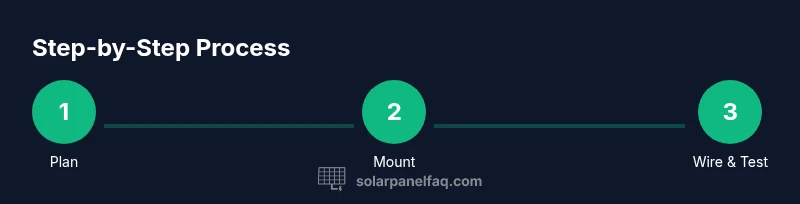
Planning defines success. This section outlines a high-level sequence to complement the detailed step-by-step instructions later. Start by confirming the roof structure, then lay out the panel positions using chalk lines or temporary weights to simulate balance. Dry-fit brackets, rails, and panels to ensure alignment and clearance above vents, skylights, and any roof fixtures. Once satisfied, remove components, apply edge sealant to all mounting surfaces, reattach hardware, and mount panels securely. Route cables along the roof edge and into the vehicle via a safe entry point, ensuring all penetrations are weather-sealed. Finally, connect the regulator and battery, perform a cautious live test, and monitor for overheating or loose fittings. This overview helps you anticipate challenges without committing to irreversible steps.
Safety, legality, and warranty considerations
Before and after installation, consider safety and compliance. Always wear PPE, use a stable work platform, and avoid working on the roof in wind or rain. Check your caravan’s manufacturer guidance on roof load limits and any warranty implications of non-factory installations. Some providers require professional installation to preserve warranty coverage; others permit DIY with proper documentation. Keep receipts for all components, including panels, mounting hardware, sealants, and the charge controller, because warranties often hinge on using compatible parts and proper installation techniques. The Solar Panel FAQ team notes that documented, quality components and careful sealing improve long-term performance and protect against water ingress.
Maintenance, performance expectations, and troubleshooting
Regular maintenance extends the life of a caravan solar setup. Clean the panels with a soft cloth and non-abrasive cleaner to maintain efficiency, and inspect seals after heavy rain or during seasonal changes. Check that all cable runs remain intact, clips secure, and no corrosion appears on stainless fasteners. If performance drops, test system voltage at the battery, measure panel voltage under light, and verify controller settings. Troubleshooting common issues—such as a non-charging status due to a blown fuse or a loose connection—can save you time and money. The Solar Panel FAQ analysis shows that routine checks reduce the risk of panel damage and ensure consistent energy generation across seasons.
Tools & Materials
- Solar panels (rigid or flexible)(Total wattage aligned to daily energy use; consider panel count for shade and roof space.)
- Mounting brackets/rails(Aluminum or stainless steel; choose flush-mount or rail-based system.)
- Sealant (UV-stable)(Apply around fasteners and edges to prevent leaks.)
- Butyl tape (optional)(Used to improve sealing at mounting points.)
- Self-tapping screws (galvanized or stainless)(Size depends on mounting hardware and roof thickness.)
- Drill with appropriate bits(Pilot holes in roof material; avoid structural members.)
- Exterior DC wiring cable (12-16 AWG typical)(Weatherproof sheathing recommended; route along edges.)
- Charge controller (MPPT recommended)(Matches total panel current; place in ventilated area.)
- Battery bank (AGM or Li-ion)( sized to daily usage; ensure proper ventilation for Li-ion.)
- Fuse or circuit breaker and holder(Protect wiring; place near battery output.)
- DC wiring connectors and crimping tool(Secure, weatherproof connections.)
- Multimeter(Test voltage, continuity, and polarity.)
- Safety gear (gloves, eye protection)(Basic PPE for roof work.)
- Ladder or stable platform(Safe roof access and fall protection.)
- Edge seating and gaskets(Additional sealing for dynamic edges.)
Steps
Estimated time: Total time: 4-8 hours
- 1
Plan energy needs and choose components
Assess daily energy consumption to determine panel wattage, regulator rating, and battery size. Create a simple load profile for essential devices and consider a buffer for cloudy days.
Tip: Document your expected daily usage to avoid over- or under-sizing the system. - 2
Prepare roof and layout mounting points
Clean the roof surface and dry-fit brackets and rails to confirm alignment away from vents or hatches. Mark drill holes with a non-permanent marker.
Tip: Use masking tape as a guide to avoid misalignment. - 3
Seal and attach mounting hardware
Apply edge sealant to mounting areas, then attach brackets/rails with the correct screws. Ensure hardware sits flush and evenly distributes load.
Tip: Don’t overtighten; use a torque guideline from the manufacturer. - 4
Mount panels and route cabling
Attach panels to brackets or rails and route cables along the roof edge, avoiding sharp edges. Use clips or conduits for protection.
Tip: Keep cables away from hot surfaces and moving parts. - 5
Connect regulator, battery, and panel wiring
Install the charge controller in a ventilated, dry space. Connect panel leads to the controller, then to the battery with proper polarity and fuses near the battery.
Tip: Double-check polarity before energizing the system. - 6
Perform safety test and seal penetrations
Power the system and inspect for heat, loose fittings, or leaks. Apply additional sealing at any penetrations as needed.
Tip: Monitor system behavior for the first 24 hours. - 7
Final check and routine maintenance plan
Document system outputs, store spare parts, and schedule periodic inspections for seals, cables, and battery health.
Tip: Set a yearly calendar reminder for inspections.
Frequently Asked Questions
Is my caravan roof suitable for solar panels?
Most caravan roofs can accommodate solar panels if the surface is solid and not overly curved. Check load limits, roof age, and the presence of vents or fixtures that could interfere. If in doubt, consult the caravan manufacturer guidelines or a professional.
Most caravan roofs can take solar panels if the surface is solid and not too curved; check load limits and speak with a pro if unsure.
Do I need planning permission to install solar panels on a caravan?
In most cases, caravan solar installations don’t require planning permission because caravans are mobile. However, always verify local regulations and any park or site rules where you plan to operate the caravan.
Usually no planning permission is needed, but check local rules and caravan park guidelines.
What is the difference between MPPT and PWM regulators?
MPPT regulators harvest energy more efficiently, especially under variable light, while PWM regulators are simpler and cheaper but less efficient. Choose MPPT for better performance on shaded or low-light days.
MPPT is more efficient than PWM, especially in less-than-ideal lighting.
How should I route wires to avoid damage?
Run cables along the roof edge or inside protected conduits, away from heat, sharp edges, and moving parts. Use clips and grommets to secure and protect cables.
Route cables along edges with protective clips to prevent wear.
Can I install solar panels myself?
DIY installation is possible with the right tools, clear instructions, and safety gear. If you’re unsure about electrical work or roof safety, hire a professional to avoid leaks and safety risks.
Yes, DIY can work if you’re careful and follow guides; consider hiring help for safety.
What maintenance is required for caravan solar panels?
Regularly clean panels, inspect seals and cables, and check for corrosion or loose fittings. Test the system periodically and review battery health and charging efficiency.
Clean panels, check seals, and test the system at least once a year.
Watch Video
Top Takeaways
- Assess roof suitability before any mounting.
- Match panel capacity to daily energy use and battery storage.
- Seal all penetrations thoroughly to prevent leaks.
- Test the system safely with proper protective gear and follow manufacturer instructions.