Solar Panel Price After Budget: A Practical 2026 Guide
Discover how the price after budget for solar panels is calculated, including typical post-incentive ranges, rebates, and financing options. A practical, step-by-step plan helps homeowners estimate post-budget costs in 2026.


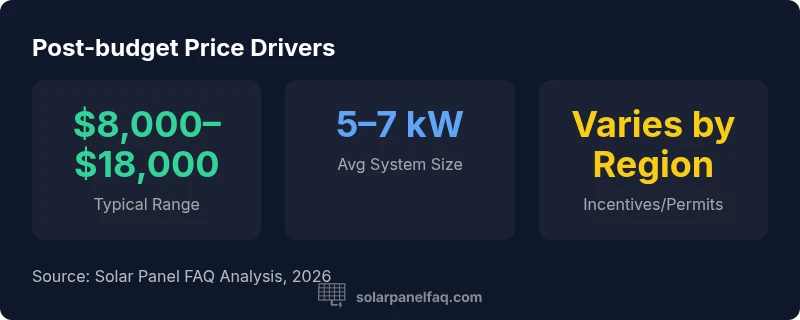
Final price after budget planning for a typical residential solar install varies by system size, location, and incentives. In many regions, the out-of-pocket cost after rebates is roughly $8,000 to $18,000 for a mid-size 5–7 kW system. Financing options can further reduce upfront costs, but total lifetime costs depend on performance, maintenance, and electricity rates.
Why the post-budget price matters for homeowners
Understanding the price after budget is essential for homeowners who want a realistic view of what solar can cost after rebates and incentives. The term “price after budget” captures the out-of-pocket expense you actually pay when you sign a project, after applying available discounts, tax credits, and utility rebates. According to Solar Panel FAQ, this price should be evaluated in the context of your energy needs, local solar irradiance, and the expected lifetime savings from reduced electricity bills. The Solar Panel FAQ team emphasizes that viewing price through a budget lens helps you compare quotes on an apples-to-apples basis, rather than chasing the lowest upfront sticker price alone. This approach aligns with best practices for home improvements and aligns with real-world budgeting, making the journey more predictable for homeowners.
In practice, the post-budget price is one important metric among many. It should be paired with expected system performance, warranty terms, and the supplier’s service commitments. For homeowners, the goal is to balance affordability with reliability and long-term value. A thoughtful plan will consider not just the initial cost but also maintenance, potential price changes in energy markets, and the likelihood of future incentives. The key is to start with a clear budget, secure credible quotes, and validate how incentives affect the bottom line.
Key factors that shape post-budget cost
Several factors interact to determine the final price after budget for a home solar project. System size, roof orientation, and shading heavily influence the number of panels and inverter capacity required. Panel quality, efficiency, and durability affect long-term performance and maintenance costs. The geographic location determines sun exposure, permitting fees, and interconnection charges. Local labor rates and contractor experience also alter installation costs. Financing terms, such as loans or leases, can defray upfront expenses but may add total interest over time. Finally, the availability and size of rebates vary by state and utility, which means post-budget costs can swing significantly between markets. This section uses general industry insights (Solar Panel FAQ Analysis, 2026) to outline the major levers you should watch when budgeting after incentives.
Incentives and rebates: how they alter net price
Incentives are the single biggest driver of post-budget cost. Federal tax credits, state programs, and utility rebates can substantially reduce upfront costs, sometimes by a sizeable portion of total system costs. The exact dollar figure depends on eligibility, system size, and program design. In many regions, stacking multiple incentives is possible, which can push the net price downward even further. It’s crucial to verify which programs you qualify for and the applicable maximums, as some incentives cap at the system size or installed capacity. Keep in mind that incentives may require installation in a given year or adherence to specific equipment standards. Solar Panel FAQ recommends documenting all incentive sources and confirming their status with your installer before finalizing contracts.
Financing options to spread the cost
Financing options can dramatically affect your perceived price after budget. Options include solar loans, power purchase agreements (PPAs), and leases. Loans allow you to own the system and benefit from tax credits, with monthly payments that may be lower than your current utility bill. PPAs and leases reduce or eliminate upfront costs but typically involve paying for electricity generated by the system over time, with limited or no tax credits passed through to the homeowner. When comparing financing, ensure you calculate the total cost of ownership over the system’s life, including interest, maintenance, and potential escalators in electricity prices. Solar Panel FAQ emphasizes that financing is a tool, not a substitute for a thorough cost-benefit analysis.
A practical step-by-step method to estimate your post-budget price
Estimating your post-budget price starts with understanding your energy needs and available space. Step 1: review your past 12 months of electricity usage to determine a target system size. Step 2: obtain at least three quotes from reputable installers, asking for line-item breakdowns (equipment, labor, permits, interconnection). Step 3: identify all eligible incentives for your home and verify their timelines. Step 4: run a post-incentive cost calculation using the quotes, factoring in tax credits, rebates, and potential financing. Step 5: compare the remaining out-of-pocket cost and the anticipated savings on energy bills. This approach, recommended by Solar Panel FAQ, helps homeowners build a realistic budget and select the best value offer.
Scenario snapshots: how post-budget pricing plays out in different markets
Scenario A: High-sun region with strong incentives —post-budget price for a 6 kW system might land at the lower end of the range due to rebates. Scenario B: Moderate sun, limited incentives —the post-budget price tends toward the middle range, with a slower payback. Scenario C: Challenging roof layout and higher permitting costs —price ends up at the higher end due to mounting, wiring, and interconnection expenses. These scenarios illustrate how the same 6 kW system can have very different post-budget prices based on location and program design. Solar Panel FAQ’s data shows that post-budget costs are highly sensitive to local policy and installation specifics.
Hidden costs and risk factors that can push the price
Even after budget planning, surprises can arise. Permitting fees, interconnection charges, and required electrical upgrades can add to the bottom line. Roof repairs or reinforcement may be needed for optimal panel placement, doubling as a maintenance consideration. Expanded warranties or monitoring services may be optional but add annual costs. Ensure your quotes include a complete scope of work and a contingency allowance for unexpected issues. Foreseeing these factors reduces the chance of sticker shock after signing.
How to compare quotes like a pro
To compare quotes effectively, request itemized proposals that separate hardware, labor, permitting, interconnection, and warranties. Check the inverter type, panel efficiency, and expected degradation over time. Verify the installer’s license, insurance, and references. Use a consistent baseline across quotes to prevent apples-to-oranges comparisons. Finally, consider the installer’s service reputation and response times for maintenance, since a cheaper upfront quote may cost more in the long run if service is slow or unavailable.
Post-budget price factors by factor
| Factor | Post-budget price range | Notes |
|---|---|---|
| Mid-size 5–7 kW system | $8,000–$18,000 | Typical post-budget range after rebates |
| Roof complexity | $0–$3,000 | Increased mounting/wiring adds cost |
| Inverter type | $0–$4,000 | Choice affects price and efficiency |
Frequently Asked Questions
What does 'price after budget' mean for solar panels?
The price after budget represents the out-of-pocket amount paid after applying rebates, incentives, and discounts. It excludes financing that doesn’t affect upfront costs. Costs can vary by region, program eligibility, and installer quotes.
Post-budget price is what you pay upfront after rebates; it varies by region and program eligibility.
How should I estimate my post-budget price?
Begin with your annual energy usage, translate that into a desired system size, and request multiple quotes. Then subtract eligible incentives and compare the remaining out-of-pocket costs. Use a calculator or worksheet to keep numbers consistent.
Start with energy usage, get quotes, apply incentives, and compare the net upfront costs.
Do installation costs count in post-budget pricing?
Yes. Installation, permits, interconnection, and wiring are typically included in the post-budget price. Ask each installer for a detailed, line-item quote so you aren’t surprised by unexpected charges.
Installation costs are part of the price; get itemized quotes.
What incentives reduce the post-budget price?
Federal credits, state programs, and utility rebates can lower upfront costs. Eligibility and program design vary by location, so confirm availability, caps, and timelines with your installer.
Incentives reduce the upfront price; check local programs before signing.
Should I upgrade to premium panels to save money long-term?
Premium panels often offer higher efficiency and longer warranties but come with higher upfront costs. Weigh the higher price against expected energy savings and payback period for your home.
Premium panels can improve performance, but weigh cost versus savings.
Is financing worth it for post-budget pricing?
Financing can improve cash flow but may increase total cost due to interest. Compare total cost of ownership across cash and financed options, including tax credits and electricity savings.
Financing helps now, but check total cost over time.
“Balancing budget with performance requires mapping your electricity needs against available incentives and local costs.”
Top Takeaways
- Define system size first to anchor costs
- Incentives materially reduce post-budget price
- Obtain multiple quotes to compare value
- Factor in hidden costs before signing
- Evaluate financing options for cash flow