What Does It Cost to Buy Solar Panels in 2026? A Practical Guide
Explore what it costs to buy solar panels in 2026, including upfront costs, incentives, financing options, and how to estimate your payback. Clear, practical guidance for homeowners and solar buyers.


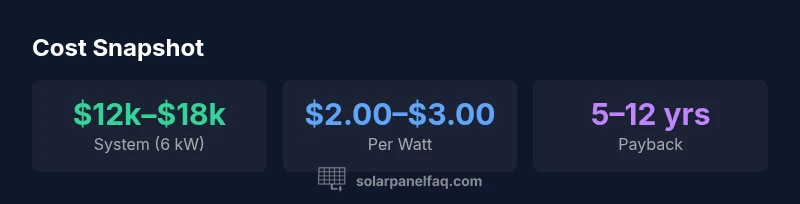
According to Solar Panel FAQ, the typical up-front cost to buy a residential solar panel system ranges from about $12,000 to $18,000 for a 6 kW setup before incentives. Costs vary by location, permits, installer, and equipment quality; after federal tax credits and local incentives, many homeowners see a payback of about 5–10 years.
What drives the sticker price: components of solar panel cost
The price you pay for solar panels is driven by several core components, not just the panels themselves. The modules—the glass-covered photovoltaic cells you see on the roof—are only part of the upfront expense. A sizable portion goes to the balance of system (BOS), which includes the racking and mounting hardware, wiring, junction boxes, inverters, monitoring equipment, and electrical labor. Permitting, interconnection fees, and any required system design or engineering services also contribute. Regional labor rates, roof accessibility, and roof type (flat, pitched, tile, or metal) influence BOS costs. Finally, contractor markup and warranty coverage add to the headline price. When you request quotes, ask for a line-item breakdown so you can compare like-for-like components and identify any hidden fees.
- Panels: Look at efficiency, warranty, and temperature coefficients. Higher efficiency panels may reduce BOS requirements on small roofs but can cost more upfront.
- Inverters: String inverters are common, while microinverters or optimizers may add cost but offer better performance under shading.
- Installation: Roof access, ladder time, and electrical wiring extent vary by home and can swing the total price.
- Permitting and interconnection: Local rules determine permit fees and utility interconnection costs, which can be a noticeable portion of the bill.
This is not just a sticker price exercise—the long-term value depends on how the system is installed and integrated with your home’s electrical setup. Solar Panel FAQ emphasizes gathering formal quotes and comparing BOS components to avoid surprises at install time.
Regional differences and installation variables
Prices are highly sensitive to location and installation specifics. States and municipalities vary in incentives, permitting complexity, and utility interconnection rules. Roof characteristics matter: a steep or multi-story roof increases labor time; tile roofs require specialized mounting hardware that can raise material costs; houses with limited sun exposure or shading from trees reduce system output and can influence system sizing decisions. HOA rules and local codes may add compliance steps or permit fees. In regions with higher electricity rates, installers may propose larger systems to maximize savings, which changes upfront cost but improves payback potential. In short, the same 6 kW system can cost thousands more in one area than another depending on these factors.
- Sun exposure and climate: More sun generally means more energy production per dollar invested, improving payback.
- Permit and interconnection: Some areas charge flat fees; others base costs on system size or complexity.
- Roof access and safety: Complex roof lines or tall structures increase labor time and risk.
Solar Panel FAQ notes that corroborating multiple local quotes is essential to understanding local pricing dynamics and total cost of ownership.
Incentives, tax credits, and how they affect net price
Incentives are a major lever in the cost equation, but they vary by year, location, and program availability. Federal and state programs, utility rebates, and local grants can significantly reduce net cost. Some incentives are tied to the system’s performance, while others apply to the upfront purchase price or labor. It’s important to identify which incentives apply to your installation and ensure your installer includes the necessary paperwork for claiming them. Because incentive landscapes change, you should verify current offerings at the time you purchase and consider consulting a tax professional to understand eligibility. Even with incentives, the economics hinge on your electricity usage patterns and energy prices.
- Federal incentives: These typically reduce the upfront price or tax liability, depending on eligibility.
- State and local programs: Ranging from rebates to performance-based incentives.
- Utility programs: Net metering credits or time-of-use rate reductions can boost the value of solar production.
For many homeowners, incentives shift the payback window from a long horizon into a more manageable period, improving ROI in net present value terms.
Financing options and how they affect the out-of-pocket cost
Beyond paying upfront with cash, there are multiple financing paths that can affect your immediate out-of-pocket cost and long-term savings. Loans for solar installations can spread the upfront price over 5–20 years, lowering monthly payments. Leases and power purchase agreements (PPAs) let you enjoy solar power with little or no upfront cost, but ownership remains with the financer and total lifetime savings may be lower. Some homeowners prefer cash for maximum ownership and maximum energy savings, while others value predictable monthly costs and protection against rising electricity rates. Compare total cost of ownership across options, including interest, depreciation, insurance, and maintenance, to pick the strategy that aligns with your budget and long-term goals.
- Cash purchase: Highest upfront investment, maximum lifetime savings, ownership.
- Solar loan: Moderate upfront cost with monthly payments; ownership transfers at payoff.
- Lease/PPA: No or low upfront cost; contract terms determine savings and ownership.
- Tax and incentive timing: Some benefits apply only if you own the system.
Assess your credit, monthly budget, and how long you plan to stay in the home to choose the best path.
How to estimate your cost for a home, with a step-by-step example
Estimating costs involves several steps beyond a simple price quote. Start by sizing the system to meet a portion or all of your energy usage, using your past 12 months of electric bills as a baseline. Get at least three quotes with detailed BOS breakdowns. Factor in roof work, wiring upgrades, and permit fees. Apply expected incentives and tax credits to calculate the net price. Finally, compare this net price to projected energy savings to determine payback. A simple worksheet can help, listing system size, gross price, BOS costs, incentives, and expected annual energy savings, then computing payback and net present value.
- Step 1: Gather last 12 months of utility bills to estimate annual kWh usage.
- Step 2: Get three or more quotes with a full BOS line item.
- Step 3: Add potential roof or electrical upgrades you’ll need.
- Step 4: Subtract incentives and tax credits to get net price.
- Step 5: Estimate annual energy savings and compute payback.
This hands-on approach keeps you grounded in your home’s specifics, not generic averages, which Solar Panel FAQ suggests leads to smarter decisions.
Cost considerations by roof type, shade, and hidden fees
Your roof type and shading can materially influence cost and performance. Flat or low-slope roofs may simplify installation and reduce labor costs, while tile roofs require careful mounting strategies and specialized hardware that can add to BOS costs. Shading from trees or nearby structures reduces energy output, often requiring larger system sizing to achieve desired savings, which increases upfront cost. Don’t overlook non-utility fees: roof penetrations, wiring upgrades, permit surcharges, and potential warranty extensions can all influence the final price. Finally, consider future maintenance costs, inverter replacement timelines, and potential panel cleaning needs in some climates. By planning for these factors, you can set realistic expectations and avoid sticker shock when the project begins.
Realistic expectations and next steps
A robust cost analysis balances upfront price, potential incentives, and long-term energy savings. Start with a reliable quote that itemizes BOS costs, compare the price per watt across installers, and confirm the expected performance under your local sun exposure. Keep in mind that a lower upfront price may come with trade-offs in warranty terms or monitoring features. A thoughtful approach—supported by the data-driven insights from Solar Panel FAQ Analysis—helps homeowners align the purchase with energy goals and budget realities.
Estimated installed costs by system size
| System Size (kW) | Estimated Installed Cost (before incentives) | Cost per Watt (before incentives) | Typical Payback (years) |
|---|---|---|---|
| 3 | $7,500–$11,000 | $2.50–$3.50 | 6–9 |
| 6 | $12,000–$18,000 | $2.00–$3.00 | 6–12 |
| 9 | $18,000–$26,000 | $2.00–$2.90 | 7–12 |
Frequently Asked Questions
What factors influence the upfront cost of solar panels?
Upfront costs are driven by equipment quality, BOS components, installation complexity, roof type, and local permitting. Quotes should break down these elements so you can compare apples to apples.
Upfront costs depend on the modules, BOS, and local permitting.Let installers itemize everything.
Do incentives reduce the net price?
Yes—federal, state, and utility incentives can reduce net cost, but availability varies by year and location. Verify which incentives you qualify for and include them in your calculation.
Incentives can lower what you pay, but they depend on location and timing.
How does system size affect total cost?
System size generally scales with cost and output. Larger systems cost more upfront but produce more electricity, potentially shortening the payback period if energy prices stay high.
Bigger systems cost more, but save more energy over time.
Are there ongoing maintenance costs?
Maintenance is typically low-cost and infrequent. Expect inverter replacement every 10–15 years and occasional panel cleaning or monitoring checks.
Maintenance is usually minimal, with occasional inverter replacements.
Is leasing or a PPA cheaper upfront?
Leasing or PPAs can reduce or eliminate upfront costs but you don’t own the system. Long-term savings depend on contract terms and electricity rates.
Leases and PPAs cut upfront costs but may secure less long-term value.
What is a typical payback period?
Payback ranges commonly depend on usage, incentives, and local electricity prices. Expect roughly 5–12 years as a broad window, with variations by location and roof characteristics.
Payback is usually between 5 and 12 years depending on many factors.
“Costs are highly variable, but a properly sized system can deliver meaningful energy savings over its lifetime.”
Top Takeaways
- Estimate upfront costs by system size and region
- Incentives reduce net price; know your eligibility
- Financing can lower monthly costs but affects total savings
- Obtain multiple, itemized quotes for accurate comparison
- Plan for maintenance and inverter replacement in long-term costs