Solar Cost in 2026: A Practical Guide for Homeowners
Explore solar cost fundamentals, what drives price, how incentives reduce out-of-pocket costs, and practical steps to maximize ROI for homeowners in 2026.


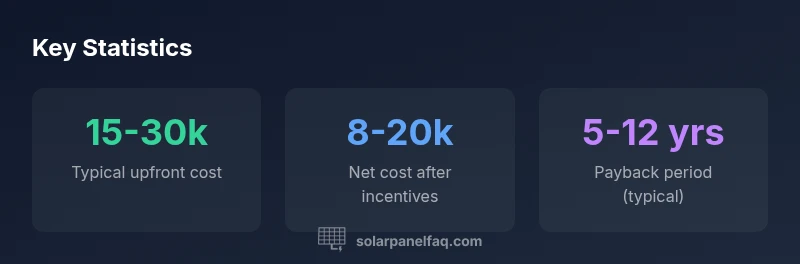
Solar cost for a typical residential solar panel system ranges widely, but most homeowners pay roughly $15,000 to $30,000 before incentives. After accounting for tax credits and rebates, net costs commonly fall to about $8,000 to $20,000. These figures depend on system size, roof orientation, and local installer rates. Costs can also be influenced by shading, inverter choice, and whether you finance or purchase upfront.
Why Solar Cost Matters
Understanding solar cost is essential for homeowners weighing a solar decision. The upfront price often dominates conversations, but the real value lies in long-term energy savings and reliable performance. According to Solar Panel FAQ, the typical residential system can transform monthly electricity bills from unpredictable peaks into more predictable payments. The largest price drivers are system size, roof orientation, and local installer rates. Solar cost is not a fixed sticker price; it evolves with design choices, financing options, and incentives. Homeowners should view cost as a spectrum rather than a single number, recognizing that the lowest sticker price isn’t always the best value over the life of the system. In practice, a thoughtful approach considers how much energy you use, how much you can save on utility bills, and how incentives alter the net expense. For most households, the path to affordable solar starts with a clear estimate of annual energy needs and a realistic projection of future electricity prices.
- Real value comes from lifetime savings, not just the first-year price.
- The role of incentives is large but varies by state and utility.
- Financing vs. upfront cash changes the financial picture even when the installed cost is similar.
What Drives the Cost of a Solar System
Prices are shaped by multiple interdependent factors that extend beyond the panels themselves. The solar modules you choose determine efficiency, durability, and production across weather conditions; inverters affect reliability and performance in real time; and mounting hardware, wiring, and permitting add job-specific costs. Labor quality and local regulations influence overall pricing as well. Regional market dynamics, such as demand for residential solar and installer competition, can push costs in one direction or another. Additionally, the roof’s characteristics—its slope, orientation, and shading—affect both production and installation complexity, which in turn impacts price. The Solar Panel FAQ team emphasizes that a lower upfront quote may come with trade-offs in warranty or system design, while a higher quote can offer longer-term value through better components and monitoring capabilities. When comparing bids, prioritize a balance of cost, performance, and service quality rather than price alone.
- Components matter: modules, inverters, and racking all influence energy output.
- Permits, interconnection fees, and inspections add to the final bill.
- Installation complexity (roof condition, penetrations, and shading) can swing costs significantly.
Regional Variations and Market Dynamics
Cost variability is a reality across the United States and other regions. Climate, solar irradiance, and the local electrical rate structure shape how much you pay upfront and how much you save over time. In sunny climates with high electricity costs, solar tends to deliver quicker payback, while in areas with milder sun and lower rates, ROI can take longer to realize. Labor costs and local competition among installers also influence price; regions with more installers typically see more competitive pricing, while remote areas may incur higher shipping and permitting costs. Policy stability matters as well: changes to incentives or interconnection rules can alter net cost in the short term. Solar cost must be assessed in its regional context to avoid over- or under-estimating value.
- Regional sun exposure and utility rates drive payback timelines.
- Local installer competition affects pricing dynamics.
- Policy environments can shift net costs year to year.
Incentives, Financing, and Net Costs
Incentives at the federal, state, and utility levels can significantly reduce net costs, sometimes altering the economics enough to change the decision from borderline to favorable. Financing options—such as solar loans or leases—offer alternative paths to ownership, changing monthly cash flow and long-term payoff. It’s important to model different scenarios: upfront purchase with cash, loan financing, and lease or power purchase agreements. Each option has trade-offs in ownership, maintenance responsibility, and total cost of the system over its lifetime. The Solar Panel FAQ team notes that incentives move the needle on the bottom line, but the long-term value is mainly driven by performance, reliability, and the stability of electricity prices. Always verify eligibility, pay attention to expiration dates, and read the fine print on warranty terms and service commitments.
- Incentives reduce net cost but vary by location.
- Financing shifts cash flow but not overall system value.
- Warranty and monitoring contribute to long-term ROI.
How to Estimate Your Solar Cost: A Step-by-Step Example
Estimating your solar cost begins with honest energy-use data and a realistic assessment of your roof’s suitability. Start by calculating your annual electricity consumption from past bills, then pick a target system size that can cover a large portion of that usage. Use a solar calculator or request a site assessment from local installers to translate consumption into an estimated system size (in kilowatts). Next, compare quotes that break out modules, inverters, racking, wiring, permits, and labor. Don’t rely on “price per watt” alone—ask for a complete breakdown and the expected annual energy production. Factor in incentives, financing terms, and any maintenance costs. Finally, model your net cost and payback period by simulating two scenarios: best- and worst-case production, plus a conservative electricity-rate forecast. The process will show whether solar cost aligns with your budget and whether the investment makes sense over 15–25 years.
- Gather 3–5 detailed quotes for a robust comparison.
- Check expected output versus bill savings to validate the design.
- Include maintenance and inverter replacement costs in long-term planning.
Choosing an Installer and Reading Quotes
Selecting the right installer is as important as selecting the right equipment. Look for experienced installers with verifiable track records, proper licensing, and strong warranties. Ask for references and verify their installed-base performance. When evaluating quotes, focus on design quality, component brands, warranty terms, and service commitments in addition to price. A lower bid might mean shorter warranties or less robust monitoring. Conversely, the highest bid is not always the best value if it lacks essential protections or a credible production estimate. Use a standardized comparison sheet to capture key details such as module type, inverter efficiency, racking system, monitoring options, and maintenance plans. Favor installers who provide a transparent production estimate and a clear path for system monitoring after installation.
- Check licenses, insurance, and warranties.
- Compare system design, components, and monitoring.
- Use a standard scoring rubric to rank quotes objectively.
Cost vs Savings: Payback and ROI
Beyond upfront costs, homeowners should evaluate long-term value. A solar system’s ROI hinges on how much electricity it offsets and how utility rates evolve. Even with similar upfront costs, two homes can experience very different payback periods due to usage patterns, roof orientation, shading, and local policy incentives. Read production estimates carefully; a well-designed system that aligns with your energy habits will deliver the best returns. Consider maintenance needs and potential inverter replacements over the system’s life. The goal is to maximize energy independence while minimizing total out-of-pocket expenses over 15–25 years. While there isn’t a one-size-fits-all timetable, the most successful homeowners model several scenarios and choose the option that delivers the strongest long-term value.
- Production estimates are critical to ROI calculations.
- Maintenance costs and component lifespans affect total cost.
- Scenario planning helps identify the best financing path.
Common Myths About Solar Cost
Myth 1: Solar is always expensive upfront. Reality: upfront costs can be offset by incentives, financing, and long-term savings. Myth 2: The cheapest quote is the best value. Reality: lowest price often sacrifices warranties, design quality, or customer service. Myth 3: Solar costs never change after installation. Reality: maintenance, inverter replacement, and monitoring fees can affect long-term costs. Myth 4: Roof replacement is always required. Reality: many roofs can be upgraded or reinforced without full replacement. Myth 5: Solar is a one-size-fits-all solution. Reality: system size and configuration should align with energy use and roof characteristics.
- Myths distort budgeting and decision-making.
- Use verified quotes and site assessments to debunk false claims.
- Plan for the long horizon, not just the initial price.
Estimated cost and payback factors for typical residential solar setups
| Aspect | Typical cost range | Notes |
|---|---|---|
| System size (kW) | 5-10 kW | Common residential size |
| Upfront cost before incentives | $15,000-$30,000 | Depends on size and components |
| Net cost after incentives | $8,000-$20,000 | Varies by incentives |
| Payback period | 5-12 years | Depends on electricity rates |
Frequently Asked Questions
What is the typical upfront cost for a residential solar system?
Upfront costs vary by system size and components, but a good starting point is to compare 3-5 detailed quotes that break out modules, inverters, and installation. Look beyond the sticker price and consider warranties, performance estimates, and after-sale service.
Compare 3-5 detailed quotes and focus on warranties and production estimates.
How do incentives affect solar cost?
Incentives—federal, state, and utility programs—can substantially reduce net cost by lowering the upfront price or increasing the value of the system. Always verify eligibility, expiration dates, and how incentives are applied in each contract.
Incentives can substantially cut net cost; check eligibility and timing.
Is leasing better than buying solar?
Leasing lowers upfront cost and reduces maintenance concerns, but ownership rewards (such as equity and higher resale value) are different. Financing or purchasing typically yields greater long-term savings if you plan to stay in the home.
Leasing lowers upfront costs but may reduce long-term savings; buying usually pays off more in the long run.
What factors influence payback period?
Payback depends on your energy usage, system size, local electricity rates, and incentives. Higher usage and rates shorten payback, while poor shading or smaller systems lengthen it.
Payback hinges on energy use, system size, rates, and incentives.
Do roof condition and orientation affect cost?
Yes. A healthy roof with optimal orientation improves production and can lower installation complexity, while poor orientation or the need for roof repairs can increase costs or reduce gains.
Roof condition and direction matter for cost and output.
How should I compare solar quotes?
Use a standardized comparison that includes module type, inverter, mounting hardware, warranties, expected production, and maintenance plans. Price alone is not enough to judge value.
Compare details, not just price. Look at warranties and production estimates.
“Solar cost is a function of design, incentives, and local labor. When you compare quotes, focus on long-term value, not sticker price.”
Top Takeaways
- Assess solar cost by system size, roof suitability, and local market rates
- Incentives reduce net cost; financing changes cash flow, not total value
- Get 3-5 detailed quotes and compare design quality, warranties, and ongoing costs
- Understand payback and long-term ROI for your home
- Regional factors influence price and payback timelines