How Much Does a Single Solar Panel Cost?
Discover how much a single solar panel costs, the factors that affect price, and how to estimate total costs, incentives, and payback for homeowners in 2026.


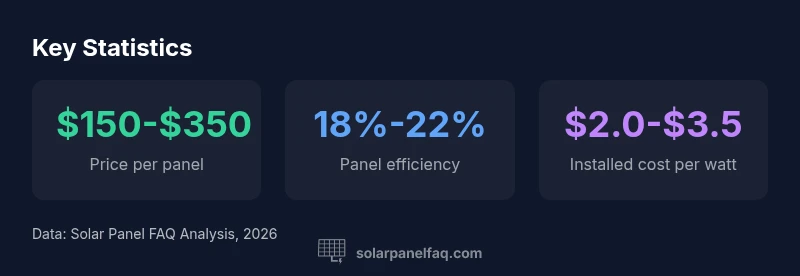
On average, a single solar panel before installation costs about $150 to $350, depending on wattage, efficiency, and brand. Higher-efficiency or premium panels can push toward the upper end, while basic models sit near the lower end. The final installed price depends on system size, mounting, inverters, and local labor costs, but the panel price itself is the key snapshot homeowners should budget for.
Understanding the price components of a single solar panel
The sticker price for a solar panel represents the cost of the unit itself, commonly driven by wattage, efficiency, and brand. On the market, a typical residential panel price before installation ranges roughly from $150 to $350 per panel. Higher-efficiency cells and premium brands command the upper end of that range, while basic, widely available models sit near the lower end. Beyond the panel, there are additional costs to consider later in this section. According to Solar Panel FAQ, the panel price reflects several upstream factors: raw materials, manufacturing scale, quality control, and the margin charged by retailers. Import duties and supply chain conditions can push prices up or down over time. When homeowners ask, 'how much does a single solar panel cost?', the panel price is the most visible data point, but the total cost to install depends on the rest of the system and the labor required to mount and connect it. In practice, buyers should compare at least two or three panel models within their target wattage to understand how efficiency and warranty terms affect the bottom line.
What drives the cost of a panel (wattage, type, and efficiency)
The cost of a panel is not a single fixed number; it scales with wattage rating, cell technology, and efficiency. Monocrystalline panels typically offer higher efficiency and reliable performance in limited space, but they usually cost more per watt than polycrystalline models. The higher efficiency means you may need fewer panels for the same energy production, which can offset higher per-unit prices if rooftop space is a premium. In addition, newer or premium brands may embed advanced coatings, improved bypass diodes, or better warranties, which adds to the sticker price. The overall demand for a given panel type in a region can shift prices quickly as manufacturers adjust production schedules. When evaluating options, homeowners should weigh the trade-offs between higher efficiency and the extra cost per watt, as well as long-term durability and performance in their climate. Remember that the price you see on a label is only part of the story; the quality and reliability of the panel affect long-term value and system uptime.
How to estimate the panel cost for your home
Estimating panel cost starts with your expected system size and energy usage. A typical home uses a certain amount of kilowatt-hours per day; your installer will translate that into a target system size in kilowatts (kW) or number of panels. The calculation hinges on the panel's wattage. For example, if you plan a 6 kW system and choose 320W panels, you would need roughly 19 panels. Multiply by the panel price to get the panel budget, then add management costs such as mounting hardware and wiring. The utility's interconnection requirements and your local codes may also add some costs. Keep in mind that these are rough estimates; actual bids vary by vendor, region, and permitting environment. Timing matters as well: prices can shift with market demand or tariff changes. A practical approach is to request itemized bids from multiple installers and use a simple checklist to compare the base panel price, the balance of system, and the included warranties.
Beyond the panel: installation costs
Even if you lock in a low panel price, the total installed cost depends on several balance of system components and services. Racking, wiring, combiner boxes, and optimizers (if used) add to the upfront outlay. The inverter (central or micro-inverters) is another major cost driver, and its size should align with your system's total capacity. Labor costs for roof mounting, electrical work, and local permits can vary widely by region. In some neighborhoods, roof work or electrical upgrades to the service panel are needed to accommodate added solar generation, raising the final bill. Some installers include the BOS (balance of system) in a single bid, while others itemize each component. If you plan a retrofit or a two-story installation, expect additional costs for accessibility and safety equipment. Finally, beware of vague quotes that lump all items into a single line item—itemized bids help you compare apples to apples.
Incentives, rebates, and financing to offset panel costs
Various incentives can materially reduce the net price of installing solar panels, but the availability and size of these programs depend on where you live and changing policy. Federal, state, and local programs may provide tax credits, rebates, or low-interest financing options. Some regions also offer performance-based incentives or net metering arrangements that improve long-term value by reducing the effective cost of electricity generated by the system. When evaluating offers, ask for the exact incentive amounts, eligibility criteria, and expiration dates. Your outlook improves if you bundle incentives with competitive bids and financing terms. For many homeowners, financing plans or solar leases/PPAs can alter the upfront cash flow and monthly costs, so weigh the total cost of ownership over the system lifetime rather than focusing solely on the sticker price.
How to compare quotes and avoid common pitfalls
To avoid overpaying or receiving suboptimal equipment, develop a simple comparison framework. Use a side-by-side checklist that includes panel price, panel type, efficiency, warranty, BOS cost, inverter type, labor, permitting, and interconnection fees. Ask for itemized bids broken down by component. Check that quotes assume the same system size and climate adjustments. Confirm the warranties cover performance guarantees, material defects, and installation workmanship. Beware of quotes that advertise 'free installation' without clear exclusions; read the fine print. Consider third-party performance metrics, independent reviews, and the installer’s track record with similar rooftops. Finally, demand a clear payment schedule and a published timeline to avoid scope creep during installation.
One-panel vs full system: what to know
Many homeowners start by considering a single panel and scale up to a full system; however, a single-panel approach rarely captures the economics of home solar. The cost per watt will typically decline as you add more panels because BOS costs are spread over a larger capacity, and utility incentives may scale with system size. In some designs, shading, orientation, and roof area constraints can affect both the number of panels and their placement, which in turn affects total cost and energy output. Always evaluate a full system plan rather than focusing solely on per-panel pricing. Your goal is to optimize for lifetime energy production, not just the upfront sticker price.
Practical budgeting tips and a quick checklist
Create a budget that includes the panel price, BOS, permits, and potential upgrades to the service panel. Build a 10–20% contingency into the estimate for unplanned work, roof repairs, or permitting delays. Use a 3-bid process to obtain competitive offers and ensure each bid includes a BOM (bill of materials) with line items and warranties. Maintain a project timeline and map out an after-installation savings plan, including expected energy savings and any incentives. Finally, document all communications and keep an organized folder of quotes, permits, and warranty certificates for future reference. The Solar Panel FAQ team recommends using a full-system plan and shopping multiple bids to maximize value.
Panel cost components and typical installed price ranges
| Aspect | Estimated Cost (before installation) | Notes |
|---|---|---|
| Panel price (each) | $150-$350 | Depends on wattage and brand |
| Installation hardware and mounting | $20-$60 per panel | Includes racking and wiring in some bids |
| Inverter and BOS equipment | varies by system size | Balanced with total capacity |
| Labor and permitting | $0.50-$1.50 per watt | Regional variation heavily influences cost |
Frequently Asked Questions
What is the typical price range for a single solar panel?
A single solar panel typically costs between $150 and $350 before installation, depending on wattage and efficiency. Higher-end models may cost more, while basic panels sit toward the lower end. This price excludes installation, BOS, and permits.
Most homeowners pay between $150 and $350 for the panel itself; installation and related costs add to the total.
Does the price of a single panel include installation?
No. The panel price is separate from installation costs. Expect to pay for mounting hardware, wiring, inverters, and labor to install and connect the panel to your electrical system.
No—installation is extra and varies by region and system design.
How does panel type affect cost?
Panel type (monocrystalline vs polycrystalline) influences price. Monocrystalline panels are typically more efficient and pricier per watt, while polycrystalline panels are generally cheaper but less efficient.
Type affects price per watt and space needs, so choose based on space and budget.
What incentives can reduce the panel cost?
Incentives vary by location and year and may include tax credits, rebates, or favorable financing. Check with local programs and your installer for current options and eligibility.
Check local and federal programs for credits and rebates, and discuss financing options with installers.
How many panels do I need for a 5 kW system?
The number of panels depends on the panel wattage. For example, 320W panels would require about 15-16 panels for a 5 kW system. Always verify with a professional bid for exact counts.
Panel count depends on wattage; a typical 5 kW setup needs roughly a dozen to sixteen panels.
Are there cheaper alternatives to a single solar panel?
There are no true substitutes for a panel when building a solar array; cheaper options include older inventory, used panels, or different financing terms, but these may affect warranty and performance. Always prioritize safety and warranties.
There aren’t real substitutes for panels; consider warranties and safety if exploring cheaper options.
“Cost clarity starts with the panel price, but total ownership hinges on the balance of system, installation quality, and incentives. A robust, itemized bid helps homeowners maximize value.”
Top Takeaways
- Estimate system size from daily energy use to gauge panel count
- Panel price varies by wattage, efficiency, and brand
- Installation and BOS costs can significantly alter total price
- Incentives and financing options can reduce out-of-pocket costs
- Always compare itemized bids for apples-to-apples budgeting