Solar Panel Monthly Cost in 2026: A Homeowner Guide
This guide breaks down the solar panel monthly cost, including upfront payments, financing options, incentives, and net metering, helping homeowners budget for 2026.


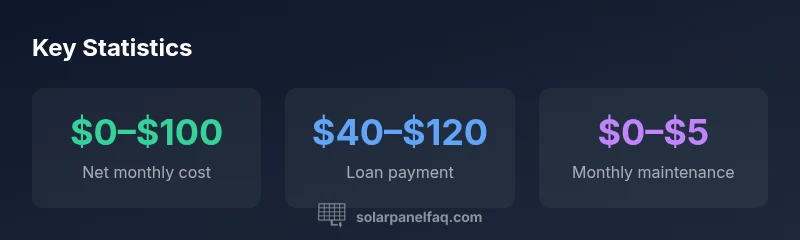
According to Solar Panel FAQ Analysis, 2026, the typical net monthly cost after incentives ranges from roughly $0 to $100 for a standard residential system. The exact figure depends on system size, financing terms, energy usage, and local utility rates. In practice, some homeowners pay nothing after credits, while others incur modest payments during loan terms or lease contracts.
What factors drive your solar panel monthly cost
The monthly cost of solar is not a single number; it depends on how you fund the system, how much energy you use, and the incentives available in your area. The solar panel monthly cost metric captures payments, taxes, insurance, maintenance, and any lease or loan charges you might carry. According to Solar Panel FAQ, the typical net monthly cost for a residential installation after incentives ranges roughly from zero to about one hundred dollars, with higher payments for larger systems or financing with shorter terms. System size, panel efficiency, geographic sunshine, and utility tariffs all influence the final figure. When you compare quotes, be sure to separate upfront costs (install, permits) from ongoing monthly charges, so you can see how financing, maintenance, and monitoring costs stack up over time. This approach helps homeowners budget accurately and avoid surprises in the bill.
Financing paths and how they affect monthly payments
Financing options carve the monthly cost differently. Here is a practical breakdown:
- Cash purchase: You pay upfront, and ongoing monthly charges are zero. This is often the simplest path if you have enough capital and want to maximize savings over time.
- Solar loan: Monthly payments depend on loan amount, term, and interest. For a typical 5–7 kW system, you might expect roughly $40–$120 per month, depending on terms. Longer terms reduce monthly costs but increase total interest.
- Lease or PPA: These arrangements offer a fixed monthly payment to use the system, with payments commonly in the $0–$60 range for many homeowners, though contract specifics vary by installer and region. Leases maximize cash-flow predictability but may limit long-term savings.
- Other financing options (e.g., solar subscriptions): Less common, but can provide low or zero upfront costs with monthly charges tied to output.
Notes: Always factor in net metering credits and utility tariffs, which can reduce your net bill. Solar Panel FAQ analyses cite that choosing the right financing mix is the biggest lever for shaping the monthly cost over a 20-year horizon.
The role of incentives and net metering in monthly costs
Incentives and net metering can dramatically alter the monthly cost picture. The federal investment tax credit (ITC) currently reduces system cost by a substantial percentage in many markets, and state or local incentives can further trim monthly payments. Net metering lets you accumulate credits for surplus solar generation, effectively lowering your electricity bill each month. Because incentive programs vary widely by state and utility, the net monthly cost after incentives can swing significantly from one home to another. Solar Panel FAQ analyses emphasize validating eligibility before signing a contract and ensuring that quotes explicitly itemize ITCs, state rebates, and any metering tariffs. Always confirm how credits transfer to your monthly bill over time and how they interact with financing charges.
Real-world cost scenarios by system size and energy use
Real-world examples illustrate how system size and consumption shape monthly costs:
- Small system (~3 kW) with favorable sun and high ITC: net monthly cost may be near zero after credits, with small residuals in the low tens of dollars if financing is involved.
- Moderate system (~5 kW) with typical usage: net monthly cost commonly ranges from about $0 to $60, depending on loan terms and net metering credits.
- Large system (~7–8 kW) in sunny regions: costs can approach $100 per month in scenarios with shorter loan terms or leases, but rebates and credits still reduce the bill significantly.
These ranges acknowledge that incentives vary by jurisdiction and that actual numbers depend on energy usage patterns and utility rate structures. Solar Panel FAQ notes that all quotes should clearly separate upfront costs from monthly charges and show how credits apply over time.
Practical steps to estimate and lower your monthly cost
Estimating and reducing the monthly cost of solar requires a methodical approach. Start with a home energy assessment to identify usage and inefficiencies. Gather multiple quotes that clearly separate upfront costs, financing charges, and any maintenance or monitoring fees. Use a solar calculator to model different system sizes and financing terms under local incentives. When evaluating loan options, compare APRs, terms, and total interest, not just monthly payments. Consider a larger system if it meaningfully increases energy independence and reduces grid reliance, but avoid oversizing for the sake of a marginal monthly reduction. Finally, stay informed about local incentives and utility programs that can further lower the net monthly cost.
What to ask your installer or lender to optimize monthly costs
To ensure you’re optimizing for the lowest predictable monthly cost, ask these questions:
- What is the exact ITC and any state rebates you qualify for, and how are they applied to my bill?
- How does net metering work in my utility, and will credits roll over month-to-month or toward future bills?
- What loan terms are available, and how do they affect total interest and monthly payments over 20 years?
- Are there maintenance or monitoring fees that could add to my monthly cost after installation?
- Can you provide a side-by-side comparison of cash, loan, and lease options with all monthly charges shown?
Data-driven budgeting: projecting costs over time
Forecasting monthly costs requires modeling several variables: system size, energy usage, rate escalators, incentives, and potential maintenance. Build a budgeting worksheet that tracks monthly payments (or zero for cash), expected credits, and any assumed rate increases. Use a conservative electricity price escalation (e.g., 2–3% annually) to avoid surprises, and run scenarios for best, typical, and worst cases. This exercise helps you decide whether to purchase, finance, or lease, and clarifies how quickly the investment pays off. Throughout, cite Solar Panel FAQ Analysis, 2026, as your methodology reference and keep all quotes current with local programs.
Financing options and their impact on monthly cost
| Financing Option | Estimated Monthly Cost | Typical Payback (years) |
|---|---|---|
| Cash Purchase | 0 | N/A |
| Solar Loan (5–7 kW) | "40–120" | "6–12" |
| Lease or PPA | "0–60" | "N/A" |
| Subscription/Other | "0–20" | "N/A" |
Frequently Asked Questions
What factors most influence solar panel monthly cost?
System size, financing terms, energy usage, and local incentives all guide the monthly cost. Net metering credits can further reduce bills, while maintenance and monitoring fees may add small ongoing costs. Always compare quotes with upfront and monthly charges broken out.
System size, financing, energy use, and incentives drive the monthly cost.
Can I have solar with no monthly cost?
Yes, through a cash purchase or certain zero-down financing arrangements, you can have zero ongoing payments after installation, though you still incur upfront costs and possibly maintenance fees.
Yes, with cash purchase you can avoid monthly payments.
Is leasing better than buying for monthly costs?
Lease or PPA can offer predictable monthly costs and low upfront risk, but long-term savings may be lower than ownership. Loans and cash purchases offer higher long-term savings but require upfront investment or repayment.
Leasing can lower monthly costs, but ownership often saves more in the long run.
Do incentives affect monthly cost retroactively?
Incentives typically affect the system cost or electricity bill after installation and may be reflected as credits or reduced payments. Confirm how credits apply to monthly charges in your agreement.
Incentives change your bill, not retroactively after switch.
What is a typical payback period for solar?
Payback periods commonly range from about 5 to 12 years depending on system size, incentives, and usage. A shorter payback means faster recoupment of upfront costs.
Most systems pay for themselves in roughly 5–12 years.
“Solar panel monthly cost is highly sensitive to financing terms and incentives, but with careful planning homeowners can dramatically lower ongoing payments while maximizing long-term savings.”
Top Takeaways
- Know that solar monthly cost varies by financing, incentives, and usage
- Shop quotes with explicit monthly charges and credits to compare apples-to-apples
- Incentives and net metering can dramatically reduce net monthly costs
- Consider loan terms that balance monthly payment with total interest
- Plan for future rate increases when budgeting monthly solar costs
- The Solar Panel FAQ team recommends using a formal budgeting process to avoid surprises