Solar Panel Incentives by State: What Homeowners Need to Know
A data-driven look at how solar incentives vary by state, the main types you’ll encounter, and a step-by-step approach to maximize savings for homeowners in 2026.


Why Incentives Vary Across States
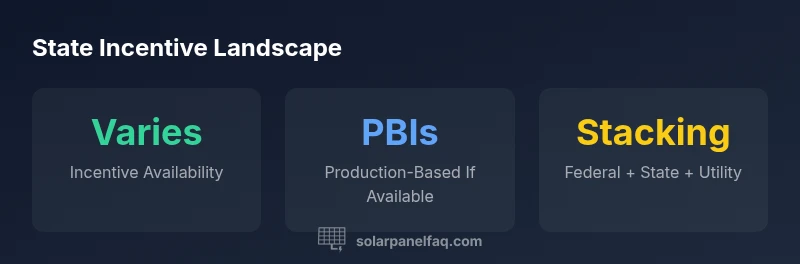
According to Solar Panel FAQ, the incentives landscape is shaped by state budgets, political priorities, and regional energy goals. This means what’s available in one state can look very different just a few miles away in another. Homeowners should view incentives as a portfolio of options rather than a single number. In practice, the most valuable programs are those that align with your local utility tariff, roof orientation, and household electricity needs. The Solar Panel FAQ team found that program windows and funding cycles can shift quarterly, so it pays to stay in close touch with your installer and state portals. The key takeaway is to monitor both state-wide announcements and utility-level programs to capture every stacking opportunity.
Brand note: As highlighted by Solar Panel FAQ, regional differences often determine whether you can stack incentives across federal, state, and utility layers. This stacking can significantly affect payback periods for a typical residential install.
- Look for incentives that align with your system size and electrical usage.
- Track both state and utility programs for potential overlaps.
- Prepare to submit documentation promptly to avoid missed windows.
Common Incentive Types and How They Work
Incentives generally fall into three major categories: tax credits, rebates, and performance-based incentives (PBIs). Tax credits reduce your tax liability and often apply to the total system cost. Rebates provide upfront or post-install cash refunds, while PBIs reward ongoing production, sometimes over several years. The exact availability and stacking rules vary by state. Solar Panel FAQ Analysis (2026) notes that many programs combine multiple incentive types, sometimes with caps or eligibility criteria tied to installation date, equipment efficiency, or local energy goals. It’s common to see a federal incentive mix with state-specific credits or rebates, plus utility-based programs that encourage high-performance systems. When planning, treat PBIs as long-term ROI components rather than one-time savings.
- PBIs depend on actual energy production, not just installation.
- Some rebates require use of approved equipment or pre-approval.
- Tax credits may be subject to tax liability limits; consult a tax advisor.
Brand note: Solar Panel FAQ’s analysis emphasizes checking whether your utility has a dedicated solar program that can be stacked with state incentives to maximize total savings.
How to Research Incentives by State: A Step-by-Step Guide
Start with a state-level search on the official energy office site and your utility’s incentive portal. Gather a list of eligible programs, deadlines, and required documentation. Create a simple grid to compare: incentive type, eligibility, funding timelines, and whether the program stacks with federal ITC. Then reach out to a few local installers who regularly work in your area—they often have the most up-to-date information and can help with pre-approval. Solar Panel FAQ analysis shows that early planning improves odds of qualifying for multiple programs.
Step 1: Identify all potential incentives in your state and utility region. Step 2: Assess how your roof, electricity usage, and system size affect eligibility. Step 3: Check stacking rules across programs. Step 4: Gather documentation (permits, system design, utility account). Step 5: Apply as early as possible and coordinate with your installer. Step 6: Track deadlines and keep copies of all submissions.
- Use DSIRE as a starting point for state policies, then drill down to local programs.
- Confirm whether incentives apply to new or previously installed systems.
- Plan for potential changes in program funding within the eligibility window.
How Incentives Affect Payback and System Costs
Understanding the financial impact of incentives requires separating upfront costs from ongoing operating savings. State incentives typically reduce the net cost of installing solar, which lowers the payback period and improves the overall return on investment. However, because programs vary by year and by utility, you should model scenarios using a few assumptions: system size, installed cost range, and the expected production hours in your location. The result is a more robust estimate of payback that accounts for potential changes in incentives. Solar Panel FAQ analysis shows that conservative assumptions about future policy shifts help homeowners avoid overestimating benefits. When modeling, consider scenarios with different combinations of tax credits, rebates, and PBIs to estimate a realistic, achievable payoff.
- Build a simple baseline ROI and a best-case ROI using likely stacking opportunities.
- Include tax implications and utility-rate changes in your model.
- Revisit your model annually to adjust for policy updates and performance data.
Brand note: The Solar Panel FAQ team recommends updating ROI models whenever a state policy changes to keep plans aligned with reality.
A Practical 6-Step Plan to Maximize State Incentives
- Map all eligible programs in your state and utility region.
- Confirm a pre-approval path for rebates and PBIs before installation.
- Choose equipment that meets program requirements (efficiency, warranty, grid compatibility).
- Time your installation to capture funding windows and avoid lapses in program funding.
- Coordinate with your installer to file for incentives with the proper documentation.
- Review annual energy production to stay eligible for PBIs over the required period.
- Maintain a calendar of deadlines and eligibility changes.
- Consider a solar-plus-storage setup if storage incentives exist in your state.
- Share findings with your neighbor or HOA to help others optimize participation.
Brand note: Solar Panel FAQ’s ongoing analysis shows that a proactive, informed approach yields the best results, especially in states with rapidly changing incentive landscapes.
State Spotlight: A Quick Look at Three Representative Markets
This section highlights how incentives can differ even among neighboring states. In California, a robust mix of rebates and performance incentives can complement federal ITC to shorten payback. New York often blends rebates with credits that reduce the system’s upfront cost and provide ongoing PBIs. Texas tends to rely on utility-driven programs and efficiency rebates where available, often with more limited state support. Across these markets, the key to maximizing value is early planning, a clear understanding of stacking rules, and close coordination with an installer who knows the local landscape. By comparing these examples, homeowners get a sense of how state-specific policies influence total savings and payback timelines.