Solar Panel Rebates 2025: A Homeowner’s Guide to Savings
Explore how solar panel rebates 2025 work, who qualifies, and how to maximize incentives. Solar Panel FAQ analyzes program design, eligibility, and timelines to help homeowners plan smarter.


In 2025, homeowners have multiple rebate channels — federal tax credits, state and local rebates, and utility programs. Typical incentives cover a portion of system costs, and many programs allow stacking with the federal ITC to boost savings. Eligibility hinges on installation date, location, and system size; always verify current program rules before purchase.
Why Rebates Matter for Homeowners
Rebates reduce upfront costs and shorten payback periods for rooftop solar. According to Solar Panel FAQ, understanding how different programs stack with the federal ITC can dramatically change the final price you pay. In 2025, programs have become more accessible through streamlined portals and clearer eligibility, though that clarity can vary by state. For homeowners planning to stay in their home for 5–7 years or more, rebates can meaningfully improve return on investment. When evaluating quotes, model your cash flow by including all eligible incentives and the expected electricity savings. Solar Panel FAQ's analysis emphasizes early planning to lock in current offers and avoid missed deadlines.
How 2025 Programs Are Structured
Programs fall into federal, state, and utility categories, each with its own rules. Solar Panel FAQ analysis shows that 2025 programs increasingly allow stacking, but the order and limits vary by jurisdiction. The federal Investment Tax Credit (ITC) typically remains a cornerstone, applied when you file your tax return. State and local rebates may come as direct payments or credits, while utilities may offer performance-based incentives tied to production. Some programs are time-limited, others are ongoing; others cap incentives by system size or customer segment (residential vs. rental). The key is to map out all potential sources before your install date and to coordinate application windows across programs. Readers should also be aware of program-defined eligible equipment, such as inverter types, module efficiency, and battery eligibility if applicable.
Common Types of Rebates and Credits
- Federal ITC: a tax credit on a portion of system costs; claim with your federal tax return.
- State or local rebates: direct payments or credits from state energy offices.
- Utility rebates/PDIs: production-based incentives or upfront rebates.
- SRECs and performance-based incentives: payments tied to production in certain markets.
- Sales tax exemptions or rebates: some states offer sales tax relief for solar purchases.
Layering these incentives, where permitted, can yield higher total savings. Always confirm stacking rules for your area, since some programs may reduce or cap other incentives. In 2025, more programs emphasize battery integration and smart-inverter eligibility, which can unlock additional rebates.
Eligibility and Documentation Checklist
- Confirm installation date and system size; ensure you are within program windows.
- Verify property ownership and residence type; some programs exclude rentals.
- Gather equipment specifics: panel model, inverter type, and battery details if applicable.
- Prepare installation contractor information and receipts; keep copies of contracts and permits.
- Apply for federal ITC if eligible; keep a copy of IRS form 5695.
- Check utility enrollment requirements; some programs require interconnection approval.
- Maintain energy bills and electric usage data to demonstrate baseline consumption.
An organized folder with scanned receipts, permit numbers, and product documentation simplifies the claim process and reduces delays.
How to Estimate Your Net Cost and Payback
Net cost = Total system cost minus sum of incentives; payback period = net cost divided by annual electricity savings. In practice, you should run three scenarios: low, mid, and high incentive estimates, since program rules can change. Include future electric rate forecasts and potential performance degradation. If you plan to finance, include loan terms and interest. Remember the importance of timing: applying for incentives before installation or within required windows matters. Use reputable calculators and double-check stacking order across programs. The goal is to produce a realistic projection that informs your decision, not to rely on a single jackpot rebate.
How to Find and Apply for Rebates
- Start with federal ITC information from the IRS and Energy.gov.
- Check DSIRE for state and local program availability.
- Talk to your installer about utility- and state-specific rebates and paperwork.
- Create a project timeline that aligns with rebate application deadlines.
- Keep a digital record of all documentation and correspondences.
- Don’t fall for scams: use official portals and trusted installers.
This section should empower homeowners to navigate the maze with confidence. It also notes the importance of reading fine print and understanding program caps.
Verdict
The Solar Panel FAQ team recommends pursuing rebates as a layered strategy to maximize savings, while maintaining rigorous documentation and a realistic payback plan. In 2025, the best outcomes come from early planning, careful stacking, and timely applications. The Solar Panel FAQ's verdict is that rebates should be viewed as one component in a broader solar investment plan, not a stand-alone windfall.
Authoritative Sources
- U.S. Department of Energy – Solar Incentives and ITC: https://www.energy.gov/eere/solar/incentives
- DSIRE – Database of State Incentives for Renewables & Efficiency: https://www.dsireusa.org/
- National Renewable Energy Laboratory (NREL) – Solar Financing and Economic Analysis: https://www.nrel.gov/solar/
Overview of common rebate programs for 2025
| Program Type | Typical Incentive Range | Processing Time | Notes |
|---|---|---|---|
| Federal ITC | up to 30% of system cost (varies by year) | Immediate on tax filing | Major federal incentive; must be claimed on tax return |
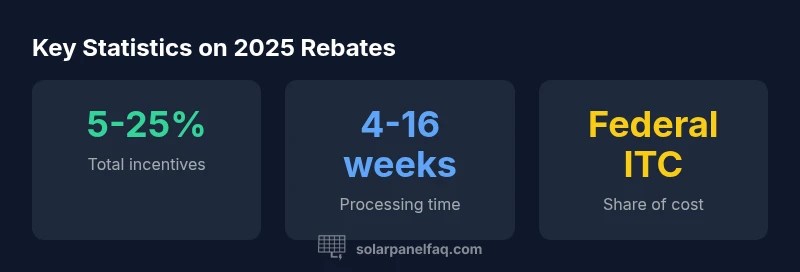
| State/Local Rebates | 5-25% of system cost | 4-16 weeks | State-specific; may require portal login |
| Utility Rebates/PDIs | 5-15% of system cost | 2-8 weeks | Often tied to production or enrollment |
| Performance-Based Incentives (PBI) | varies by kW-hr production | 6-12 weeks | Payments over time based on performance |
Frequently Asked Questions
What is the federal ITC and how does it work in 2025?
The federal ITC is a tax credit that reduces the cost of a solar project when you file your federal tax return. The exact percentage can vary by year, so verify current rules for 2025. It can be combined with other incentives where allowed.
The federal ITC reduces your solar costs when you file taxes, and it can work alongside state or utility incentives where allowed.
How do I stack rebates from different programs?
Stacking rules differ by state and program. Generally, you can combine the federal ITC with some state and utility incentives, but some programs cap or reduce others. Always check current stacking rules before installation.
You can often stack federal credits with other incentives, but rules vary by location—check specifics before install.
Do I need to enroll with my utility to get rebates?
Many utilities require enrollment in a program or interconnection approval, especially for production-based incentives. Confirm with your utility and installer which steps apply to your home.
Yes—enrollment or interconnection steps are common for some rebates; verify with your utility and installer.
How long do rebates take to process?
Processing times vary by program and jurisdiction, typically ranging from a few weeks to several months. Start early and maintain organized documentation to minimize delays.
Processing times vary; start early and keep organized records to avoid delays.
Are rebates available for both new installs and upgrades?
Most programs target new solar systems, but some offer incentives for upgrades, battery additions, or system modernization. Check program specifics for eligibility.
Most rebates apply to new systems, but some programs cover upgrades like batteries—check the details.
“Rebates in 2025 are best leveraged when homeowners plan for stacking and proper documentation, not as a single lump-sum incentive.”
Top Takeaways
- Plan early to maximize stacking opportunities
- Expect incentives to vary by state and program
- Document everything to speed claims
- Combine federal ITC with local rebates for best results
- Check battery and inverter eligibility to unlock extra credits