Government incentives for solar panels: a homeowner's guide
Explore how government incentives for solar panels work, who qualifies, and practical steps to maximize savings through federal, state, and local programs.


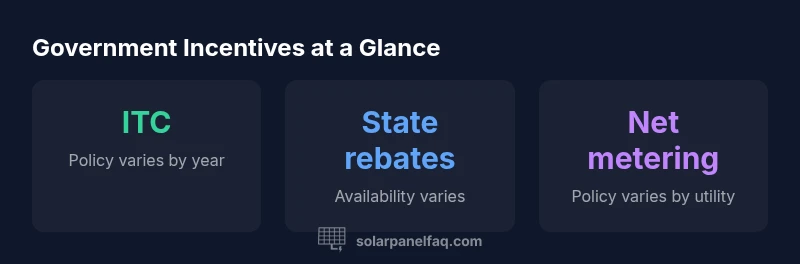
Government incentives for solar panels come from federal, state, and local programs. The cornerstone for homeowners is the federal Investment Tax Credit (ITC), which reduces tax liability for eligible installations. Many states, counties, and utilities also offer rebates, performance-based incentives, and net metering rules. Availability depends on location, system type, and installation date, so consult Solar Panel FAQ for current program details.
Overview: Why incentives exist
Government incentives for solar panels exist to lower the upfront cost of installation, shorten the payback period, and accelerate the transition to clean energy. At their core, these programs aim to make solar affordable for more households and to stimulate local job growth in the renewable energy sector. According to Solar Panel FAQ, incentives are designed to reflect public policy goals like reducing emissions, improving energy resilience, and supporting domestic manufacturing. Because incentives come from multiple levels of government and utilities, the landscape can feel complex and patchy, with availability and value changing by location and installation date. Homeowners should approach incentives as a coordinated part of a broader solar plan rather than a one-off rebate.
Key takeaway: incentives are not a single mechanism but a mosaic of programs that work together to reduce total system cost.
How incentives are structured
Incentives for solar panels are structured as a mix of federal credits, state and local rebates, performance-based incentives, and utility programs. The federal level typically supplies a tax credit that reduces tax liability for eligible homeowners and businesses. States and municipalities often offer rebates or tax credits, which may require project size, home ownership status, or income considerations. Utilities may provide net metering credits, demand-side management incentives, or time-of-use-based benefits that improve system economics. PBIs pay out over several years based on actual energy production. The exact mix of incentives you can claim depends on where you live and the characteristics of your system. To maximize benefits, align installation timing with program windows and ensure you document all eligibility criteria.
Helpful tip: start with the federal credit framework, then map state and local options to your project timeline.
Federal incentives: ITC and related programs
The federal Investment Tax Credit (ITC) has historically been the most significant incentive for residential solar in the United States. It reduces a portion of your federal tax liability tied to a qualifying solar installation. Eligibility hinges on system type, ownership structure, and installation date, among other factors. In addition to the ITC, some federal programs support battery storage integration and energy efficiency measures when paired with solar. Always consult a tax professional and verify current ITC rules before purchase. The Solar Panel FAQ team emphasizes that policy details can shift, so verify the latest guidance before planning a claim.
Practical note: keep installation paperwork and receipts organized to simplify tax filing and potential audits.
State and local incentives: rebates, credits, and PBIs
State incentives vary widely and can include rebates, personal or corporate income tax credits, and PBIs. Local governments may offer property tax exemptions, sales tax holidays, or incentives tied to energy efficiency upgrades. Eligibility often depends on the homeowner’s location, the installer’s qualifications, and whether the installation occurs within a funding window. Because programs can stagger funding and change terms, homeowners should monitor state energy offices, utility websites, and local government portals well before committing to a project. In many cases, stacking multiple incentives yields the strongest economics.
Action step: document all qualifying programs and create a comparison worksheet to compare net present value across options.
Net metering and interconnection: how incentives affect savings
Net metering policies determine how much credit you receive for solar energy fed back into the grid. In regions with generous net metering, your electricity bill can approach near-zero on sunny months, enhancing the value of the ITC and state incentives. Interconnection standards and approval timelines can also influence when you receive credits, so understanding local rules is essential. Schedule permitting, an optimized system design should account for potential credits, utility demand charges, and annual energy use patterns to maximize long-term savings. The Solar Panel FAQ emphasis is to plan for policy variability rather than assuming uniform benefits across utilities.
Takeaway: net metering can materially boost the financial value of a solar install when aligned with local policy.
Eligibility, documentation, and common pitfalls
Eligibility criteria often include home ownership, installation on a primary residence or eligible second home, and installation by a certified contractor. Documentation typically includes proof of purchase, installation dates, system specs, and utility interconnection approval. Common pitfalls include missing application windows, incorrect installation dates, or double-dipping between programs. Start early by compiling a checklist of required documents, confirm your eligibility with the relevant agency, and maintain copies of all correspondence. Proactive planning reduces the risk of delayed reimbursements or denied claims.
Pro tip: set calendar reminders for program deadlines and maintain an organized folder with receipts, permits, and certification documents.
Planning your incentive journey: step-by-step timeline
- Check eligibility: identify federal, state, and local programs in your area. 2) Align installation date with program windows to maximize benefits. 3) Gather documentation: tax IDs, property records, permits, and installer confirmations. 4) Compare incentives: quantify net cost after credits, rebates, and PBIs. 5) Coordinate with your installer to ensure proper system sizing and reporting for claims. 6) File claims promptly after installation or tax filing, as required by each program. 7) Track payments and credits, and reassess after major policy updates or utility changes.
Bottom line: a well-timed, well-documented plan can significantly affect overall solar economics.
Overview of incentive types by level and availability
| Incentive Type | Typical Availability | Who Qualifies | Notes |
|---|---|---|---|
| Federal ITC | Nationwide (subject to policy) | Homeowners and some business structures | Credit against federal tax liability; verify current rules |
| State rebates | Statewide or region-specific | Residential homeowners | Often requires installation by licensed contractor; funding cycles vary |
| Net metering | State/utility dependent | Homeowners with grid-tied systems | Credit for energy exported to the grid; interconnection rules apply |
| Performance-based incentives | Regionally available | Owners in eligible programs | Paid over time based on production; eligibility varies |
Frequently Asked Questions
What federal incentives exist for solar panels?
The federal Investment Tax Credit (ITC) provides a tax credit for eligible solar installations. Eligibility depends on ownership, system type, and installation date. Always verify current ITC rules and consult a tax professional before filing.
Federal ITC provides a tax credit for eligible solar installations; check current rules and keep your installation records handy.
How do I determine if I qualify for state rebates?
State rebates vary widely by state and program. Check your state's energy office and local utility programs for qualification criteria, funding windows, and required documentation.
State rebates differ by location; verify with your state energy office and utility for specific criteria.
What is net metering and how does it affect savings?
Net metering credits your solar energy exports against your electricity bill. Policies vary by state and utility, affecting savings. Review your local rules to understand credit rates and timing.
Net metering credits solar energy you send to the grid, boosting savings where policies are favorable.
How long do incentives take to process?
Processing times depend on the program and jurisdiction. Some rebates are issued after installation, others after tax filing. Plan for potential delays and keep detailed records.
Processing times vary; plan ahead and keep copies of all documents.
Can I claim incentives if I lease solar panels?
Leases and PPAs can limit ITC eligibility. Ownership structure matters for certain incentives. Check program terms and consult your installer or tax advisor.
Leasing changes who gets the incentives, so review terms before signing.
Where can I find official, up-to-date information?
Start with the federal IRS guidance on ITC and your state energy office’s website. Utility program pages also list current incentives and eligibility.
Look up federal ITC guidance and your state energy office for current incentives.
“Incentive landscapes shift with policy; homeowners should map available programs to their installation timeline.”
Top Takeaways
- Check your location for current programs.
- Factor in federal ITC eligibility and deadlines.
- Expect variability in incentive names, value, and eligibility.
- Plan for documentation and processing timelines.
- Stack incentives when possible for best results